Read two @ClaremontInst John Marshall alums about their fight inside the admin to restore founding principles and colorblind constitutionalism.
Claremont fellows are our mission on the march. Hats off to Elliot and Josh.
Big picture:
I think "kids should be learning at their actual level"is the most foundational belief I have about education. It doesn't serve kids to pass them on when they haven't mastered something or to make them tread water when they have.
I believe something like 'kids are naturally curious/it matters enormously what kids' innate interests and motivations are' while also believing that if you just do whatever is most intrinsically interesting in the moment, you'll sort of end up in an impoverished local maximum, and much of the point of adults is to offer the scaffolding to do hundreds of times better than that. You do want to take kids' interests extremely seriously and have, for each kid, a vision of what their education is supposed to offer them and which benefits are visible to them.
I am really strongly in favor of reading-heavy instruction. Our science and social studies curricula are both extremely book heavy; our American history/lit course assigned 17 books. Reading is a very efficient way to gain information, it's how most well-informed adults know most of the things that they know, there's content in books that I know of no other way to come by, and there are really excellent books on a huge range of topics. My biggest disagreement with Alpha is here. They deemphasize books to a degree that seems really tragic to me. I've written a bit about the TeachTales app they use, which I think is worse than good books for 99% of kids. If I were trying to do all academic instruction in 2 hours a day, 1 hour would be reading.
I ideally don't want kids to relate to learning as something they get out of the way in order to do interesting things, but something that enables all of the interesting things. That said I think it's just a fact that a lot of learning involves practicing something to mastery and this can be boring and it's fine if kids are doing this because they want the end result rather than out of an intrinsic love of times table practice.
I think AI changes everything and in particular will dramatically alter the world our children enter as adults, but I've been extremely cautious about using AI to teach. I'm much more in favor of using it to create and improve assignments than having kids use it. I worry a lot that tech-enabled learning, unless done well, trains extremely fast-reward styles of thinking and makes kids struggle to enjoy activities where the rewards are not delivered instantly. I'd love to try to build an analog, books-forward Alpha School (and kind of am trying to do this).
I think it's important to have a vision for transmission of your values. This doesn't mean school should be about indoctrination: one of our values is free debate and improvement through argument and questioning inherited wisdom! But you do have to articulate what you believe in to children, and I think it's important that articulation be compelling and morally serious. It's a bad thing if the richest, free-est societies in all of human history are raising children who are unaware of this fact about their society and cannot even articulate a defense of it.
(13/20) People Underestimate Extent of Illegal Immigration
Most Americans underestimated the number of illegal immigrants that came into the country during Biden's Presidency (at least 10 million entered illegally, graph below on the left).
Liberals were the least accurate group, and were also much more likely to believe that the United States government has a moral obligation to provide health care to illegal immigrants (see graph below on the top right).
In a follow-up survey, we found that Americans who most strongly supported the deportation of illegal immigrants also most closely guessed the number of illegal immigrants currently in the country (see graph below on bottom right).
No, autism is still not associated with pregnant moms' use of Tylenol.
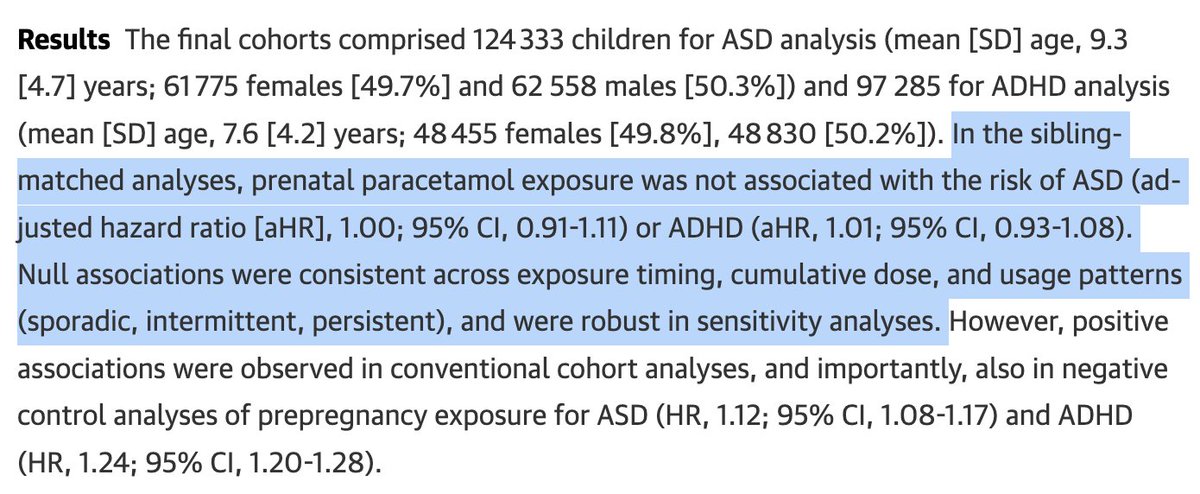
New paper: researchers used data on 708,000 Hong Kong mothers. They compared 124,000 children assessed for autism and 97,000 assessed for ADHD to sibling controls.
The result: "Prenatal paracetamol exposure was not associated with an increased risk of either ASD or ADHD and these findings were consistent across paracetamol exposure timing, pattern, and dose."
https://t.co/nQhT5zHgts
The Liberal Party has proven durable—Trudeauism has not
American commentator @mattyglesias wrote this week that Justin Trudeau is “low-key the most successful progressive leader of our time.”
Trudeau was no doubt electorally successful. He took the Liberal Party from third place to government, won three elections, and governed for nearly a decade. But if success is measured by the durability of his ideas, then Trudeauism is more consequential as a warning to progressives elsewhere than as a political model.
Trudeau’s significance lies in what he rejected. He came out of the post-financial-crisis Left that had turned against Clintonism and Blairism, and he sought to overturn a governing paradigm that had broadly shaped Canadian policy since the 1985 Macdonald Commission. Fiscal restraint, market-led growth, competitive taxation, resource development, and a generally constrained federal government gave way to a more expansive vision of state action. Trudeauism amounted to more than a collection of policies. It was a deliberate attempt to shift the Canadian political economy to the Left.
The Trudeau years are thus best understood as a large-scale test of progressive governance. Canada’s Westminster system gave Trudeau something that Barack Obama never had: a majority government with few counter-majoritarian checks standing in his way. The ideas coursing through global progressivism—de facto open borders, deficit-financed entitlement expansion, an equity-first economic agenda, identity politics excess, and even a so-called “feminist foreign policy”—got about as frictionless expression in Canada as any Western democracy has permitted.
The results amounted to what we’ve calleda “lost decade.” On various measures of economic and social well-being, Canada underperformed its peers. Perhaps the best (or worst) example is the Trudeau government’s record on real GDP per capita growth. Between 2014 and 2024, Canadian growth was the third-lowest among advanced economies, and the country’s GDP per capita fell below the OECD average for the first time on record.
It’s no surprise, therefore, that Trudeau not only left office as one of the most unpopular prime ministers in Canadian history, but that the country found itself in a more general malaise. The share of the population that believed the country was on the wrong track and doubted their children’s futures reached the highest levels in decades.
Prime Minister Carney’s own policy agenda is the strongest evidence the against the durability of Trudeauian progressivism. He’s repealed the consumer carbon tax, abandoned the capital gains tax hike, lowered immigration targets, shelved the Online Streaming Act and the digital sales tax, and swapped “resourcefulness not resources” for pipelines. His government talks about growth rather than redistribution and patriotism rather than post-nationalism. He also goes out of his way to present himself as leading a new government rather than continuing the old one, which, it’s fair to say, isn’t how incumbents treat successful predecessors.
Even the new entitlement programs that Yglesias cites as durable legacy cut the other way. Pharmacare is quietly languishing, while dental care and child care sit atop a structural deficit that Trudeau built and never funded. Deficit-financed entitlements are less a consolidated inheritance than unfunded mandates awaiting a fiscal reckoning.
The fair verdict gives Trudeau his due and no more. He ran the experiment that progressives elsewhere never got to run, and the returns came back negative on both the economics and the politics. The Liberal Party has proven durable. Trudeauism has not.
Trudeau matters as a case study rather than a model, and the people who’ve read the study most carefully are sitting in Carney’s cabinet.
https://t.co/9H6NojFVUy
More good evidence accumulating for one of the least-appreciated points relevant to accelerated education:
VERY MUCH of the achievement variation in classrooms is WITHIN school, not BETWEEN schools.
i.e. an intractable problem for most teachers everywhere - no, they cannot be reasonably expected to "differentiate" it away
This new study has essentially replicated prior achievement spread results, this time specifically in a "rural, low-socioeconomic primary school."
In case you would like this in color... here is the glaring truth about the perennial infeasibility of the tightly age-based grade level:
@IFP’s great online PhD course on the economics of innovation is coming to YouTube! For the launch, I wrote a post for the MacroScience substack on 5 Reasons to Study the Economics of Innovation
https://t.co/tJaLNoqSlW
The authors of a new article found that reading achievement at the end of 1st grade within one low-income school ranged from the lowest level of reading achievement to 3rd grade and beyond.
In practical terms, about 25% of children in one classroom were still struggling to put letter sounds together to form words, while about 20% are fluent readers with increasing comprehension. There's no teacher in the world who can create one lesson plan that meets both groups' needs (and everyone in between).
Ability grouping is a must for competent teaching--even in the earliest grades.
Read more:
https://t.co/cKqNyWluhK
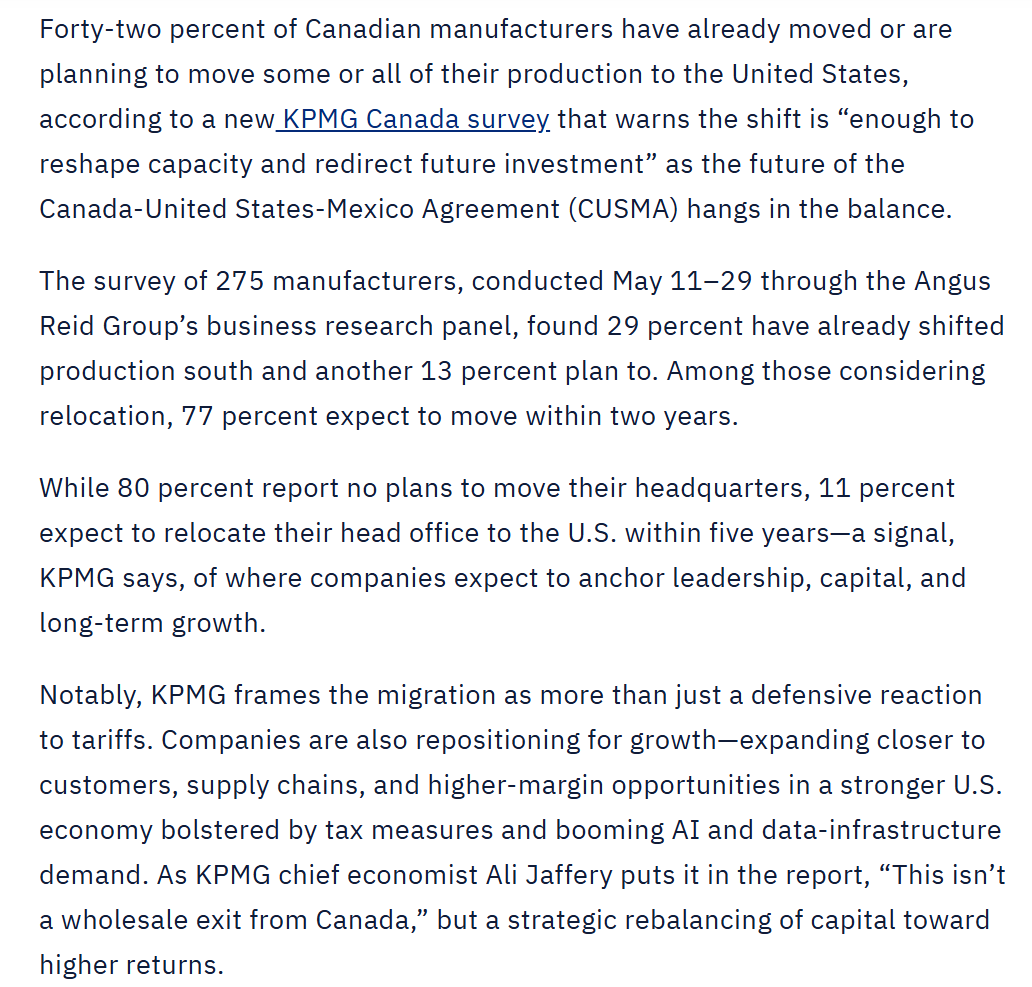
.@TheHubCanada breaks down the KPMG report tracking a major shift in Canadian manufacturing toward the U.S. market.
Key data from the survey of 275 manufacturers (conducted May 11–29 via Angus Reid Group):
• 42% have moved or plan to move production to the U.S. (29% have already shifted, 13% plan to).
• 77% of those planning to relocate expect to do so within two years.
• 11% expect to move their corporate head office south within five years.
https://t.co/lbBnzLMFu3
natives: “yeah so we have huge amounts of unused land. we’d love to rent them to you in exchange for AI industry cash flow to our tribes”
nytimes: “these poor, poor exploited folks. they simply are not smart enough to understand”
47% of American Jews are favorable toward the Israel government.
44% of American Muslims are favorable toward Hamas.
Think whatever about the causes, that’s a remarkable finding.
This Philosophy professor died recently
And his daughter posted every lecture he ever gave during his life on YouTube
From his 20s to 60s, documented. His last videos are literally in a hospital, in his deathbed, still talking about Nietzsche
And I find it beautiful how he dedicated his entire life to transmitting the best possible teachings, to now becoming immortalized and forever consumed, prolonging his life mission as more and more people discover him
Absolutely legendary way to both die and live imo
Had to share it rq