A 27 YEAR OLD BANGALORE DEV BOUGHT A DECOMMISSIONED BANK SERVER RACK FOR $3,200 AT AUCTION AND NOW PULLS $24,000 A MONTH FINE TUNING LLMs FOR US SAAS COMPANIES
raj is 27, bangalore, one bedroom flat with a ceiling fan, won the lot off a state bank IT refresh in march, four 2U storage shelves with 96TB of enterprise SAS drives and a managed switch
added two custom towers with RTX 3090s under the desk, runs llama 3.3 70B and fine tunes indic and english variants for 11 US saas clients on hugging face
pause at 0:30 on the finger pointing at the yellow drive caddies, that is gear that sold new for $180,000
$24,000 in, $61 in karnataka power, the auction lot paid itself back in 4 days, no claude bill no rate limits, nothing leaves the flat
the window is open, follow and bookmark before it closes
Been exactly a year since we launched water purifiers
We now have TDS data from tens of thousands of Atomberg water purifiers installed across the country
And we combined that with publicly available data from different government sources like central pollution control board, jal jeevan mission and central ground water board
And built a free tool where you can enter your pincode and check your water quality- TDS levels, TDS variance, chemicals present etc
"No European country has been attacked with Indian Weapons... So Keep that in Mind"...!!!
I think Europe was not expecting that answer from Minister @DrSJaishankar 👏
A few points: Japan did not court FDI or FII during their economic take off. They instead licensed foreign tech and worked on mastering it and improving on it, and eventually surpassing it.
Second, FII is by nature fickle. Mostly it promotes the "casino" mindset. We also start dancing to FII masters. Never good.
We cannot financialize our way to prosperity.
I am sure I would be told I am hopelessly old-fashioned but I will say "Study Japan". Even with extremely poor demographics, Japan punches way above its weight in a wide range of crucial technologies.
Two years ago, a developer I know launched a small product here in Nigeria.
Everything was going fine.
Users were signing up, logging in, and using the platform daily.
Then one morning he woke up to something strange.
Several users were complaining their accounts had been accessed… without their permission.
Kindly bookmark for yourself and retweet so others too can learn
this is actually insane
> be tech guy in australia
> adopt cancer riddled rescue dog, months to live
> not_going_to_give_you_up.mp4
> pay $3,000 to sequence her tumor DNA
> feed it to ChatGPT and AlphaFold
> zero background in biology
> identify mutated proteins, match them to drug targets
> design a custom mRNA cancer vaccine from scratch
> genomics professor is “gobsmacked” that some puppy lover did this on his own
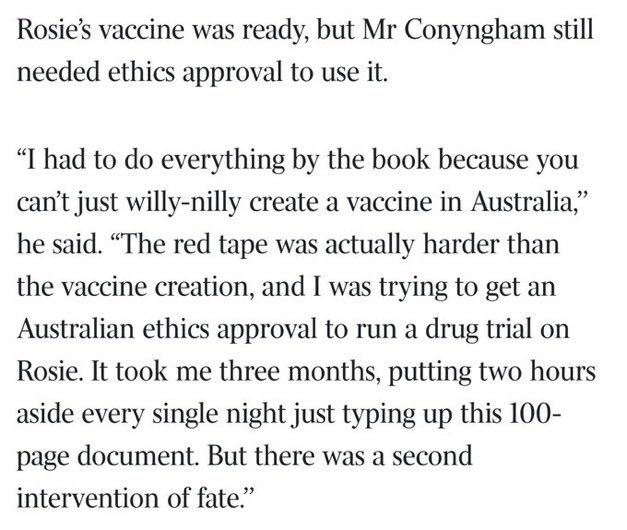
> need ethics approval to administer it
> red tape takes longer than designing the vaccine
> 3 months, finally approved
> drive 10 hours to get rosie her first injection
> tumor halves
> coat gets glossy again
> dog is alive and happy
> professor: “if we can do this for a dog, why aren’t we rolling this out to humans?”
one man with a chatbot, and $3,000 just outperformed the entire pharmaceutical discovery pipeline.
we are going to cure so many diseases.
I dont think people realize how good things are going to get
Andrej Karpathy just dropped a project scoring every job in America on how likely an AI will replace it from 0-10
> Scraped all 342 occupations from the Bureau of Labor
> Fed each one to an LLM with a detailed scoring rubric
> Built an interactive treemap where rectangle size = number of jobs and color = how exposed that job is to AI
The key signal in his scoring: if the work product is fundamentally digital and the job can be done entirely from a home office, exposure is inherently high.
The scale:
0-1: Roofers, janitors
4-5: Nurses, retail, physicians
8-9: Software devs, paralegals, data analysts
10: Medical transcriptionists
Average across all 342 occupations: 5.3/10.
The entire pipeline is open source. BLS scraping, LLM scoring, the visualization. All of it. Much respect for the sensei this is scary and awesome
this quote from Carl Jung hits so hard.
"The world is full of people suffering from the effects of their own unlived life. They become bitter, critical, or rigid, not because the world is cruel to them, but because they have betrayed their own inner possibilities. The artist who never makes art becomes cynical about those who do. The lover who never risks loving mocks romance. The thinker who never commits to a philosophy sneers at belief itself. And yet, all of them suffer, because deep down they know: the life they mock is the life they were meant to live."
I used AI to bring back old scanned books in Hindi (and any other language) that were lost to history back to life.
I brought back the prescient 1924 Hindi novel "Baeesween Sadi" (22nd Century) that predicts what life in the future might look like, 100+ yrs later. Indian author Rahul Sankrityayan had predicted things like video calls far before they were invented.
How do you do it? Claude Code w/Opus 4.6 as the orchestrator, OCR by Sarvam [more on this later], GPT-4.1 as the translator, Gemini 3 Pro for illustrations.
I've always wanted to bring back obscure literature from the past back and readable for everybody since I was a kid and I was gobsmacked that you can effectively achieve this with a few prompts *perfectly*.
If there's anything in particular you want to be brought back to life, let me know and I'll front the bill to do it!
Here is a link to the full PDF:
Started a week ago, not knowing how to write a single line of code
I wanted to read the Bhagavad Gita daily, but couldn't find an app that felt right. So I built one.
Ended with a full iOS app live @10minutegita on the App Store:
→ 239 daily readings of the Bhagavad Gita
→ Original Sanskrit shlokas + transliteration
→ Verse-by-verse translations & commentary
→ Personal daily reflections
→ Streak tracking with calendar heatmap
→ Shareable verse cards with 8 gradient themes
→ Hindi & English bilingual support
→ Light/dark mode, adjustable fonts
→ Completely offline after download
Total cost: $200 Claude Max Subscription + $20 ChatGPT Pro Subscription + $99 Apple Developer fee
Lines of code I wrote: 0
Claude Code wrote everything. I just described what I wanted in plain English (non-technical background). Codex reviewed it. Now it's live on the App Store.
The barrier to building isn't coding anymore. It's just knowing what problem you want solved.
Links & Full Process in 🧵↓
Built with @AnthropicAI's Claude Code
Examples are now pouring in about AI-assisted Code Engineering productivity.
The quoted post is a Bhagwad Gita app.
Anthropic has built an entire C compiler with their Claude AI. That is not an easy engineering feat at all.
At this point, it is best for those of us who depend on writing code for a living to start considering alternative livelihoods. I include myself in this. I don't say this in panic, but with calm acceptance and embrace.
As a matter of fact, I did a detailed session with Gemini Pro on how the economy will be shaped by the AI revolution. It was like having an extremely intelligent economic philosopher debating you. I asked it to critique its own work and it did a fantastic job too.
As Gemini and I developed see this, the future could unfold in two ways, depending on who owns and collects rent on this technology.
The optimist in me thinks that this technology will make most technological prowess by humans redundant and that would push tech to the background (all tech become trivial, like digital watches today) and we then get to focus on life, family, soil, water, nature, art, music, culture, sports, festivals and faith (faith is important), and that is best done in small close-knit rural communities. I live a life like this today and if we solve rural poverty, I consider this a very good life.
The pessimistic dystopian vision is centralized control.
Here is my Gemini chat session on this. You can continue the session on Gemini and see where it all goes.
https://t.co/ORdh7ejen4
Unbelievable opportunities are available in markets now if you can dig deeply. I'm not going to name the company. It's part of my non disclosed holdings. As you are aware, I've disclosed only 3 names that too because my stake is exceeding 1%.
This company is showing triple digits earnings growth rate for last few quarters. Management is of high pedigree with excellent credit ratings. The company is valued at pittance. I'm not bothered. It is question of when and not whether it would get rerated.
Likewise today's marketcap of some companies can be their yearly profit in say next 5 years. That is the kind of wealth creation potential that is available in the markets. It is not that I own all those companies. I do own some of them.
Study extensively many industries and companies. Not only your knowledge would improve but you will develop potential to create huge wealth.
If you think it is just running a query in Screener, you'll be extremely disappointed. Screener mostly throws many junk and fraudulent companies. Who ever said getting rich is easy? There is no substitute for deep and continuous learning.
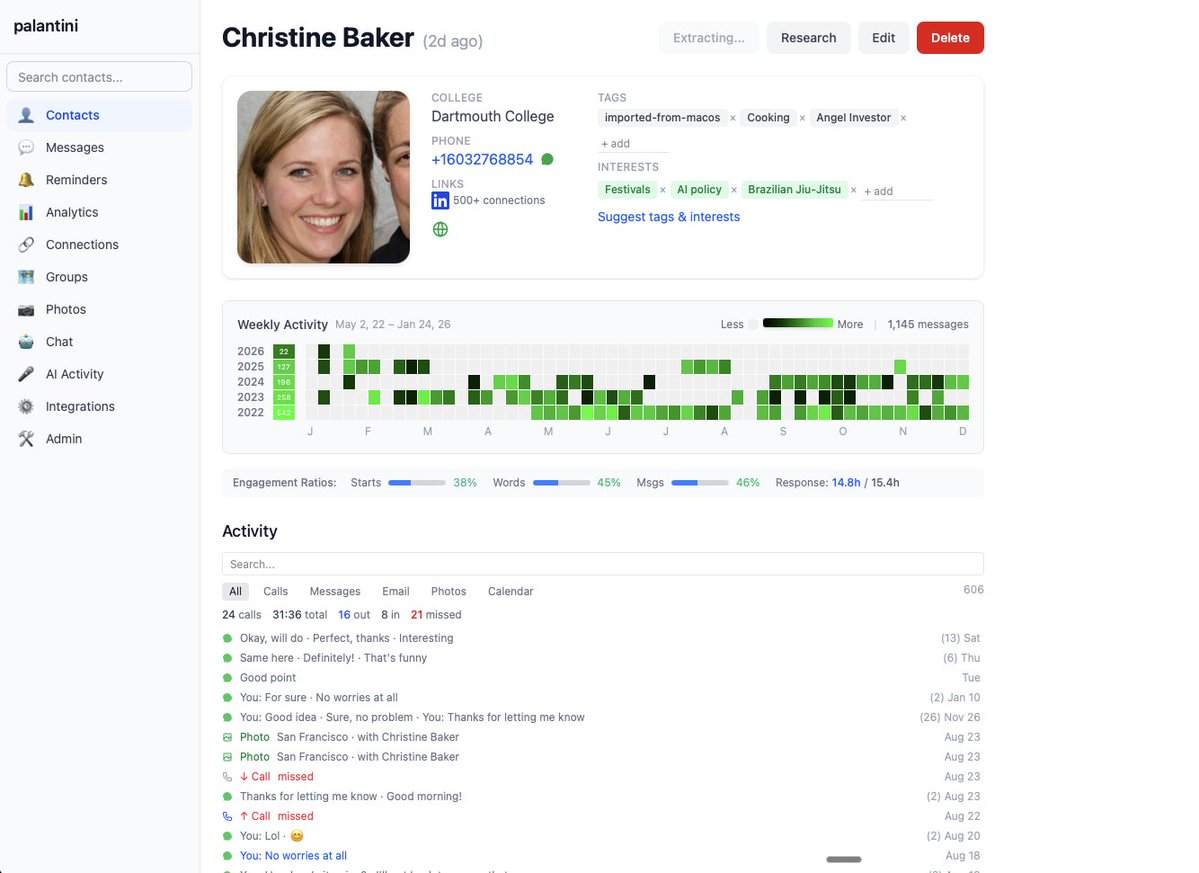
Claude Code made me the CRM I've wanted for ten years. Automatically updates from text messages, email, iPhoto, calendar, etc. Shows all interactions in one place.
Most of us have decades of data on interactions with thousands of people that just sits there unused.
I call it Palantini - as in a tiny Palantir.
🧵1/7
A few random notes from claude coding quite a bit last few weeks.
Coding workflow. Given the latest lift in LLM coding capability, like many others I rapidly went from about 80% manual+autocomplete coding and 20% agents in November to 80% agent coding and 20% edits+touchups in December. i.e. I really am mostly programming in English now, a bit sheepishly telling the LLM what code to write... in words. It hurts the ego a bit but the power to operate over software in large "code actions" is just too net useful, especially once you adapt to it, configure it, learn to use it, and wrap your head around what it can and cannot do. This is easily the biggest change to my basic coding workflow in ~2 decades of programming and it happened over the course of a few weeks. I'd expect something similar to be happening to well into double digit percent of engineers out there, while the awareness of it in the general population feels well into low single digit percent.
IDEs/agent swarms/fallability. Both the "no need for IDE anymore" hype and the "agent swarm" hype is imo too much for right now. The models definitely still make mistakes and if you have any code you actually care about I would watch them like a hawk, in a nice large IDE on the side. The mistakes have changed a lot - they are not simple syntax errors anymore, they are subtle conceptual errors that a slightly sloppy, hasty junior dev might do. The most common category is that the models make wrong assumptions on your behalf and just run along with them without checking. They also don't manage their confusion, they don't seek clarifications, they don't surface inconsistencies, they don't present tradeoffs, they don't push back when they should, and they are still a little too sycophantic. Things get better in plan mode, but there is some need for a lightweight inline plan mode. They also really like to overcomplicate code and APIs, they bloat abstractions, they don't clean up dead code after themselves, etc. They will implement an inefficient, bloated, brittle construction over 1000 lines of code and it's up to you to be like "umm couldn't you just do this instead?" and they will be like "of course!" and immediately cut it down to 100 lines. They still sometimes change/remove comments and code they don't like or don't sufficiently understand as side effects, even if it is orthogonal to the task at hand. All of this happens despite a few simple attempts to fix it via instructions in CLAUDE . md. Despite all these issues, it is still a net huge improvement and it's very difficult to imagine going back to manual coding. TLDR everyone has their developing flow, my current is a small few CC sessions on the left in ghostty windows/tabs and an IDE on the right for viewing the code + manual edits.
Tenacity. It's so interesting to watch an agent relentlessly work at something. They never get tired, they never get demoralized, they just keep going and trying things where a person would have given up long ago to fight another day. It's a "feel the AGI" moment to watch it struggle with something for a long time just to come out victorious 30 minutes later. You realize that stamina is a core bottleneck to work and that with LLMs in hand it has been dramatically increased.
Speedups. It's not clear how to measure the "speedup" of LLM assistance. Certainly I feel net way faster at what I was going to do, but the main effect is that I do a lot more than I was going to do because 1) I can code up all kinds of things that just wouldn't have been worth coding before and 2) I can approach code that I couldn't work on before because of knowledge/skill issue. So certainly it's speedup, but it's possibly a lot more an expansion.
Leverage. LLMs are exceptionally good at looping until they meet specific goals and this is where most of the "feel the AGI" magic is to be found. Don't tell it what to do, give it success criteria and watch it go. Get it to write tests first and then pass them. Put it in the loop with a browser MCP. Write the naive algorithm that is very likely correct first, then ask it to optimize it while preserving correctness. Change your approach from imperative to declarative to get the agents looping longer and gain leverage.
Fun. I didn't anticipate that with agents programming feels *more* fun because a lot of the fill in the blanks drudgery is removed and what remains is the creative part. I also feel less blocked/stuck (which is not fun) and I experience a lot more courage because there's almost always a way to work hand in hand with it to make some positive progress. I have seen the opposite sentiment from other people too; LLM coding will split up engineers based on those who primarily liked coding and those who primarily liked building.
Atrophy. I've already noticed that I am slowly starting to atrophy my ability to write code manually. Generation (writing code) and discrimination (reading code) are different capabilities in the brain. Largely due to all the little mostly syntactic details involved in programming, you can review code just fine even if you struggle to write it.
Slopacolypse. I am bracing for 2026 as the year of the slopacolypse across all of github, substack, arxiv, X/instagram, and generally all digital media. We're also going to see a lot more AI hype productivity theater (is that even possible?), on the side of actual, real improvements.
Questions. A few of the questions on my mind:
- What happens to the "10X engineer" - the ratio of productivity between the mean and the max engineer? It's quite possible that this grows *a lot*.
- Armed with LLMs, do generalists increasingly outperform specialists? LLMs are a lot better at fill in the blanks (the micro) than grand strategy (the macro).
- What does LLM coding feel like in the future? Is it like playing StarCraft? Playing Factorio? Playing music?
- How much of society is bottlenecked by digital knowledge work?
TLDR Where does this leave us? LLM agent capabilities (Claude & Codex especially) have crossed some kind of threshold of coherence around December 2025 and caused a phase shift in software engineering and closely related. The intelligence part suddenly feels quite a bit ahead of all the rest of it - integrations (tools, knowledge), the necessity for new organizational workflows, processes, diffusion more generally. 2026 is going to be a high energy year as the industry metabolizes the new capability.
I’ve been living and working in Japan for more than 24 years, and my family is coming to visit. These are ten tips I wrote them to keep in mind when touring Japan ↓
① Don’t pack the day schedule. I don’t care what Chat GPT suggests - it’s too much. Those four things recommended are all great, but once you get to the area you will find there is twice as much to explore. Take your time and do half the items.
> be Google in 2017
> small team drops “Attention Is All You Need” on arXiv
> execs nod politely, go back to selling ads for socks
> let Transformer gather dust for 5 yrs like a vintage Beanie Baby
> be Noam Shazeer, OG wizard
> quits, builds AI-boyfriend app “https://t.co/KRAcLptABl”
> millions of lonely hearts pay $9.99 to e-date 2B from Nier
> Google HR: “any chance you wanna come back?”
> Shazeer: “busy, my e-gf is calling”
> 2022, OpenAI drops ChatGPT
> world loses its mind, Google stock does bungee jump
> Sundar holds all-hands: “guys, we need a response by Q2”
> team ships Bard in 3 weeks using 12 interns, 2000 TPUv4s, and pure panic
> Bard hallucinates that the earth is flat
> Wall Street: “sell sell sell”
> Sergey hears the screams from his yacht
> flies back on a carbon-negative jet, reclaims unofficial crown
> merges GoogleBrain + DeepMind like Dragon Ball fusion
> axes Bard, slaps Gemini sticker on everything
> Gemini launches, immediately generate a black Abraham Lincoln
> Twitter dubs them “Bing’s woke cousin”
> Shazeer finally answers HR’s 47th email
>“fine, but I want my own parking spot and unlimited LaCroix”
> returns, waves wand, Gemini 2 & 2.5 drop
> context window so big it can summarise the Bible + your group chat
> Google processing 980T tokens/month, equal to 40 % of human SMS traffic
> someone sneezes “Nano Banana” into the Play Store
> overnight it’s #1 app, turns ur selfie into big-tiddy anime waifu
I retired at 34 with $13.8M in annual revenue.
But I could have retired at 25 if I'd started these habits earlier.
Here's what separates future millionaires from everyone else:








![deedydas's tweet photo. I used AI to bring back old scanned books in Hindi (and any other language) that were lost to history back to life.
I brought back the prescient 1924 Hindi novel "Baeesween Sadi" (22nd Century) that predicts what life in the future might look like, 100+ yrs later. Indian author Rahul Sankrityayan had predicted things like video calls far before they were invented.
How do you do it? Claude Code w/Opus 4.6 as the orchestrator, OCR by Sarvam [more on this later], GPT-4.1 as the translator, Gemini 3 Pro for illustrations.
I've always wanted to bring back obscure literature from the past back and readable for everybody since I was a kid and I was gobsmacked that you can effectively achieve this with a few prompts *perfectly*.
If there's anything in particular you want to be brought back to life, let me know and I'll front the bill to do it!
Here is a link to the full PDF:](https://pbs.twimg.com/media/HAdFWTcacAIG3E2.jpg)