1/ Today we launch an ambitious paper on the ethics of embryo screening. While the technology is new, our hopes and fears about our future children are as old as the Greek myths, including stories about Hera, goddess of fertility and the namesake of our company @herasight
@dwarkesh_sp@garettjones on his Singapore trilogy, @mungowitz on public choice economics, and @_twolfram on the genetics of cognitive ability and the promise of polygenic prediction
@CMichaelGibson All of our validation studies, as well as our ethics paper, can be found at https://t.co/hP8ZTSix3h. Here is an overview of our approach to polygenic embryo screening:
https://t.co/fvGp5oT3br
@anshulkundaje@GeneSmi96946389@hecubian_devil “Expected” is probably the best way to put it: we definitely cannot say a PRS will boost IQ by x points, any more than we can say a PRS reduces diabetes. We can only alter risks
@anshulkundaje@shae_mcl I don’t disagree. This is why I don’t like to focus on IQ much. Truth is, not a single one of our customers that I’m aware of has prioritized IQ over serious health conditions when there’s a real tradeoff
@shae_mcl@anshulkundaje Sure, while I stand behind our predictors (as we’ve validated them within family and across various ancestries) the case being discussed today is a massive outlier, and totally unrepresentative of an average person doing IVF
@hemabe@herasight It’s a good question, but we haven’t done any original research on this. @russwarne has summarized the research here: https://t.co/D9aLdIqaWy
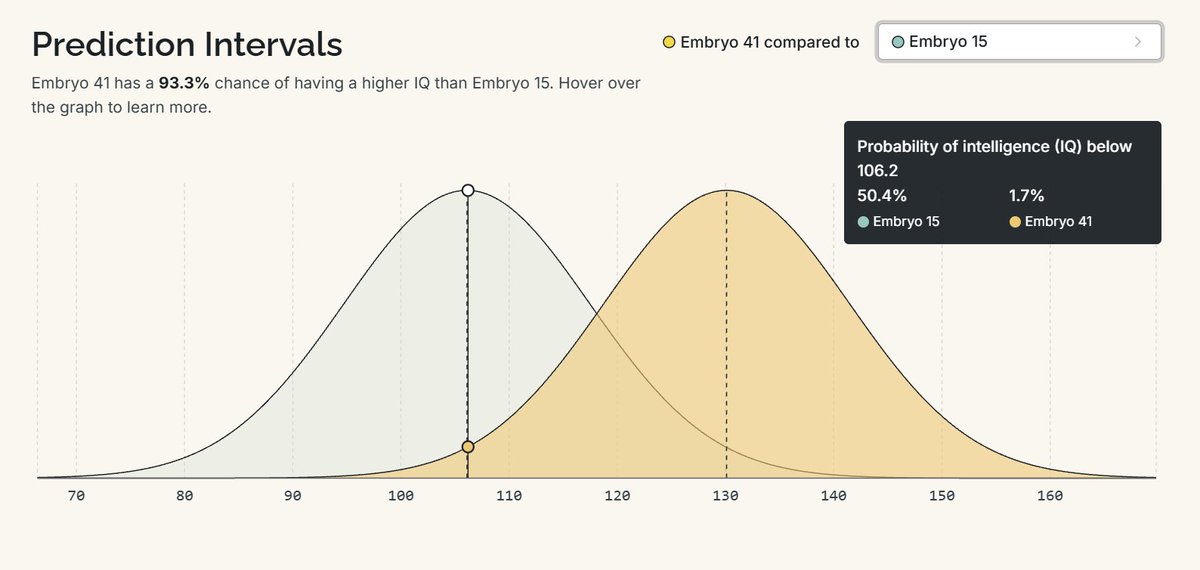
A lot of people seem to be thinking the 99.99th percentile here means the 99.99th percentile of the IQ distribution.
This is just showing the quantiles of the embryo PGS compared to the reference distribution. When translated into predicted IQ it looks like the below image.
A mean of about 2SDs above average but with substantial uncertainty. Note Herasight's prediction model also takes into account parental phenotypes and regression to the mean, important for getting the mean prediction right but not relevant for predicting differences for a quantitative outcome.
The important point is that this particular case shows there can be really substantial variation in predicted IQ from embryo testing in an individual family, around 1.6SDs.
Most families won't have enough embryos to observe that range, but it's certainly a possible outcome for some.
@paulnovosad@KelseyTuoc We show clearly that the genetic correlations between our cognitive ability predictor and health traits are almost entirely positive:
https://t.co/VZA3hh6bqF