@joefrancis505@RiccardoIorio4@JonSteinsson Just to understand you better, let me turn that around, and ask you to point to a few recent papers that do make meaningful contributions to empirical economic history. What are there defining characteristics?
@joefrancis505@RiccardoIorio4@JonSteinsson Sacrificed or handed a lifeline? But for few exceptions (you!) history depts sacrificed ec history. In econ: by 1990s most programs hardly taught it. Today, a sizeable fraction of new students are drawn by its revival. Not answering to ur standard, but asking history Qs.
@joefrancis505@RiccardoIorio4@JonSteinsson OK but addressing e.g. Conley/Kelly spatial correlation concerns demands amounts of data that (but for a few narrow questions) is not available in historical research. Risk ending up like randomistas, chasing perfect measures of impact, but only of things under the lampost?
@joefrancis505@RiccardoIorio4@JonSteinsson Their project is/was to put politics/history back into "political economy" when, in 1990s, both had been reduced. Econometricians, historians, pol scis, anthros will (for good reasons) find fault, but they shifted the field and conversations to asking better questions.
@joefrancis505@RiccardoIorio4@JonSteinsson "Why not a political Coase Theorem?"
"Are endowments fate?"
"Why did the West extend the franchise?"
"Why nations fail?"
"Does democracy cause growth?"
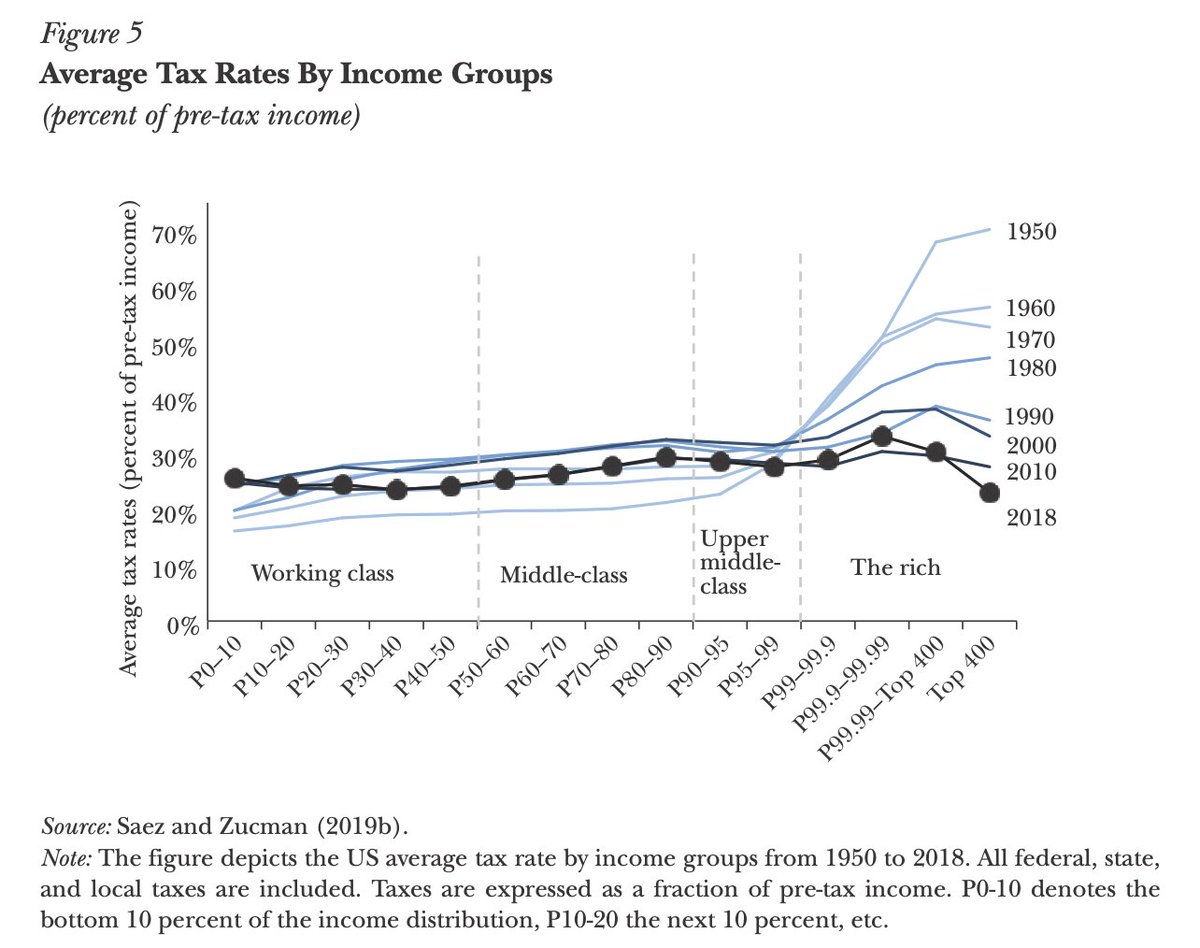
If one takes a comprehensive view of taxation in the US, here’s the picture that emerges:
All social groups pay broadly the same effective tax rate today – around 25%-30% of income, all taxes included – with billionaires having the lowest tax rate: 24% on average in 2018–20.
https://t.co/SEzTC7VifI
@mcmanusgrp@cblatts@jrovner Except us students would then be deprived of an important part of their education and would almost certainly pay higher tuition and/or see less support, since foreign students cross subsidize a large part of uni costs
@EdHHanna @PhysInHistory But isn't that exactly what Einstein 's quote says. If you have no uncertainty about your assumptions you get an airtight mathematical theory. But which of many possible theories (assumptions) explains the reality we perceive? If you're not uncertain, you're not doing science
@EdHHanna @PhysInHistory Many theories, each based on different assumptions, can plausibly explain observable data patterns. Which one is true or "real"? A proof takes us to logical conclusions from assumptions, but cannot resolve uncertainty over those assumptions.
@JohnHCochrane It's quantity limited for obvious rent-seeking purposes. The proclamation says it's now at "the Secretary’s discretion" to waive the fees or grant the licenses. Trump admin now has huge new leverage over Amazon, Alphabet, etc. Expect big transfers
@pseudoerasmus@dylanmatt To quote Larry Westphal, Anne Krueger should be read and understood for having 'concluded on the basis of Turkish evidence that infant industry protection *cannot* work.' So interesting to read Krueger saying in the interview that export promotion strategy *can* work
@DJsCouch @VikingFBR @mitchellvii Europe, Canada, and most of our trading partners have generally low tariffs on the USA (proving trade deficits have little to do w/ tariffs!). Joan Robinson is about response to a country that raises tariffs in an effort to 'beggar-thy-neighbor' -- as Trump is doing now!
@DJsCouch @VikingFBR @mitchellvii Tariffs have little to do (do countries w rocky coasts which raise import costs have trade surpluses?) Trade deficits= spending beyond income. driven huge govt deficits (just made worse) and foreign inflows driving up investment
@DJsCouch @VikingFBR @mitchellvii Europe had about 3% tariff rate on US goods in trade-weighted terms. You can find specific sector exceptions, just as in the USA. But 80 years of US-led multilateral trade liberalization succeeded in bringing tariff rates down between rich countries. Until Trump blew it up.
@DJsCouch @VikingFBR @mitchellvii Tariffs raise prices, reducing quantity demanded. Even if Americans are stupid enough to tax themselves and pay most of the tariff, EU exports to USA fall --> less production in EU. EU demand for all goods. Tariffs don't balance trade, they just reduce trade and incomes.