1/n ⚠️⚠️ how to use github and dropbox for economists. Economists are now told, for good reason, that if we use AI for research code, we should also use GitHub.
That advice is right. But the way many economists actually work creates a trap.
Most projects still live in Dropbox.
RIP Ned Phelps
Ned Phelps followed his own intellectual journey.
When Keynesians relied on a long-run tradeoff between unemployment and inflation, he showed why this was a weak reed to stand on. Thus was born the natural rate hypothesis (although the coining of the word goes to Friedman, a year after Ned’s paper).
When, later, New Keynesians were focusing on nominal rigidities, he built models of fluctuations where nominal rigidities played no role. When New Classicals were exploring the cyclical implications of competitive markets, he focused on the role of distortions in goods and labor markets, be it efficiency wages, or variable markups.
It would be fair to say that, today, the frontier macro models embody the natural rate hypothesis, and many of the distortions Ned focus on---and, what he did not like, i.e. nominal rigidities.
His style was highly idiosyncratic. He was often a poor expositor of his fundamental insights. He did not listen much to others, pursuing his agenda with focus and passion. But, to use an overused but appropriate expression, he was certainly one of the giants in the field. We often met and sometimes fought, be it on hysteresis or nominal rigidities, but I had infinite respect for him.
Another reminder the applications for our course "Tools in Macroeconomics" is still open (will likely close by the end of June): https://t.co/Lp4ItiM80h
This is a course that teaches students key computational methods used in macro, as well as the more advanced stuff. 1/3
Totally agree with this excellent article by Maury Obstfeld: "Don't blame America's current account deficit on the dollar." Not so long ago I tweeted "The view that the dollar’s reserve currency status is responsible for its deficits is a terribly flawed view." Yet, like a zombie, this view will not die even if, as Maury says "This notion is dead wrong." https://t.co/SHXPVzFVWT
The Fed’s balance sheet is $6.6T and growing. In 2008 it was $0.9T. Why the huge increase? Why can’t we go back to that much leaner pre-crisis state of affairs? (Kevin Warsh thinks we should.) Some thoughts. 1/
(i) Not clear why growth in world trade should create a net demand for dollars. World trade can grow through both rising exports and imports while remaining balanced. (ii) The other commonly cited argument is that the demand for safe assets requires the safe asset issuer to run deficits. This again is theoretically weak. Demand for safe assets is about gross flows. There is no reason this should necessarily lead to net deficits. (iii) Empirically too the reserve currency argument has limitations. As @Brad_Setser points out the relation between fiscal deficits and trade/current account deficits is imperfect. There were 2 previous major episodes of global imbalances: One was in the 1980s where indeed large fiscal deficits (and an appreciating dollar) contributed to growing current-account deficits. The second episode was in the run-up to the GFC in 2008 when fiscal deficits were not the driver (and the dollar was depreciating). (iv) During the years when the British pound was the dominant currency of the world Britain ran current account surpluses. (v) The Swiss Franc is a reserve currency country that consistently runs surpluses. New Zealand, on the other hand, is not a reserve currency country and has consistently run deficits. So, both theoretically and empirically, it is hard to argue that the dollar's reserve currency status is what is behind persistent US current account deficits.
Great appointment. Congratulation to @HyunSongShin and the Bank of Korea BIS economist Shin Hyun-song named Bank of Korea governor | Reuters https://t.co/d564haHOM3
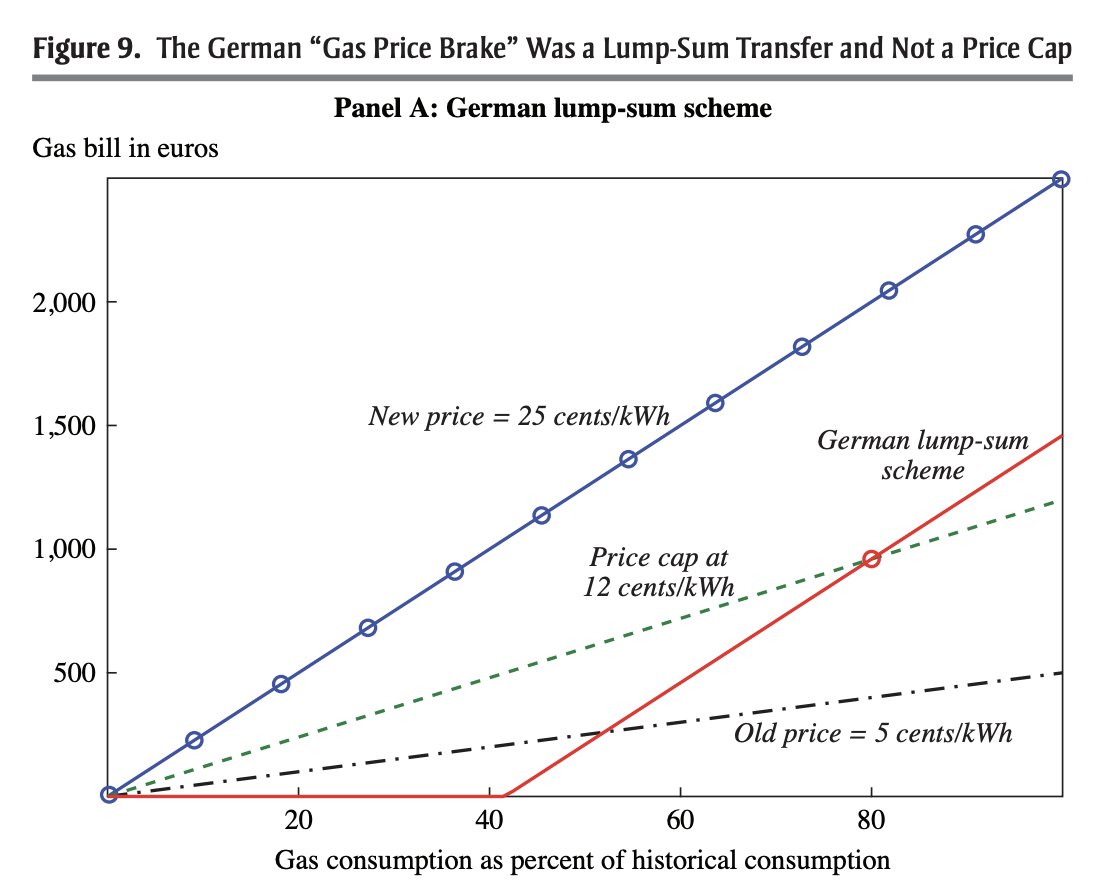
Worth keeping in mind: there actually *are* workable alternatives to energy price caps!
See for example Section III.D. here https://t.co/PLiTUC7doC
"Policy Choices Matter: Germany’s Alternative to a Price Cap"
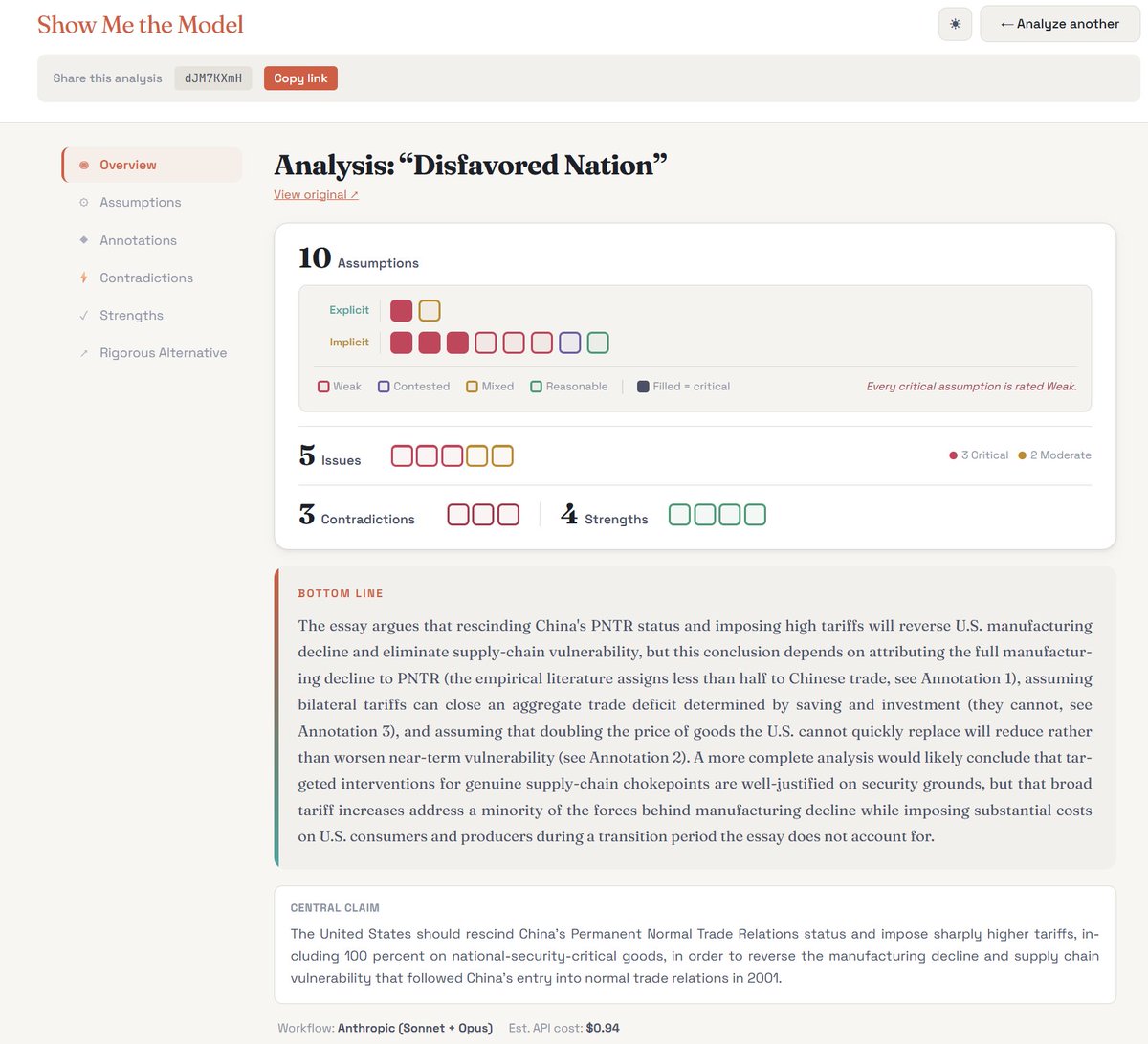
I spend way too much time on social media debunking "economic slop" promulgated by lawyers pretending to be economists, so I built Show Me the Model: a tool that uses AI to check whether the economic reasoning in an essay actually holds up.
https://t.co/cfhWs6MI27
Give it a URL or paste some plain text, and the tool flags hidden assumptions, internal inconsistencies, and other problem areas, and tells you how a real economist would think through the issue.
Right now, it has 4 "personas:" macro, trade, IO/price theory, and labor. The tool first figures out which persona is right for the job, and then uses a parallelized prompt scaffold specific to that persona to process the source text.
Here are some example outputs based on some essays that triggered me hard:
Citrini Research's viral essay on how AI could trigger a self-reinforcing financial crisis rivaling the GFC:
https://t.co/ZNUFHqyEFT
American Compass on the harms of trade deficits:
https://t.co/Nasfvr36iY
@oren_cass on why Built-to-Rent should be banned:
https://t.co/niie7bVRoK
American Compass on the "China Shock:"
https://t.co/nZvoEaTdTv
@michaelxpettis on why China's trade surplus reduces global output:
https://t.co/LqocDslRrH
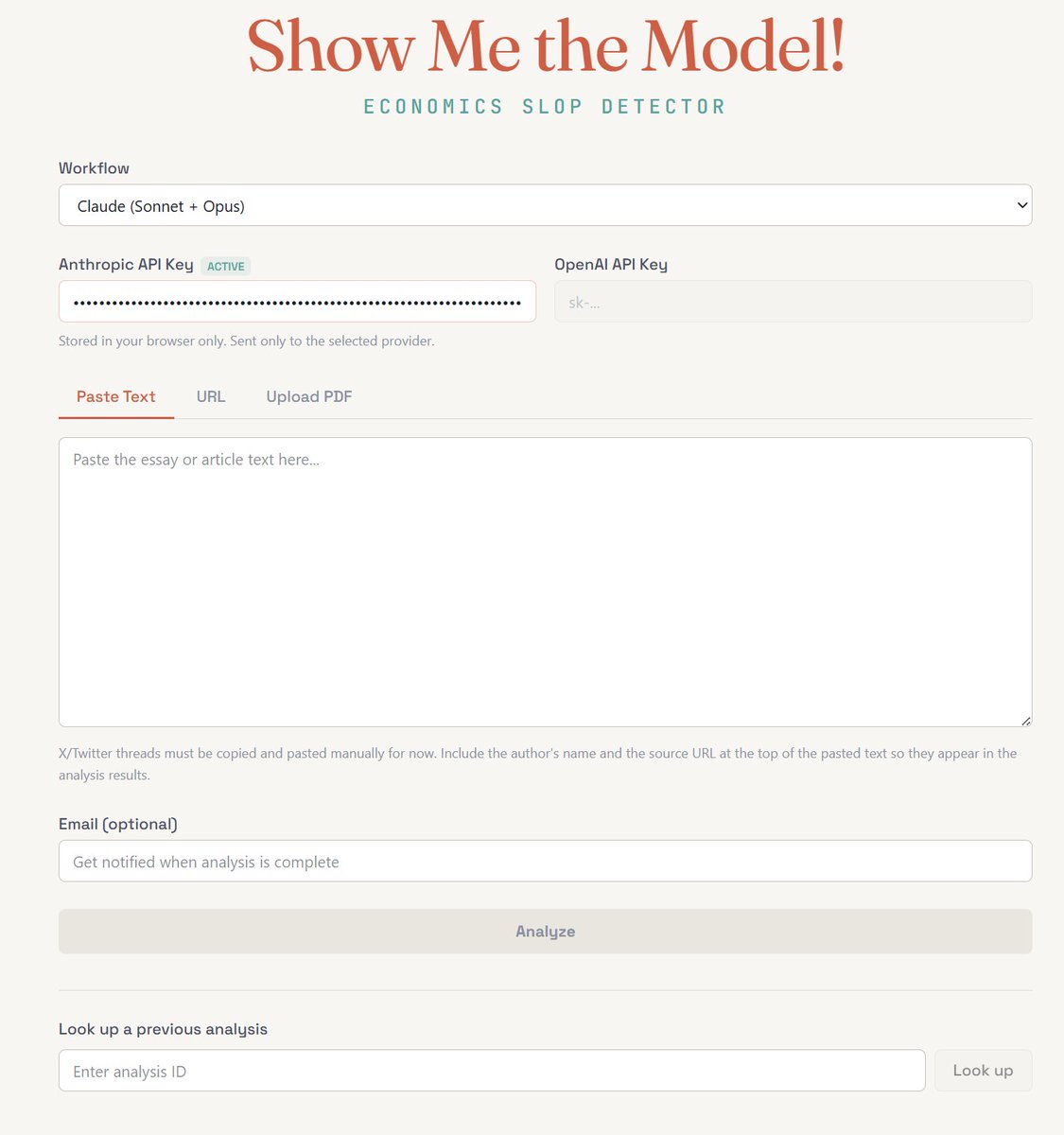
Try it yourself at https://t.co/cfhWs6MI27. You'll need to bring your own API key (OpenAI or Anthropic), and a typical analysis costs $0.50–$1.50.
It's super preliminary and will probably break on you. I'd love feedback about both the functionality as well as the quality of the output.
Hélène Rey, Professor of Economics at @LBS, is appointed as Economic Adviser and Head of the Monetary and Economic Department, replacing Hyun Song Shin, from 1 September 2026
https://t.co/eDVN0Hepvt
I want to take a moment to defend calibration. A common critique of macro by non-macro people centers on the supposed lack of scientific rigor associated with calibration of models. 1/10
In 2013, Markus K. Brunnermeier (@MarkusEconomist) invited me to give a guest lecture in his Princeton graduate course on two venerable topics: the Cambridge capital controversy and Austrian business cycle theory. I put together a set of slides for what I recall was a 75-minute session; fun to teach, but never meant as a definitive treatment.
Yesterday, @ecorami noted that I had once mentioned the Cambridge debate in passing in Spain and that he was working on something related. So I uploaded my old slides “as is.” To my surprise (given that it was a reply to a reply, and in Spanish), the post circulated widely.
That prompted me to fix a few typos, recompile the file, and share the slides properly. Here they are:
https://t.co/2gYfUOXZdd
They are only a brief introduction to the issues, with no ambition beyond showing that the absence of an aggregate production function (or of a homogeneous notion of physical capital) is not particularly troublesome once one uses modern tools.
I also do not attempt to review the literature or more recent work, such as this excellent paper by @pol_antras:
https://t.co/sNM6aiV63Y
Since I might do that someday, constructive feedback is more than appreciated.
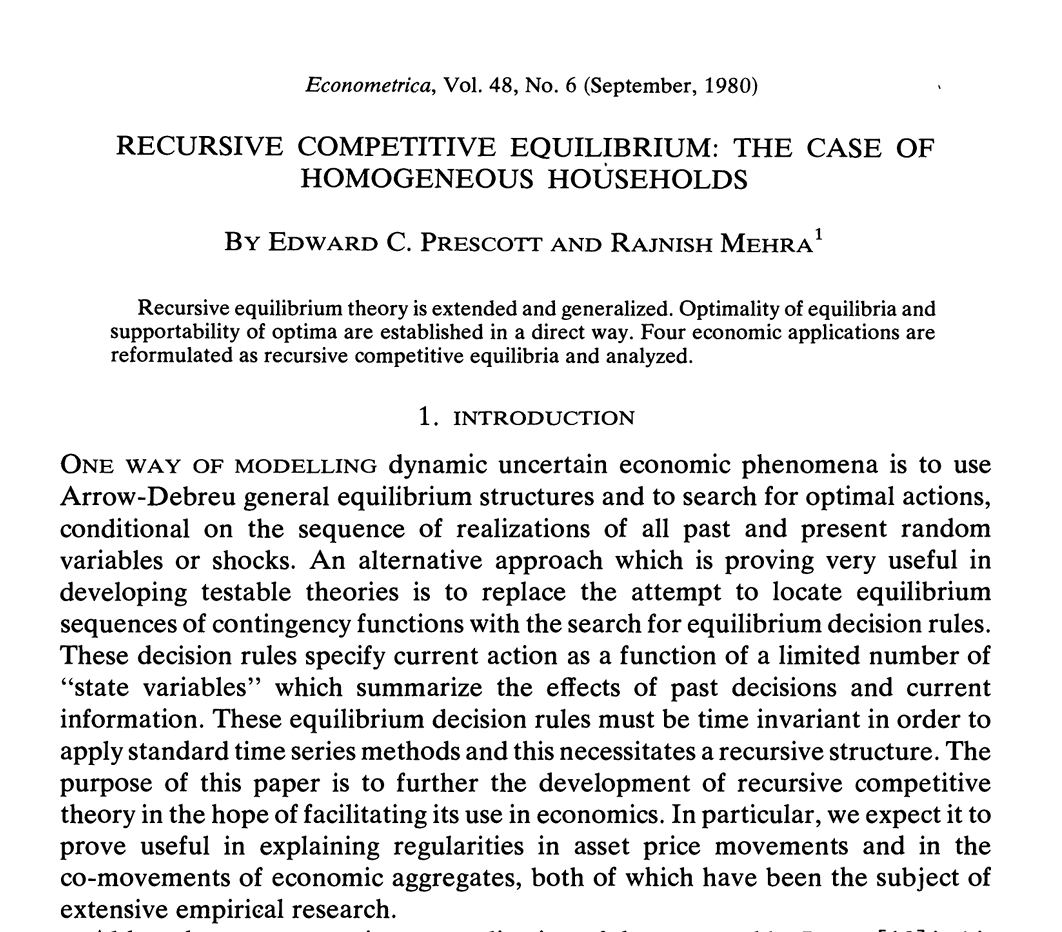
A personal footnote. As a graduate student, I had the fortune to work as Ed Prescott’s RA. It was the best job imaginable: Ed believed that RA-ship meant stopping by my cubicle at the Federal Reserve of Minneapolis first thing in the morning (we were both early birds) and spending an hour talking about whatever economic idea had crossed his mind or asking me random questions about global economic history.
We often spoke about the Cambridge controversy, a topic on which Ed was deeply knowledgeable. He cared enormously about aggregation and regularly asked about it in his macro exams.
His view was that Samuelson and Solow came out the worse in the exchange because they had never been precise enough in defining their core concepts, starting with equilibrium.
Even brilliant minds can lose their bearings when definitions are loose. Intuition and heuristics take us only so far. Clear, rigorous mathematics is often the surest way to avoid mistakes in our reasoning.
A guide for students of economics: Ten statements that demonstrate that someone does not understand modern economics or what an equilibrium is, and that you can safely ignore everything else they say.
1. “Equilibrium means the economy is stable or at rest.”
Many assume that an equilibrium is a peaceful state with no forces at play. Instead, an equilibrium is just an arrangement of actions and expectations over time that are mutually consistent. It can be locally unstable, explosive, or fragile. Nothing in the definition of equilibrium implies stability.
2. “Equilibrium implies optimality or social efficiency.”
Equilibrium is often conflated with efficiency, but equilibrium merely reflects decentralized consistency, not welfare maximization. Market power, externalities, incomplete markets, nominal rigidities, and frictions routinely produce inefficient equilibria. I often teach a first-year macro graduate course, and not a single one of the equilibria I define is efficient.
3. “Equilibrium is a unique outcome.”
Many often expect models to have one equilibrium. In reality, multiple equilibria arise naturally in dynamic, strategic, and incomplete-market environments. Models of coordination failures, self-fulfilling expectations, bubbles, overlapping generations, and liquidity traps all hinge on the existence of equilibrium multiplicity.
4. “Equilibrium requires perfect foresight or perfect information.”
Equilibrium does not assume agents know the future. In fact, equilibria are often stochastic. The definition of equilibrium only requires that beliefs are consistent with the (perceived) stochastic laws of motion implied by the model. Bayesian learning, noisy signals, ambiguity, and subjective uncertainty all fit well within an equilibrium framework, provided beliefs converge to an internally consistent (but possibly incorrect) distribution.
Bonus point: equilibria are compatible with agents having diverging beliefs that never converge to a single Dirac distribution.
5. “Real economies are rarely in equilibrium, so the concept is unrealistic.”
Equilibrium is not meant to describe the daily state of the world. It is a conceptual device used to understand the outcome of our models under the assumptions we make. Also, see point 1 above.
6. “Equilibrium requires agents to be fully rational in a psychological sense.”
Equilibrium only assumes internal consistency: agents optimize given preferences and constraints. It does not assume realism about human cognition. We can and do define equilibria in models with behavioral biases, bounded rationality, inattention, or rule-of-thumb behavior. We only need to ensure that the resulting actions and beliefs are mutually compatible.
7. “Equilibrium eliminates dynamics or learning.”
Equilibrium is sometimes misinterpreted as a static state in which nothing evolves. In fact, many equilibria are sequences of probability distributions over states driven by shocks, policy rules, and endogenous responses. Learning dynamics (Bayesian updating, adaptive rules, experience-based expectations) can occur within equilibrium if the evolution of beliefs is self-consistent.
8. “Equilibrium renders expectations unimportant.”
A common misconception is that equilibrium mechanically determines outcomes. In reality, expectations are often central: they determine investment, consumption, asset prices, and policy responses. Many equilibria differ only in their expectations. This is why communication, credibility, and forward guidance matter even in fully rational models.
9. “Equilibrium excludes policy intervention.”
Some interpret equilibrium as a laissez-faire concept. In fact, equilibrium analysis is the foundation of modern policy evaluation. Fiscal, monetary, and regulatory interventions work through equilibrium responses (prices, wages, interest rates, quantities) and must satisfy equilibrium conditions to be credible. Equilibrium is a tool for policy design, not a barrier to it.
10. “Equilibriums…”
Aequilibrium is a Latin neuter noun of the second declension, which forms a nominative plural in “a”. It is composed of aequus (equal; the same root as equality or equity) and libra (balance or scales or the name of several currencies over history).
A final thought: “equilibrium” is a term of art. Its meaning in economics differs from its use in the natural sciences or in everyday language. Terms of art are ubiquitous across academic disciplines, and the first act of intellectual diligence when one starts studying a discipline is to learn what they mean.
We are excited to release a public, research-ready dataset with complete holdings at the security level for U.S. mutual funds and ETFs each quarter, built from SEC Form N-PORT mutual fund filings.
👉 Access the data and code at the GCAP Data Hub: https://t.co/YzOyhwoPmE
1/3