Twitter is alive with diagnoses of the unfortunate present state of the British national spirit. Many of them perceptive and melancholic, and many of them offered by non-Brits. It's heartening to see how much the country's current depressive state, and the notion of our coming revival, means to so many of our cousins around the world.
But beneath concerns of mere policy, debates over reindustrialisation strategy or philosophies of criminal justice, I believe there's something more fundamental we have to fix in the British spirit before it can support itself on its own wings again.
There's an exchange of views that stands out in my mind when I think of the way the last decade or so is gone. You will have seen it play out a thousand times.
In that exchange, you have two people. On one side, someone who is not a fan of Britain, though they are British. Sometimes these people conform to what you might consider the description of a 'leftist', though it's much more exact to call them a member of the Metropolitan class.
On the other side, you have someone who considers themselves a patriot. I deliberately do not describe the latter as of a rightward leaning, because in my experience patriots can come reasonably from either side of the aisle, though perhaps the right-leaning ones are more typically voluble these days.
In essaying Britain's current condition, the Met will arrive at a point in their argument where they'll claim that Britain, and its culture, doesn't really exist at all. That Britain has no culture, no history worth defending, nothing about it worth esteeming, owning, remembering, and taking pride in.
Then the patriotic voice answers, hotly and at volume, that they disagree.
What I find remarkable is that, often, both sides realise they cannot say much, beyond Shakespeare and the war, as to what British culture is really constituted by. Of course, the patriots know more, because they're interested to know more, but the exchange is never settled. It resolves to silence and a stalemate.
This silence is the deepest thing wrong with Britain in 2026.
Beneath the policy failures and the political incompetence and the slow leak of every public institution sits a quieter, more corrosive failure: we have forgotten who we are.
There is an inability among the British people - who are among the most naturally and winningly modest in the world - to articulate what their own civilisation has been, and is, and could yet be. We have lost our cultural sense of self. We have mislaid the inventory.
So I plan to start a list.
A list essaying everything reasonably within the bounds of the British cultural heritage.
And the start goes like this.
The novel as a literary form. Science fiction. Children's literature as a serious form: Carroll, Stevenson, Potter, Milne, Tolkien, Lewis, Dahl.
The dictionary as a cultural project. The King James Bible, which gave the English-speaking world the prose architecture it has used ever since.
The discovery of how the heavens move, the composition of light, and the laws of motion (Newton). The structure of DNA (Crick, Franklin, Wilkins, working with Watson at King's College and Cambridge). The discovery of penicillin (Fleming, Florey, Chain). The vaccination of mankind against smallpox (Jenner). The invention of antiseptic surgery (Lister). The discovery that cholera came from water (Snow, the Broad Street pump). The marine chronometer that solved the longitude problem (Harrison). The first hospital nursing school (Nightingale). Modern epidemiology. Modern statistics. The randomised controlled trial.
The steam engine. The locomotive. The railway. The factory system. The Industrial Revolution, the great miracle of mankind, originated here, not in some abstract elsewhere, but in Coalbrookdale and Cromford and Manchester and the Black Country.
The jet engine. The hovercraft. The Spitfire. The Harrier. Radar. The cavity magnetron, without which radar at scale is impossible. The Bombe and Colossus, the world's first programmable electronic computers. The stored-program computer in hardware (Manchester Baby, 1948). The ARM chip, the architecture inside almost every smartphone on Earth. The World Wide Web itself, given freely to mankind by Tim Berners-Lee, a British civil servant's son working at CERN.
Football, association and rugby. Cricket, codified at Lord's. Tennis. Boxing. Golf. Snooker. Polo, codified by the British in India. The Olympic revival, partly inspired by the Wenlock Olympian Games of Shropshire. The marathon distance of 26 miles 385 yards, set at the 1908 London Olympics and exported to the world.
Magna Carta. Habeas corpus. Trial by jury. The Mother of All Parliaments. The Loyal Opposition as a constitutional concept. The abolition of the slave trade, paid for in blood and glory by the West Africa Squadron of the Royal Navy through the nineteenth century. The Statute of Anne, 1710, the first copyright law in the world. The Statute of Monopolies, 1624, the foundation of the modern patent system. The first national topographic map (Ordnance Survey). Greenwich Mean Time. The Prime Meridian. The first daily newspaper. The first scientific journal. The Royal Society itself.
The English landscape garden, exported across Europe. The Georgian terrace. The garden city. The joint stock company. Lloyd's of London. The Bank of England, the model for every central bank that has followed.
The Beatles. The Rolling Stones. Pink Floyd. Bowie. Queen. Iron Maiden. The Clash. Drum and bass. Jungle. The BBC, exported as a model of public broadcasting to the world. The Beck Tube Map, copied by every transit system on the planet. The red phone box. The Routemaster. The black cab.
Yes, this is the start of my list.
And already the list is a history of preposterous genius. The work of a single modest, damp, exquisite island. There is no reason Britain should have done a fraction of what it has, let alone all of it. The output, pound for pound, is unrivalled in human history. Athens, Rome, and Florence are our only credible competitors.
And whatever the ingredients of this concentration of genius were, they are not magical. They are in us. They were and remain a culture, an inheritance, a magna-discipline of curiosity and craft, an instinct for liberty (and, yes, moral courage) bound to an instinct for institution-building, a people who did the work.
By the time this decade is through, and by one means or another, I plan to see to it that the country that produced the world as we know it today - that produced the water in which all these glorious varieties of fish delightedly swim, though they know it not - will know who and what it is again.
And it will be a fine thing when we get there.
🚨 INCREDIBLE! This is a stunning drone light show depicting Jesus on the Cross (the Crucifixion)
It was created as part of the “Jesus Jesus Jesus” Holy Week event by The Church on Master’s Road in Manvel, Texas.
Thousands of synchronized drones lit up the night sky during Good Friday to tell the Gospel story in a powerful, modern way.
Absolutely breathtaking!
Pensioners were already voting for reform, you didn't need to bribe them. State pension is unaffordable and needs to be scrapped altogether following intro of auto enrolment but I guess that's a problem for 2nd term (if lucky enough to win) - 2035 is optimal timing for it to be announced to give people 20 years to plan (on top of 20 years contributions) which would take sting out of it. But by taking this stance now you make that much harder politically which let's face it means you'll bottle it because of some other short term crisis = more uniparty and not the radical Reform country needs. But that will be someone else's problem won't it Rob...
⚠️ Since the media are cherry picking this, let me explain what control actually looks like.
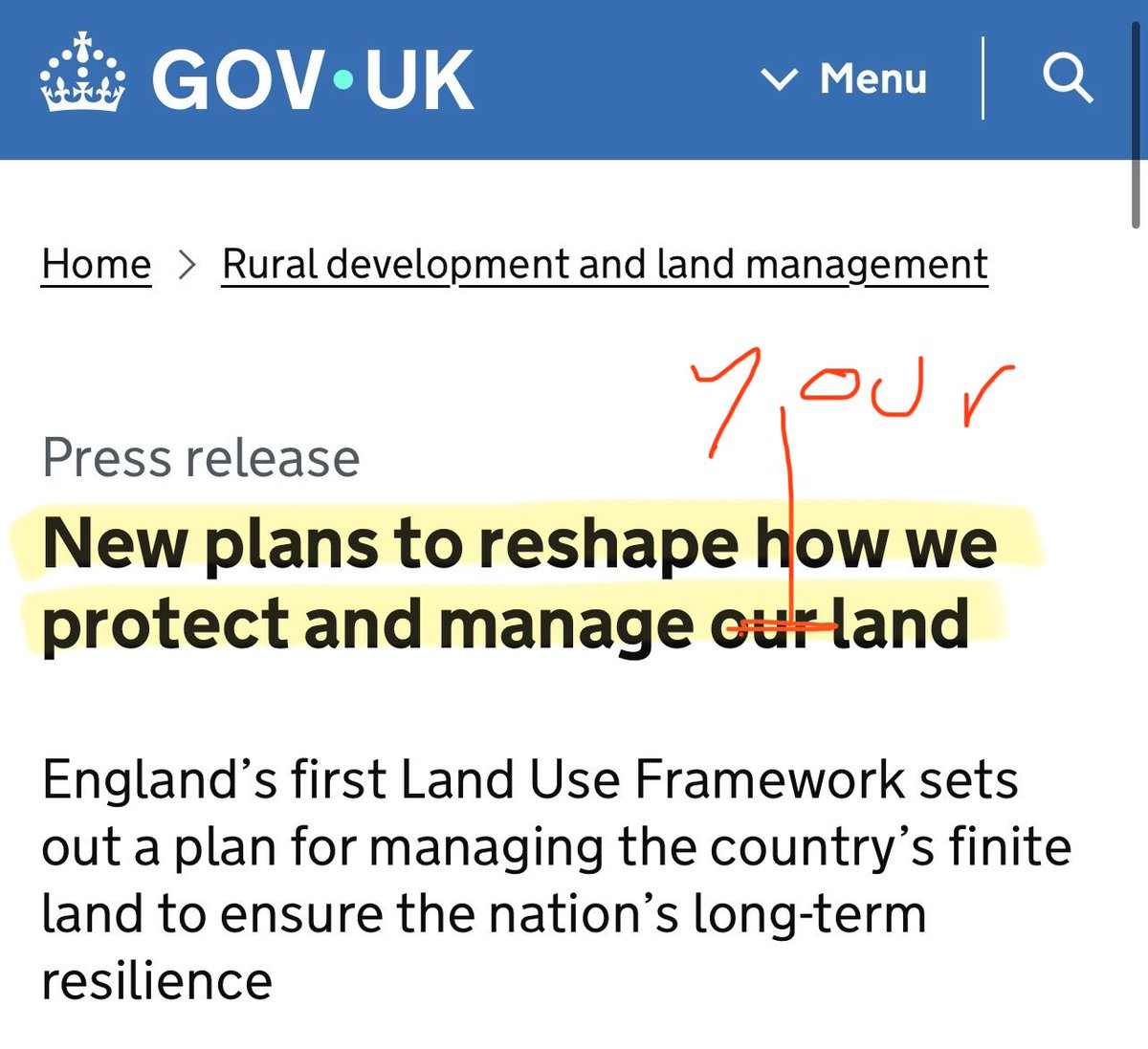
The land use framework was published yesterday. There was no parliamentary vote on it, yet you will be forced to accept it.
The framework aligns closely with the same priorities around land, climate and biodiversity seen in Agenda 2030 SDG 15 even if it doesn’t explicitly reference it. What it means in practice is that the government won’t need to own the land to increasingly decide how it’s used.
This isn’t about taking land. It’s about redefining how it’s used. And that’s far more powerful.
▪️moves land from ownership to managed permission.
You may still own it, but what you can actually do with your land, and profit from, will increasingly be controlled by centrally defined priorities set by the government. That includes food, housing, nature, carbon and infrastructure. It means your land sits within that system.
▪️A national map. A single, government led spatial view of England, layering farming, housing, energy, biodiversity and climate targets into one system. Once that exists, planning decisions, subsidies and restrictions will increasingly be guided by it. I suspect so will tax.
▪️land becomes digital.
Fully mapped, measured, and classified via data, including soils, flood risk, biodiversity value and land use. Once land is digitised like that, it becomes manageable at a National scale, regardless of what you want to do with your own bit.
▪️ownership becomes more transparent Who owns what, where, and how much, will be increasingly mapped and accessible. Giving the state the ability to apply pressure, incentives or restrictions with greater precision. Again, I suspect extra taxes.
▪️At the same time, large landowners and farmers are being pulled into alignment. They will be expected to publish land use plans, report emissions and demonstrate how they contribute to national goals, often linked to funding and support schemes. If they don’t do as they are told by government, funding may not be given. So, there is no confiscation or ‘force’, just a coordinated compliance with a wider system. Funding will increasingly be directed toward “approved” uses, with growing pressure on uses that don’t align, the behavioural nudge type approach.
All of this is tied to climate targets, biodiversity commitments, and wider international priorities the public never directly voted on.
Complete control and government overreach looks just like this ⚠️
Christianity in the West is not just another religion. It is the moral infrastructure of the civilization. And the atheists who can’t wait to see it disappear will one day regret their contribution to pushing it out, just as their master, Dawkins, did last year.
If Christianity goes, it does not go alone. With it goes everything it produced and then secularized: human dignity, equality before the law, freedom of conscience, freedom of speech, limits on state power, the idea that rulers answer to something higher than themselves.
These did not fall from the sky. They were not discovered by pure reason. They were not produced by biology or evolution. They were born from a worldview.
What makes a king and a homeless man equal? Nature does not, power does not, history does not. Only one idea does: that both are made in the image of God.
What about freedom of speech? Why should anyone be allowed to say what they think? Because in the biblical worldview, conscience belongs to God before it belongs to the state. Because truth is not created by authority.
That is not Greek philosophy, or Roman law, or modern science. That is Judeo-Christian theology translated into politics.
What about limited state power? Why shouldn’t the state control everything? Because in the biblical model, the state is not divine. It is not sacred. It is not the source of morality. It is restrained because God stands above it. Remove God, and the state has no ceiling.
So when people say:“Human reason produced these values,” they are confusing inheritance with invention.
You did not invent them, you were born into them.
Societies that abandon Christianity keep the language of rights but lose the substance. They still say “human dignity,” but they can no longer explain why humans have it. They still say “freedom,” but they redefine it as appetite. They still say “equality,” but they replace it with grievance.
When we defend Judeo-Christian principles we are defending the moral architecture of the West.
A society can survive anything except the destruction of its moral foundation. Those who cheer the death of Christianity believe they are freeing society. In reality, they are removing the load-bearing walls.
And when the roof collapses, they will discover too late
that what they hated was what was holding everything up.
@GoodwinMJ Not sure Reform should field a candidate... Burnham would give Starmer a headache in parliament, if he became leader he's even more left so would accelerate damage to country even more, prompting calls for early election?
Tears streaming down my face listening to this audio out of Iran. They are saying it’s a massacre worse than the mind can fathom. That the 12,000 estimate is a joke in comparison to the numbers killed. And above all, that they outside help… and they need it NOW
“I found that, in the end, atheism was not a basis for a meaningful life.” @nfergus on his recent Christian conversion and the need for people to “go to church and open their hearts to Christ.”
ht @MLInstitute
@garyseconomics Top 0.1% already pay 50% of all tax in the UK. Let that sink in. It's ridiculous. It's unfair. It's moronic to think taxing them more will solve anything. But as long as there's someone else to blame...