When an AI project stalls, the workflow around it is usually the issue. Fix the process first. Leading that work? Come on @techimpactTV https://t.co/bKtj0yek4U https://t.co/t6Q0zSJ0Hi
World models don’t just need to look realistic.
They need to obey reality.
If a model can’t reliably handle motion, friction, collisions, or fluid dynamics, how can we trust it to plan actions in the real world?
This kind of physics benchmark is exactly what the field needs.
Andrej Karpathy (ex-OpenAI, ex-Tesla) just released a prompt that turns Opus 5.5 into a harness that actually finishes the any job.
It's f*cking unreal...
send it to Opus 5.5, and thank me later. Then read the full guide for Opus 5.5 Harness Engineering.
LATEST: Netflix has released the first trailer for its upcoming film about Sam Bankman-Fried, the former FTX CEO whose crypto empire collapsed in 2022.
Why doesn’t @thsottiaux like multiple bots working together?
A native answer would be that OpenAI’s dots feature is a single dot. There are no other dots it can collaborate with.
But let’s be real. Nobody with an engineering mindset builds products using bots. The only reason to do it is to demonstrate your bots in public.
And when it comes to reliability, Tibo is right. If your prompt looks like code expressed in English, it should be code, not instructions for an agent. That way, you don't have to relay on AI following the instructions.
Claude Opus 5.5 with this prompt is a f*cking cheat code
paste it in and Opus 5.5 designs the whole system for you:
> the agents and what each one owns
> the prompt each agent runs on
> the workflow, handoffs and stop conditions between them
Claude Code tip: run it in plan mode first, cut every agent without a clear output, then let it build
grab it before it becomes everyone's default playbook:
Want to learn AI-Powered System Design? Start here.
You don’t need to master everything at once. Start with the fundamentals, understand how each component connects, and gradually build production-ready AI systems.
Here are 6 stages to guide your learning:
→ Stage 1: Scalability & Performance
Learn load balancing, caching, API gateways, autoscaling, and rate limiting to handle growing traffic.
→ Stage 2: Data, Storage & Retrieval
Explore databases, indexing, replication, partitioning, vector search, and knowledge graphs for efficient data access.
→ Stage 3: Distributed Systems & Reliability
Understand message queues, retries, idempotency, circuit breakers, and failover to keep services running.
→ Stage 4: AI & Agent Architecture
Connect LLM APIs, RAG, tools, memory, workflows, and multi-agent systems to build intelligent applications.
→ Stage 5: Security, Governance & Compliance
Implement identity controls, encryption, human approvals, audit logging, and prompt injection protection.
→ Stage 6: Observability, Evaluation & AI Operations
Monitor latency, costs, traces, model quality, RAG performance, drift, and production incidents.
Each stage builds on the previous one.
Start with a simple application. Learn how it handles traffic, stores data, recovers from failures, and integrates AI.
Then gradually add security, evaluation, and monitoring.
AI-Powered System Design is about connecting these layers to build reliable, secure, and scalable applications.
Which stage are you currently learning?
P.S. Preparing for a software engineering role? Check out my book, System Design and Behavioral Intelligence.
It will help you:
• Build strong System Design foundations and approach design problems with confidence
• Develop practical frameworks to navigate complex behavioral and leadership challenges
Get Your Copy anywhere internationally:
US: https://t.co/tkmGPyI7IC
UK: https://t.co/b6QWqdMAIB
India : https://t.co/RoOZPwiFcY
Google Brain founder Andrew Ng:
"Prompting will die in 7 months
Harnesses are what's replacing it"
Prompts → Agents → Harness → Loops → Graphs → Self-Improving Systems
In just 97 minutes, Andrew shows how to build a harness that lets agents plan, execute, verify, and improve without you
A harness → Loads the right context → Routes each task → Checks the output → Triggers the next step
Most people are still perfecting prompts while the real work is already moving into the harness
Watch it today
Then save the full harness engineering guide below ↓
AI coding with GPT-6 Astra is getting f...cking dangerous
i gave Astra one GitHub repo and a 30 minute autonomous run and watched it route 38 changes through planning, patching, review and tests without letting a failed check reach release
[the stack was basically this 👇]
1. OpenSpec turns the request into an explicit spec before Astra starts touching code, so the agent has something concrete to build and verify against
▸ https://t.co/8e7ExnmR5Y
2. Kestra handles the execution flow and keeps each coding job moving through separate stages instead of letting one agent freestyle the entire run
▸ https://t.co/RWyZZDOB5P
3. Dagger gives the patches a programmable environment for builds and tests, so the same verification can run locally and inside CI
▸ https://t.co/hEz1NxaMeG
4. Reviewdog takes the outputs from linters and analyzers and puts the failures directly back into the code review loop
▸ https://t.co/HR2tbObPRh
the useful part is the order
spec → route → patch → review → test → release
Astra can keep moving fast
GitHub decides what survives
Billionaire Data Center Builder Insists There’s No AI Bubble
Despite NIMBY pushback, an existential threat to humanity and delays, data centers are "still going to get built," says billionaire Bob Clark, whose fortune has quadrupled in three years.
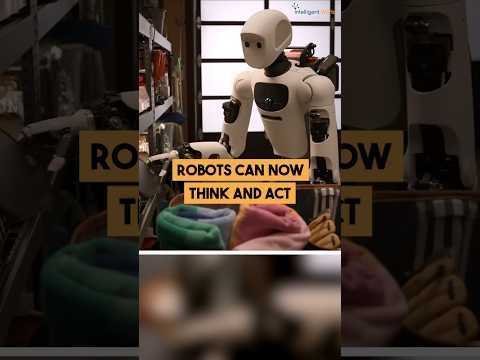
Robots Can Now Think and Act https://t.co/bIjjCXwZBH via @Ronald_vanLoon of Intelligent World on @Thinkers360#AI#BigData#IoT 📣 AI Expert? Get certified at Thinkers360: https://t.co/THKb91hw26
OpenAI Dots reads simple on the launch page, but the docs tell a different story...
Before you hire your first Dot, read these. three official pieces show what OpenAI promises, and five outside breakdowns show what happens once people start using it
Here are 8 sources:
source 1 → Introducing dots (OpenAI announcement). what a Dot is, where it runs and who gets access first
source 2 → Getting started with your dot (OpenAI Help guide). creating your first Dot, naming it and connecting the apps it needs
source 3 → Dots docs (OpenAI Learn). rules, approvals, cloud computers and the Activity view
source 4 → Always-on AI agents that proactively help (WIRED article). the case for agents that act before you ask them to
source 5 → OpenAI launches Dots (TechCrunch article). launch news, plan tiers and how the rollout works
source 6 → Everything announced at DevDay 2026 (Decrypt recap). Dots, Space, Sol, Codex Cloud and agent computers in one place
source 7 → OpenAI Dots, a deep dive (Flavio Copes blog). a developer walking through how Dots work under the hood
source 8 → Are enterprises ready to delegate real work? (InfoWorld article). what changes when agents take on real tasks inside a company
go through them in this order and the architecture in the article below makes a lot more sense. official first, then outside takes
Full Dots reading roadmap below, read it and then go through the complete architecture ↓
Leonardo lived centuries before we started talking seriously about “multidisciplinary thinking”, yet his entire life seems built around it. Art informed anatomy, anatomy informed mechanics, mechanics informed his understanding of nature.
Good compilation @dinisguarda