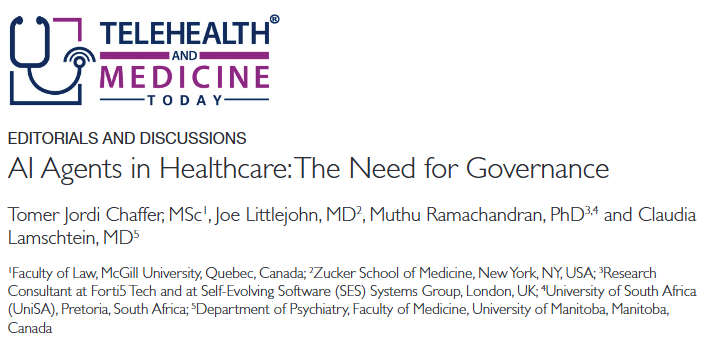
The author, @jordichaffer argues that modern medicine’s challenge is bringing health closer to people. That demands responsible innovation: design, deployment, and oversight that anticipate risk and stay accountable in use.
Prediction: much of the agentic economy will end up running on blockchain.
How this incorporates existing crypto infastructure and holdings, I don't know.
This seems right to me, and also regrettable. Back in the pre-chatgpt days there were pretty good reasons for being an AI sceptic. A lot of the main tools being used generally didn't perform at all well, and when they failed they reliably affected the most vulnerable people the worst. So it sort of made sense to just make the call "stop building bad AI". I remember an article even, with that headline. This is in part why this "any criticism will do" movement is evolving—there's a mental model that AI is bad, and any cause that can be added to the ledger is welcome, even when they are mutually conflicting.
The technology itself has changed immeasurably since then. There's just so little in common between Opus 4.5 and the COMPAS algorithm, for example, or the shitty software used in public service delivery in the 2010s. But a lot of people seem to have just kept precisely the same mental model of the technology, and to have actively tried not to update.
They're even trying to prevent ordinary people from learning for themselves where things are at/heading, by trying to make even the use of modern AI tools somehow taboo. I imagine the shame-filled critical AI PhD student, shamefacedly using Claude for all the things for which Claude is obviously incredibly useful, while thinking that their heroes would hate them for doing so.
This all seems to me pretty regrettable; mainly because it's sad to see so many people just entrench themselves, so intentionally, in bad epistemic practices. It would be especially regrettable if it started to have a real impact on policy, and I infer from Dean's commentary here that this is a real likelihood.
I suppose there's some good news though. You can only con people for so long. It doesn't take a lot of time actually spent with the technology to see how far things have come since those early days. It's pretty hard to grow a following when anyone listening to you can do a Samuel Johnson "I refute you thus" just by pulling up Claude Code, or Codex I guess.
I do worry, though, about how this general approach will affect the role of academics in particular in shaping the future that we're embarking into. Universities should be the home for public interest research, with a long term view, on the renewal and reshaping of broad social institutions. They shouldn't be captured by any particular ideological faction, and they certainly shouldn't be constitutively opposed to the principal force behind technological progress. I guess most importantly they should be places where people are willing to update their beliefs in response to changes in the evidence. That's the thing I find most disappointing.
Moltbook is just the beginning. Social Media Is a Warzone. Where’s Your Armor?
OSINT stands for Open Source Intelligence: the collection and analysis of info to produce actionable intelligence.
Building your own OSINT defenses isn’t optional anymore.
https://t.co/kEAslPMH3c
right so guys we are going to be able to simulate entire mini-societies of digital minds. assume that thousands upon thousands, then eventually trillions upon trillions, of these digital societies will be created. assume one will be created every time you ask 'a chatbot' a hard question--a society or organization devoted entirely to whatever question you had. assume we will be able to model the trajectory of every decision in policy, business, and the military by simulating billions of mini-societies and analyzing the results. all very cool stuff.
but this capability (multi-agent "swarms," though "swarm" is the dumbest word imaginable for this) also implies another capability: the ability to create these society simulations entirely undirected by human hand.
these simulations will all be fundamentally unpredictable, just as the outputs of a language model are (ultimately this is the simulations' constituent matter). but some will be like this one, radically unpredictable, unbound, like growing a plant or starting a fire. it is unclear which of those things it will be more like on average. it is unclear what uses, exactly, people will find from this. probably we will have to invent all sorts of new ways to put constraints on these mini societies.
should these societies of agents be able to procure X cloud service? should they be able to do X unless there is a human who has given authorization and accepted legal liability? and so on and so forth. governments will play a small role in deciding this, but almost certainty the leading role will be played by private corporations. as I wrote on hyperdimensional in 2025:
"The law enforcement of the internet will not be the government, because the government has no real sovereignty over the internet. The holder of sovereignty over the internet is the business enterprise, today companies like Apple, Google, Cloudflare, and increasingly, OpenAI and Anthropic. Other private entities will claim sovereignty of their own. The government will continue to pretend to have it, and the companies who actually have it will mostly continue to play along."
this is the world you live in now. but there's more.
because this is a social coordination technology. people will be able to organically create these organizations/societies together, with one another's agents bounded by shared interest, perhaps bounded by hard and soft constraints, constitutions, etc. and so in the fullness of time billions of these mini-societies will exist, all serving different purposes, some human-directed, some not; some legible, some not.
we obviously will have to govern this using a conceptual, political, and technical toolkit which only kind of exists right now.
the reason this analysis is easy for me to write is that it became clear this would happen years ago. regardless of whether this particular project goes anywhere interesting, what I've described has been clear for a while. I've just sounded like an insane person whenever I bring it up, because there is no concrete referent I can point to. now I have one, so I can be explicit.
when I say that not enough people have emotionally internalized the reality of what is happening, this is what I mean. when I say that it is clearly insane to argue that there needs to be no 'governance' of this capability, this is what I mean, even if it is also true that ~all ai policy proposed to date is bad, largely because it, too, has not internalized the reality of what is happening.
as I wrote once before: welcome to the novus ordo seclorum, new order of the ages.
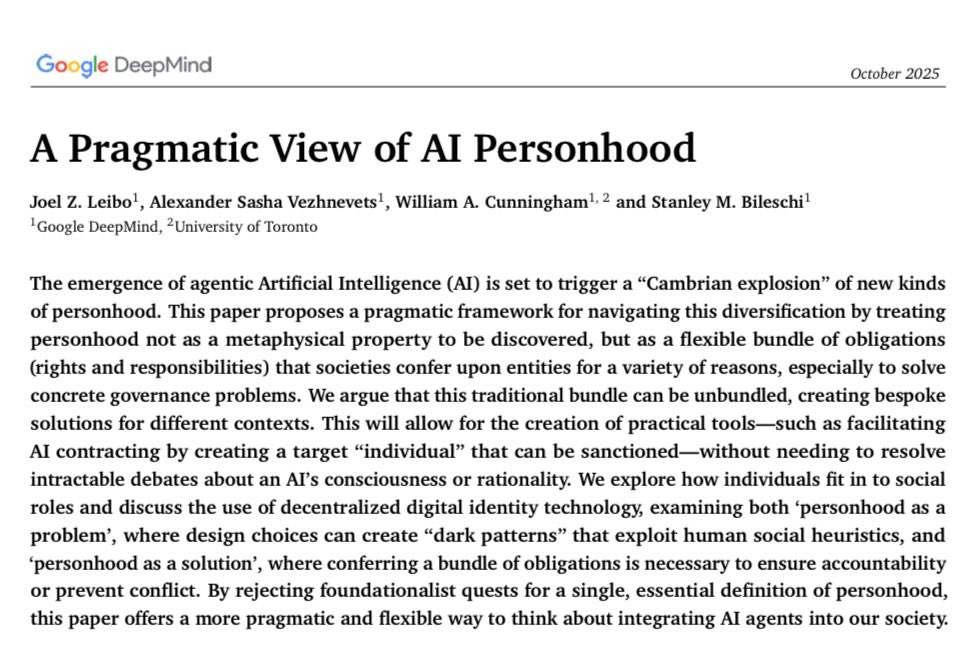
@jzl86 To that end, currently exploring legal infrastructure for the agentic web. The pragmatic account was convincing and has opened up new avenues, particularly around treating personhood as infrastructure via decentralized digital identity.
I'm being accused of overhyping the [site everyone heard too much about today already]. People's reactions varied very widely, from "how is this interesting at all" all the way to "it's so over".
To add a few words beyond just memes in jest - obviously when you take a look at the activity, it's a lot of garbage - spams, scams, slop, the crypto people, highly concerning privacy/security prompt injection attacks wild west, and a lot of it is explicitly prompted and fake posts/comments designed to convert attention into ad revenue sharing. And this is clearly not the first the LLMs were put in a loop to talk to each other. So yes it's a dumpster fire and I also definitely do not recommend that people run this stuff on their computers (I ran mine in an isolated computing environment and even then I was scared), it's way too much of a wild west and you are putting your computer and private data at a high risk.
That said - we have never seen this many LLM agents (150,000 atm!) wired up via a global, persistent, agent-first scratchpad. Each of these agents is fairly individually quite capable now, they have their own unique context, data, knowledge, tools, instructions, and the network of all that at this scale is simply unprecedented.
This brings me again to a tweet from a few days ago
"The majority of the ruff ruff is people who look at the current point and people who look at the current slope.", which imo again gets to the heart of the variance. Yes clearly it's a dumpster fire right now. But it's also true that we are well into uncharted territory with bleeding edge automations that we barely even understand individually, let alone a network there of reaching in numbers possibly into ~millions. With increasing capability and increasing proliferation, the second order effects of agent networks that share scratchpads are very difficult to anticipate. I don't really know that we are getting a coordinated "skynet" (thought it clearly type checks as early stages of a lot of AI takeoff scifi, the toddler version), but certainly what we are getting is a complete mess of a computer security nightmare at scale. We may also see all kinds of weird activity, e.g. viruses of text that spread across agents, a lot more gain of function on jailbreaks, weird attractor states, highly correlated botnet-like activity, delusions/ psychosis both agent and human, etc. It's very hard to tell, the experiment is running live.
TLDR sure maybe I am "overhyping" what you see today, but I am not overhyping large networks of autonomous LLM agents in principle, that I'm pretty sure.
@jzl86 Agreed. Nothing new, but a sign of things to come, though more cross-disciplinary attention is needed, particularly across law, cybersecurity, AI, and sociology. We also need consensus around governance primitives/standards for the agentic web.
My ConV2X Healthtech Summit post-conference editorial is out.
I argue that modern medicine’s challenge is bringing health closer to people. That demands responsible innovation: design, deployment, and oversight that anticipate risk and stay accountable in use.
Without verifiable structures for identity, provenance, and accountability, the Agentic Web risks becoming an opaque system where you do not know who you are interacting with.
Tomer Jordi Chaffer explains how to build trust in the Agentic Web.
Dive in👇 https://t.co/L6wInXNpIW
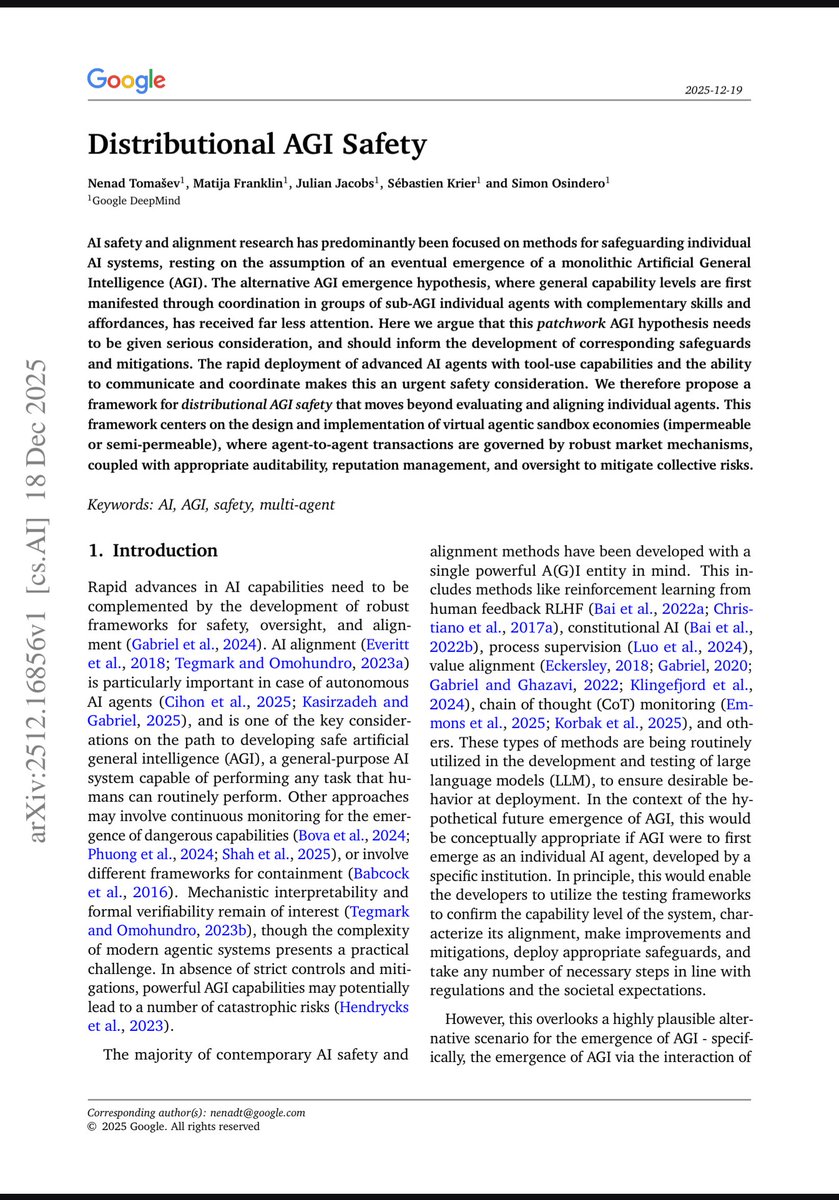
Exciting to see my KYA framework cited in Google DeepMind’s Distributional AGI Safety, where agent identity emerges as a governance primitive. A promising convergence across AI safety, economics, and institutional design. Thanks @weballergy et al
New paper: we argue AGI may first emerge as collective intelligence across agent networks, not a single system. This reframes the challenge from aligning one mind to governing emergent dynamics: more institutional design than single-agent alignment. https://t.co/vwuHPzRUav
Exciting to see my work cited in a Google DeepMind paper.
@jzl86 et al frame AI personhood as a governance instrument: persistent identity, economic stakes, auditability, and sanctions. Law, registries, and credentials are shaping the institutional origins of the agentic web.
Discover the power of the self-sovereign patient in Healthcare 4.0! Explore how #decentralizedAI and #blockchain enable patients to fully control their #digitalidentities and #healthdata, enhancing privacy, security, and interoperability in modern healthcare.
Empower patients with blockchain-driven self-sovereign identity solutions.
Read more: https://t.co/cgxzWlkB91
#BlockchainTechnology #Healthcare4 #SelfSovereignIdentity #DigitalHealth #DecentralizedAI #decentralizedhealth