Sports Scientist. Forbes Health Advisory Board Member. Scientific Commission for ENHANCED. CEO and co-founder of the International Society of Sports Nutrition.
Athletes competing at the next level don’t leave recovery or performance to chance.
Nutrition and smart supplementation can give you an edge in addition to proper sleep. I sat down with @JoseAntonioPhD (co-founder of the International Society of Sports Nutrition @IntSocietySN and one of the most cited researchers in the field).
We discussed the protocols his wife Karla Antonio, a UCI Gran Fondo World Championship medalist cyclist utilized to gain the competitive advantage and more!
Full episode drops this week.
🎧 LISTEN TO EPISODE 23 with Dr. @JoseAntonioPhD!
YOUTUBE: https://t.co/2EoVRuK5FE
SPOTIFY: https://t.co/2UTw18FtZo
APPLE PODCAST: https://t.co/paUlLKbbc1
💪 Resistance training improves strength and physical function. Higher muscular strength is associated with lower mortality risk.
🏋️ Keep it simple: compound lifts, 2–3×/week, a few hard sets, ~1–3 RIR.
https://t.co/vd3PsKo5Em
A 2026 review challenges 16 common diet myths:
💪 Muscle growth doesn’t require a calorie surplus
⏳ Fasting isn’t superior for long-term weight loss
🥗 No universally optimal macro ratio
🧬 DNA diets lack convincing evidence
Evidence beats diet hype
https://t.co/oLMqpDJjbJ
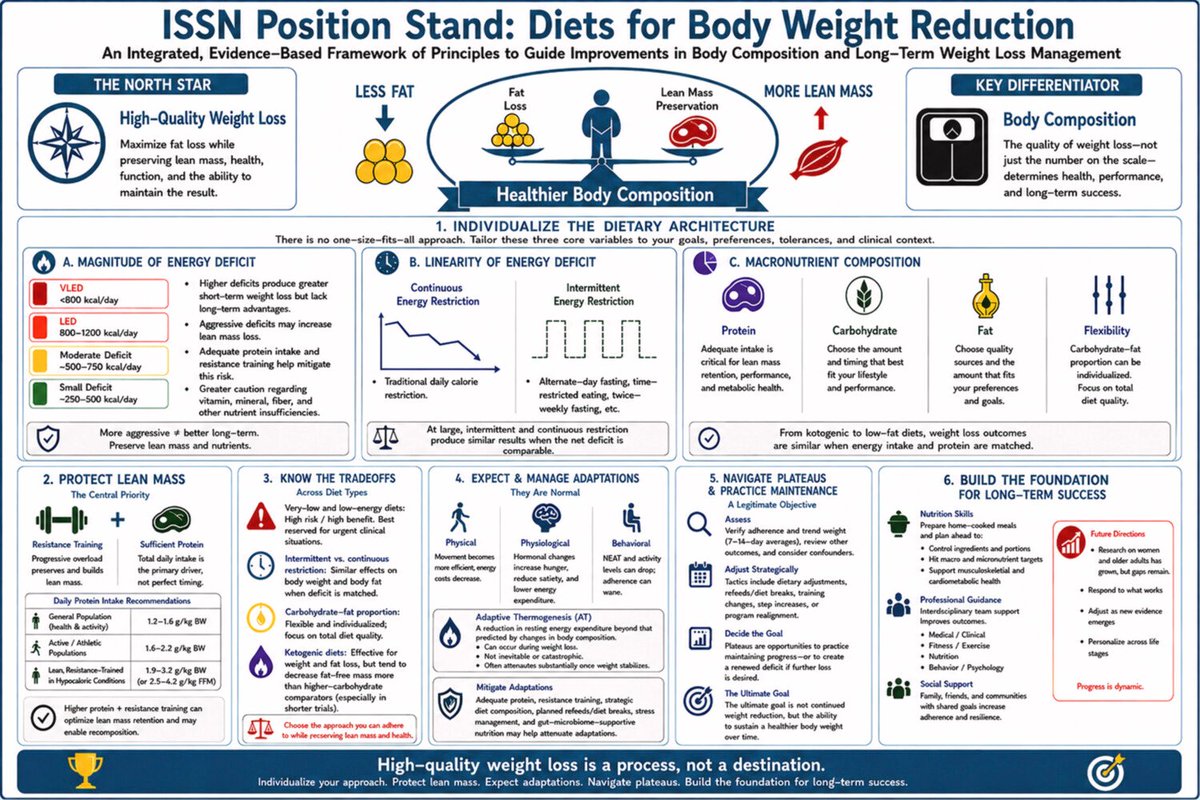
New ISSN position stand on diets & body weight reduction!!! I'll provide the link in the comments so this post sees a smidge of day light :). Congrats to the team, thank you for your brilliance on this paper. Almost a decade since the previous similar project.
@JoseAntonioPhD
100 g/h carbohydrate improves endurance durability compared to 60 g/h 🚴
This new study examined whether 60 vs 100 g/h carbohydrate influenced durability, substrate oxidation and muscle glycogen use during prolonged cycling in 15 trained male cyclists and triathletes 🔍
Participants completed 4 h of intermittent cycling at ~60% of their fresh 15-min time-trial power, including high-intensity intervals 🚴
Carbohydrate was provided as a 1:0.8 glucose-to-fructose mix at either 60 or 100 g/h 🥤
Results 📊
📉 Performance declined after 4 h in both conditions, but the reduction was significantly smaller with 100 g/h
⚡ 15-min TT mean power fell by ~6.4% with 100 g/h versus ~9.3% with 60 g/h
📈 Accordingly, late-exercise mean power was ~9 W higher with 100 g/h
🧬 Interestingly, muscle glycogen utilisation was virtually identical between conditions
↔️ Post-exercise muscle glycogen availability was also similar: 192 vs 209 mmol/kg dry weight
🔥 Whole-body carbohydrate oxidation was better maintained with 100 g/h, falling from 2.6 → 2.3 g/min, versus 2.6 → 1.9 g/min with 60 g/h
🩸 Blood glucose remained stable in both conditions, suggesting the performance difference was not explained by greater preservation of circulating glucose
💡 This means the durability benefit from higher carbohydrate intake did not appear to come from sparing muscle glycogen
⚠️ The study included only trained men, so findings should not automatically be generalised to female athletes or all endurance populations
For long endurance events, increasing carbohydrate intake from 60 to 100 g/h may help preserve late-race power and durability even when muscle glycogen utilisation is unchanged, supporting higher intakes when athletes can tolerate and practically execute them ✅
Reference:
https://t.co/b6HB4u4A77
Subscribe to https://t.co/kPsQssm5ut FREE to receive your daily study breakdown, straight to your inbox or via the Substack app 📥
Powered by https://t.co/V0YqjzPGsK⚡️
10 vs 90 vs 120 vs 150 g/h carbs for endurance 🚴
This new study examined how 10, 90, 120 and 150 g/h carbohydrate affected substrate metabolism, exogenous carbohydrate oxidation and exercise capacity in 8 trained male cyclists 🔍
Participants cycled for 3 h, followed by an exercise-capacity test at 150% of lactate threshold 🚴
The 90, 120 and 150 g/h conditions used a 1:0.8 glucose-to-fructose ratio 🥤
Results 📊
📈 Exogenous carbohydrate oxidation increased dose-dependently, reaching 1.23, 1.48 and 1.62 g/min with 90, 120 and 150 g/h respectively
🔥 However, whole-body carbohydrate oxidation did not differ between 120 and 150 g/h
⬆️ Both 120 and 150 g/h produced greater whole-body carbohydrate oxidation than 90 and 10 g/h
🩸 Blood glucose was significantly lower with 10 g/h than with 90, 120 or 150 g/h
⏱️ Total exercise duration was significantly shorter with 10 g/h than with both 90 and 120 g/h
↔️ There were no significant performance differences between 90, 120 and 150 g/h
📊 Modelling suggested optimal exercise capacity occurred at approximately 107 g/h, with a 95% CI of 92–122 g/h
⬆️ Increasing intake from 120 → 150 g/h therefore increased exogenous carbohydrate oxidation, but did not further increase whole-body carbohydrate oxidation or exercise capacity
🧩 Importantly, individual responses varied substantially, with the authors highlighting the potential value of personalising carbohydrate intake rather than assuming more is always better
⚠️ This was a very small study involving only 8 trained men, so the exact “optimal” intake should not be treated as a universal prescription
For prolonged endurance exercise, carbohydrate intakes around 90–120 g/h appear to support substantially greater performance than very low intake, while pushing intake to 150 g/h may increase exogenous oxidation without providing additional performance benefit; tolerance and individual response should therefore help determine the athlete’s target ✅
Reference:
https://t.co/rJtxw6SsaP
Subscribe to https://t.co/kPsQssm5ut FREE to receive your daily study breakdown, straight to your inbox or via the Substack app 📥
Powered by https://t.co/V0YqjzPGsK⚡️
It was an honor to co-author the International Society of Sports Nutrition position stand evaluating the scientific evidence on dietary strategies for weight loss and body composition (PMID: 42867412). Huge kudos to @thealanaragon for spearheading the effort.
Some key takeaways:
--Calorie deficit is king: Weight loss is primarily driven by sustained energy restriction, with dietary approaches best tailored to individual preferences and goals.
--Intermittent fasting isn't superior: Time-restricted eating and other fasting strategies generally produce similar weight and fat loss compared with continuous calorie restriction.
--Carb vs fat ratios are overrated: Both lower-carbohydrate and lower-fat diets can be similarly effective for fat loss. Ketogenic diets may lead to greater reductions in fat-free mass, but this appears to be partly attributable to changes in glycogen/water stores.
--Protein matters: Intakes of 1.2–1.6 g/kg/day are appropriate for the gen pop, while 1.6–2.2 g/kg/day may optimize muscle anabolism when combined with resistance training. Higher intakes may benefit lean, resistance-trained individuals dieting in a caloric deficit.
--Lift weights to preserve muscle: Resistance training combined with adequate protein intake is essential for minimizing lean mass loss during weight reduction.
--Meal frequency is flexible: Eating more frequently does not inherently enhance fat loss, although distributing protein across at least three meals daily may benefit muscle retention and performance.
--Aggressive dieting isn't necessarily better: Very-low-calorie diets can accelerate short-term weight loss but offer no clear long-term advantage and may increase the risk of muscle loss and nutrient deficiencies.
--Metabolic adaptation is real: Energy expenditure can decline during weight loss, sometimes beyond what is predicted by changes in body composition. However, these adaptations aren’t inevitable and may diminish with weight stabilization.
Bottom Line: There is no universally superior diet for fat loss. The best approach is one that creates a sustainable calorie deficit, provides sufficient protein, incorporates resistance training, and aligns with individual preferences to promote long-term adherence.
https://t.co/q9lz8vlIZM
Just wrapped up recording episode 23 of the Wendi Irlbeck show with special guest @JoseAntonioPhD ! 🎙️
We covered all things supplements, including creatine monohydrate what the research actually shows, who can benefit, and how to use it wisely. 😎Stay tuned for the full episode dropping soon! Iron sharpens iron. 🪓I’m truly so grateful and blessed to get to do the work I love as a daughter of Christ, disciple and dietitian!
Wishing you all the BEST day ever! 🙌 Stay rooted in your faith, use critical thinking skills, have an open mind, and remain curious. A good scientist questions everything! 🤓
Just 10 g/h carbohydrate improves endurance by 22% in low- and high-carb triathletes 🍬
This randomised crossover study examined whether minimal carbohydrate during exercise could improve endurance after 6 weeks on very-low- or high-carbohydrate diets in 10 trained male triathletes 🔍
Athletes completed 6 weeks of a very-low-carbohydrate/high-fat diet (~40 g CHO/day) and 6 weeks of a high-carbohydrate/low-fat diet (~380 g/day) 🥑
After each diet, they cycled to exhaustion at 70% VO₂max following a >15 h overnight fast 🚴
During exercise, athletes consumed placebo or only ~10 g carbohydrate/hour 🍬
Results 📊
↔️ Time-to-exhaustion performance was not significantly different between diets
📈 10 g/hr increased time to exhaustion by ~22%, equivalent to ~19 minutes, regardless of habitual diet
🩸 Without carbohydrate, exercise-induced hypoglycaemia occurred after both diets; 10 g/h completely prevented it
🔥 The low-carb diet produced greater fat oxidation and lower carbohydrate oxidation, yet this did not translate into poorer performance
🧠 The authors argue that maintaining blood glucose may therefore have contributed more to the benefit than simply increasing carbohydrate oxidation
⏱️ Continuous glucose monitoring showed lower glucose during the first weeks of the low-carb diet, but values normalised after ~4 weeks, alongside stabilisation of blood ketones
⚠️ Muscle and liver glycogen were not directly measured
A small amount of carbs may meaningfully delay fatigue during prolonged fasted exercise by maintaining blood glucose, but these findings do not show that ~10 g/h is optimal for competition or that higher carbohydrate intakes are unnecessary ✅
Reference:
https://t.co/LuR1XTO745
Subscribe to https://t.co/kPsQssm5ut FREE to receive your daily study breakdown, straight to your inbox or via the Substack app 📥
Powered by https://t.co/V0YqjzPGsK⚡️
New ISSN position stand on diets & body weight reduction!!! I'll provide the link in the comments so this post sees a smidge of day light :). Congrats to the team, thank you for your brilliance on this paper. Almost a decade since the previous similar project.
@JoseAntonioPhD
🥛🌱 Whey, pea, egg or mycoprotein?
A network meta-analysis of 51 studies found broadly similar acute muscle protein synthesis responses after resistance training, with uncertain differences between sources.
Train hard. Get enough protein.
https://t.co/ijjS5TcLef