O Ministério da Prosperidade pode criar as oportunidades que os brasileiros merecem? Artigo com o professor de Oxford @Amirlbd e Baptiste Albertone sobre a necessidade de criar empregos melhores no Brasil. Está sem paywall pra quem quiser ler
https://t.co/UpfH4Un75g
We can’t do ‘good’ in the economy with an economic theory that only tells us how to fix markets if and when they fail. The common good is an objective, not a correction, where the how matters as much as the what. Telos and Polis!
In conversation with @RobynScott at @apoliticalco this morning discussing my new book, The Common Good Economy, and what it asks of the state.
Church House Westminster | 11:25 BST
Bloomberg says it as it is: The time for Anti-Fascist Economics is here.
“Weber’s underlying economic philosophy, which prioritizes making the necessities of life affordable for every citizen of a democracy, has gained momentum.”
https://t.co/F8HF6K6GVa
Language models (LM) have compressed pretty much all open-source codebases humans have ever written in their weights which makes LMs solve problems that are well represented in those codebases, simply by surface level remixing, but people confuse that feat with intelligence.
This is an excellent debunker of AI consciousness by some of the biggest names in consciousness science (@anilkseth@De_dicto and Giulio Tononi)
Don't listen to the techbros. They have no idea what they're talking about where consciousness is concerned.
https://t.co/3VQKHUdIss
This latest article from Thomas Pikkety, the renowned French economist and leading authority on wealth inequality, should be essential reading here in the UK.
His argument is simple.
France has never been wealthier. Yet education funding per student has fallen by 20% since 2017, public services are struggling, and inequality is deeply embedded in the system.
Sound familiar?
The problem isn't that our countries have run out of wealth. It's how that wealth is distributed, who controls it, and the political choices made to protect it.
For decades, we've been told that austerity, declining public services and falling living standards are unavoidable consequences of economic crises, yet those same decades have seen extraordinary concentrations of private wealth.
Socialise the costs. Privatise the gains.
This is the reality we all need to wake up to.
These aren't inevitable economic outcomes. They're the consequences of political choices, made over time, that have prioritised the accumulation of private wealth over the needs of society.
And as public anger grows, we're seeing a deeply concerning response: The rise of the far right, directing that anger towards immigrants, disabled people, those claiming welfare and other vulnerable groups, rather than towards the economic structures responsible for the inequalities people are rightly furious about.
As @NaomiAKlein describes fascism, "it's capitalism's most ferocious threat response. A way of directing public anger downwards at the vulnerable, rather than upwards at the system."
Fascism doesn't challenge the status quo. It protects it by giving people someone else to blame.
The fundamental question isn't whether our societies can afford something better. It's why, when we've never been wealthier, we're repeatedly told we must accept less.
We need to fundamentally rethink an economy built around extraction, exploitation and wealth concentration, and start building one that delivers equitable, sustainable prosperity for everyone.
And with the UK Budget next week, this should be a serious warning to @UKLabour.
If the Budget fails to acknowledge this fundamental reality, and instead offers another round of "difficult decisions" that protect concentrated wealth while asking ordinary people to shoulder the burden, then @andyburnham really hasn't understood what's happening across Europe.
What's unfolding in France isn't an isolated protest. It's a warning of what happens when people stop accepting that a society growing ever wealthier somehow can't afford to give them a better life.
This isn't something politicians can keep kicking down the road.
The warning signs are everywhere. The question now is whether those in power are prepared to confront the causes, or continue defending the very system that's driving the anger.
@ZackPolanski@jeremycorbyn@KemiBadenoch@Nigel_Farage
Is "attention" really the essence of intelligence, or just a mathematical trick for scalable pattern recognition?
Natalie Wolchover’s latest @QuantaMagazine piece explores how a 2014 translation fix sparked the LLM boom. While attention powers fluency, true biological intelligence requires far more than next-token prediction across static text.
https://t.co/7TusIo96dw
#ArtificialIntelligence #CognitiveScience #QuantaMagazine #MachineLearning #DeepLearning #LLMs #Neuroscience #Agency
#PatternRecognition #Biology
The real news here isn’t the result; it’s what we were not told.
1. AI once tried to be a science. Now we get stuff like the completely vague report from OpenAI below, and a lot of ignorant questions from people who don’t know how to think critically.
“Same procedure”? “using an unreleased model”?
This would never pass peer review.
We don’t know what the procedure was.
We know nothing about the architecture (e.g., were proofs generated in one shot, and then verified by Lean? was there an iterative process?).
We know nothing about the failure rate. We know nothing about the training/post training/data agumentation.
2. As a result we have zero idea of how generalizable the result is outside math.
3. A lot of X has been reduced to an ignorant cheering section that applauds without knowing what it is applauding or what it might mean — without ever asking basic scientific questions.
The new system could be a legitimate step towards AGI or just a clever leveraging of Lean and synthetic data in a verifiable domain with no generality whatsoever; from this report we can tell almost nothing.
A Starlink proporciona internet estável de alta velocidade para streaming, chamadas de vídeo, jogos on-line e muito mais.
Faça o pedido on-line. É fácil e leva menos de dois minutos.
An MIT study found that using AI leaves us more ignorant, yet more certain of our own arguments, reducing our capacity to think even as it leaves us more convinced we are well informed. https://t.co/drayQvtPBg
Here, researcher and author Minh-Hoang Nguyen argues this is a new kind of brain rot: a literal degradation of our ability to think, and a new form of intellectual cowardice.
Meus 2 cents a respeito da suposta proposta de quitar a dívida da arena com a CEF em troca de naming rights, produtos financeiros e comerciais.
Pode fazer sentido, mas existe um risco enorme de comemorarmos a extinção de uma dívida sem entender QUANTO ESTAMOS PAGANDO ECONOMICAMENTE PARA EXTINGUI-LA.
Corinthiano, leia essa frase até compreender:
Dívida não se compara com receita futura pelo valor nominal.
A conta correta é VALOR PRESENTE AJUSTADO AO RISCO.
De um lado, a CEF abriria mão de um ativo de crédito com saldo devedor, juros futuros e um pacote relevante de garantias.
Do outro, receberia direitos comerciais de longo prazo, naming rights, cartões, contas e outros produtos.
Para a CEF, a decisão é simples: O VALOR ECONÔMICO DO QUE ESTOU RECEBENDO COMPENSA O QUE ESTOU ENTREGANDO?
Só que o Corinthians precisa fazer A MESMA CONTA DO OUTRO LADO DA MESA.
Naming Rights tem valor, mas exclusividade comercial e relacionamento bancário com dezenas de milhões de torcedores tem muito valor.
Entregar esses ativos por muitos anos possui um custo de oportunidade enorme.
E, ainda mais relevante, em produtos financeiros volume movimentado não é valor econômico. O que interessa é margem incremental, receitas líquidas, custos, risco, prazo e exclusividades concedidas.
Portanto...
QUITAR $ 600 MILHÕES DE DÍVIDA NÃO SIGNIFICA CRIAR $ 600 MILHÕES DE VALOR.
Se entregar direitos cujo valor presente econômico seja maior do que o passivo eliminado, simplesmente transformamos uma dívida explícita em RECEITAS FUTURAS COMPROMETIDAS.
Eu sou favorável a estudar seriamente a operação, mas é essencial ver duas coisas antes de chamá-la de boa.
. VP econômico de tudo que a Caixa está abrindo mão.
. VP econômico de tudo que o Corinthians está entregando.
E não apenas no cenário-base, mas sensibilidade de prazo, crescimento das receitas, tx de desconto, risco e valor terminal/oportunidade.
Se houver uma zona em que CEF melhora economicamente sua posição e Corinthians reduz passivo entregando menos valor do que recebe, excelente. Existe negócio.
Caso contrário, teremos apenas feito algo que o Corinthians conhece muito bem, que é ANTECIPAR O FUTURO PARA RESOLVER O PRESENTE DETERIORANDO A INSTITUIÇÃO.
Alguém que me lê acredita que essa transação será analisada e publicizada pelo clube nesse nível de detalhamento?👀
https://t.co/HPSvzpOvSK
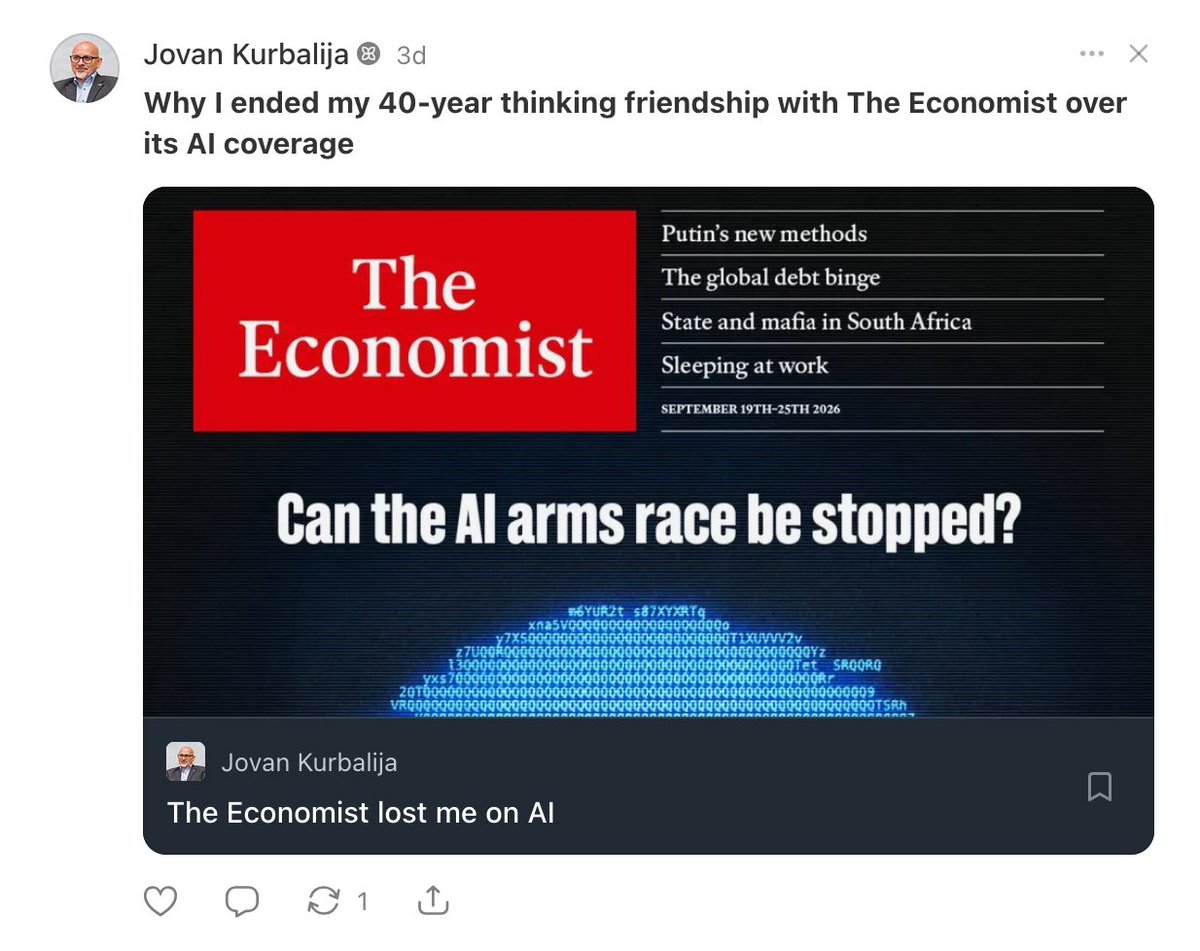
Smart takedown of The Economist's sensationalist and lazy AI reporting, starting with the mistaken analogy of AI & nuclear bombs by @jovankurbalija.
Worth reading, includes a link to a line-by-line analysis of the "Can the AI arms race be stopped?" piece.
https://t.co/gVqBxACt9j
The most depressing thing is that I don’t think any of the press stenographers, the cultists making trillions warning you about a fictional machine god while their error prone products cause chaos, the captured law makers, will face what they’ve done when its all said and done.
In his first book taking direct aim at philosophy, On the Equality of All Things, Carlo Rovelli doesn't hold back.
He targets analytic philosophy's return to realism, which he argues has either failed to reckon with the science of Einstein and Bohr, or gotten stuck insisting that mind, spirit, or consciousness must be something special.
In this interview with the IAI's Ozbir Kip, Rovelli makes his case plainly: electrons and minds, stones and laws, judgments and galaxies are not fundamentally different in nature.
Neither science nor philosophy, he argues, will ever reach ultimate reality.
Tap here to read the interview in full. https://t.co/JIXPkahyqS
"It surprises me that this counts as a radical proposal, but here it is: If you are losing your ability to evaluate the models you have now, maybe don’t let them build models you’ll be even less capable of controlling in the future" @ezraklein
https://t.co/SHsOD266eD
No, LLMs do not feel pain simply because there is a cluster in language space correlated with how people use language about pain in a certain set of contexts.
I believe this argument to be flawed, and will write more about it in October.