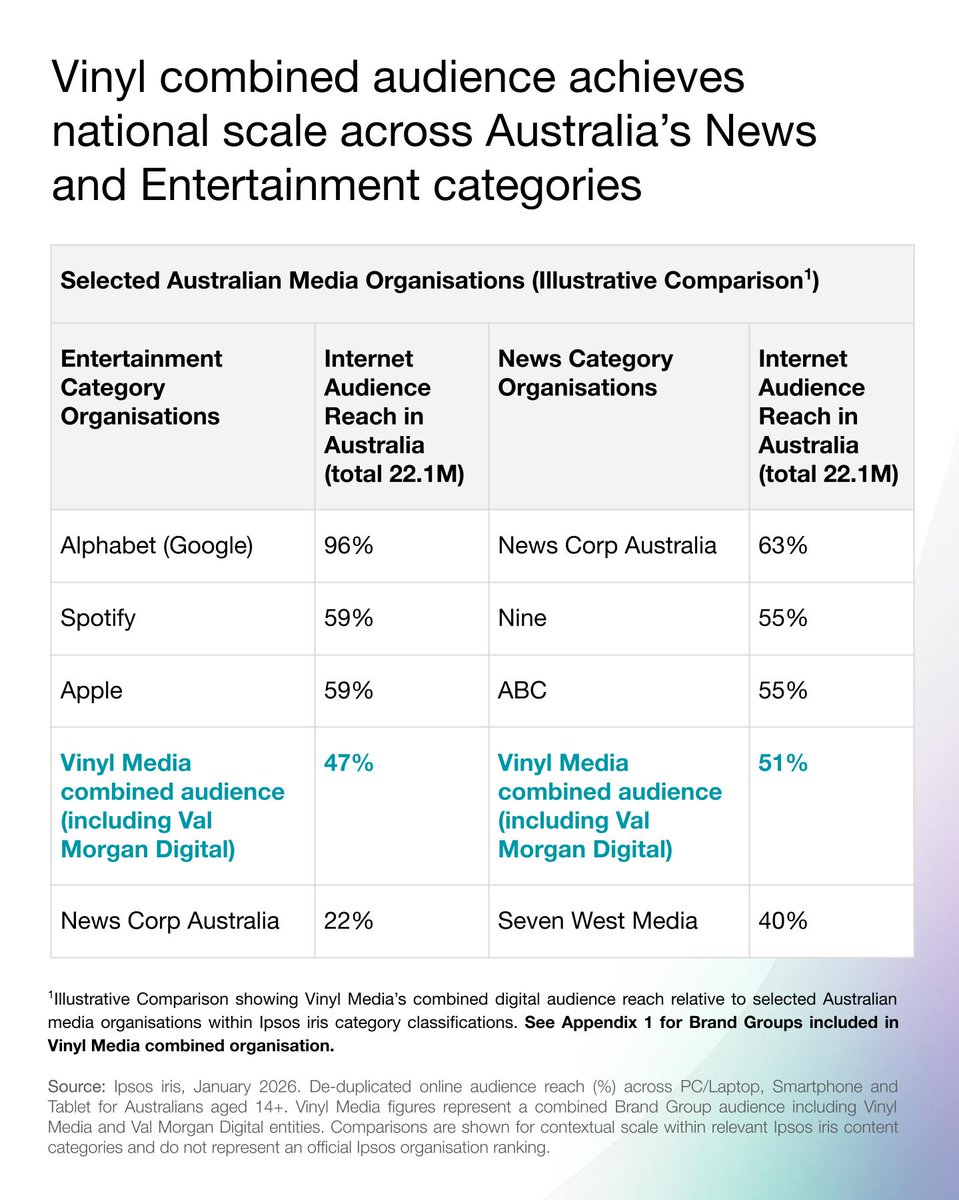
On Monday we announced the acquisition of Val Morgan Digital and welcomed Damian Keogh to the @VNLASX Board.
Today I wanted to share why this matters.
Adaptive Media is built on a simple belief.
You cannot simply prompt your way to cultural relevance. AI is rapidly reducing the cost of producing content, targeting audiences and optimising campaigns.
Supply is exploding. However, attention is not.
The scarce asset is trusted cultural reach.
With this transaction, Vinyl Media now operates at national scale across Australia’s News and Entertainment categories, with audience reach comparable to the country’s largest advertising companies.
That scale is not built on a single publication or platform. It comes from consolidating culturally relevant brands that audiences actively choose to engage with every day.
When combined, these assets form something much more powerful than traditional publishing.
They become cultural distribution infrastructure.
AI strengthens this model rather than threatening it. It improves efficiency, personalisation and commercial yield, while the underlying cultural relevance remains defensible and difficult to replicate.
Every brand in the world is chasing relevance because relevance drives outcomes. Impressions are fine, but recall, trust and conversion is the clear opportunity in front of us.
Build a platform anchored in culture, amplified by technology, and operating at meaningful national scale. Prove the model at home, and then scale globally.
This is what Adaptive Media looks like in practice.
Almost two years since our last podcast, and fresh from our recent online dispute, @timburrowes and I sat down together yesterday for a conversation, recorded for your audible pleasure.
I’m glad we were able to resolve things sensibly and have an open and robust conversation about the future of publishing, the commercial realities facing media businesses and, inevitably, AI.
Listen here 👇
https://t.co/qciX1MNOe1
Our big picture vision at @VNLASX Group is to build and scale a tech-enabled media company, which provides engaging and relevant content for consumers, and a strong value proposition for advertisers.
FY26 was a year of scaling and reshaping Vinyl Group for the next phase.
Revenue grew 31% to $18.9m, primarily through organic growth, gross profit margin increased to 42.1% in line with forecast, and net loss was almost halved year-on-year.
We also completed the acquisitions of Val Morgan Digital, Pedestrian Group and Time Out Australia, taking Vinyl Media’s reach to more than 50% of Australians online.
We enter FY27 with a stronger platform, a lower ongoing cost base and a clear pathway to profitability.
For FY27, we are forecasting revenue of $38m to $40m and targeting a sustainable cash-positive run-rate by the end of 1H.
The next phase is about turning that scale into revenue: deeper agency access, new products and trading models powered by programmatic, automation and AI, more premium video, branded content and creator inventory, and accelerating our direct-to-client business.
Read the full update 👉 https://t.co/0v2XC7MbQY
Statement from Vinyl Group CEO Josh Simons on Mumbrella Reporting and Press Council Process
Vinyl Group welcomes scrutiny. We are a publicly listed company operating across media, music and technology, and we accept that our strategy, performance and leadership will be questioned.
What we do not accept is a sustained pattern of inaccurate reporting, unsupported speculation, personal abuse and commercial denigration presented to the market as informed industry analysis.
Between February 2025 and July 2026, we reviewed more than 30 Mumbrella articles and podcast episodes substantially dedicated to Vinyl Group. The review was not exhaustive. It identified recurring factual inaccuracies, opinion presented within news reporting as though it were established fact, unrelated historical material repeatedly inserted into new stories, undisclosed conflicts of interest and increasingly hostile commentary about our strategy, people and journalism.
The volume and hostility of the coverage increased following Vinyl Group’s acquisition of Mediaweek, a publication operating in the same trade-media market as Mumbrella.
For many months, the attacks were directed primarily at me. I largely chose not to respond. Being criticised personally is an occupational hazard of leading a public company.
That changed when Mumbrella began targeting the work of our writers and other hard working team members.
In the week beginning 20 July alone, Mumbrella published five articles, two newsletters and a podcast substantially focused on Vinyl Group. Across that concentrated burst of coverage, Mumbrella and its proprietor, Tim Burrowes, described Vinyl’s strategy, communications and journalism as “semi-delusional”, “verging-on-delusional”, “bombastic”, a “publishing circus”, a possible “face-saving move”, the work of an “enthusiastic collector of brands”, a “piece of crap” and “editorial slop”. Since then, Burrowes has also described what we are building as “fantasy”.
Tim Burrowes also suggested that advertisers may become embarrassed to associate with our brands, groundlessly speculated that a newly appointed executive would replace me as CEO, and falsely assumed that a human-written article produced by one of our journalists was AI-generated.
Burrowes’ succession speculation misunderstands the nature of Vinyl Group as a founder-led business. I developed the strategy, have led the company through its transformation and remain fully committed to executing its next phase. Building and attracting a stronger executive team is evidence of my effectiveness as a founder CEO, not evidence of an undisclosed succession plan.
More importantly, the article Burrowes denigrated was not AI-generated, as he claimed. It was written by a journalist, and Concrete Playground was not the publication on which the AI workflows described in our strategy were being trialled. Those trials were being conducted on Blunt, as disclosed.
Tim Burrowes and Mumbrella therefore selected an unrelated article, falsely treated it as evidence of our AI strategy and described the journalist’s work as a “piece of crap” and “editorial slop” without making any inquiry into how it had been produced. That is not scrutiny of corporate strategy. It is abuse directed at a writer who had nothing to do with the broader business proposition being criticised.
Tim Burrowes and Mumbrella have also repeatedly inserted personal allegations concerning Richard White into reporting about Vinyl Group, despite Richard not being a direct shareholder and having no operational role in the company. RealWise, of which Richard is the beneficial owner and sole director, is a shareholder, but Richard does not control Vinyl’s operations, management or editorial decision-making. The pattern has also extended to the casual distribution of my non-work phone number to Mumbrella staff and external contractors, and the manipulation of my image to create an unflattering depiction despite the availability of approved photographs.
In just the last week, our investor relations team was required to seek corrections to Mumbrella reporting that:
- confused cash receipts with revenue;
- misrepresented our 15x workflow efficiency metric as a commitment to produce 15 times more articles;
- misrepresented our 95%+ quality metric as AI content being “95% as good as human output”;
- initially presented the statutory 0.4-quarter funding calculation without the normalised 3.81-quarter runway disclosed in the same Appendix 4C; and
- incorrectly interpreted our audience reporting.
Tim Burrowes was expressly told that Vinyl’s editorial model is human-first and technology-enabled. He was told that the 15x metric relates to specific story-sourcing and curation workflows, not automated article output. He was told that the 95%+ metric means existing editorial and SEO standards were maintained while those workflow efficiencies were achieved.
Despite those clarifications, the same false characterisation continued.
It was also suggested that Vinyl deliberately released its strategy presentation four minutes after its Appendix 4C to obscure or distract from the quarterly results, when both documents had been uploaded simultaneously before market open and the timing and sequencing of their release were controlled by the ASX.
Vinyl’s strategy is not hidden. We have published a strategy update at the beginning of every financial year since I became CEO and provide further strategic updates several times each year, in addition to our minimum reporting obligations.
Our model is straightforward. We acquire trusted brands and cultural assets with established audiences at attractive prices, integrate shared commercial and technology infrastructure, and create scale effects across the portfolio.
We have completed approximately 10 transactions in three years and, on average, acquired businesses at discounts of approximately 90% to the values previously attributed to them through earlier sales or capital raisings.
Some of those businesses were distressed, neglected or mismanaged. That was the opportunity.
The work of rescuing and integrating them has been difficult and, at times, messy. Aggregation is difficult. Turnarounds are difficult. But Vinyl has preserved brands and journalism assets that may otherwise have disappeared, while building audience reach far faster and cheaper than could have been achieved organically.
With the support of our investors, Vinyl, under my leadership, has made one of the most significant commitments to independent media in Australia in the past decade, preserving mastheads, audiences and journalism jobs that may otherwise have been lost.
Mumbrella has also left unmoderated reader comments accusing the company of “smoke and mirrors” and deception in how it characterises its audience growth and financial performance. So let me be clear: as previously disclosed, the company delivered 28% year-on-year organic growth in cash receipts and increased its Australian web audience reach from 26% in FY25 to 55% in FY26, based on January 2026 Ipsos data. That 55% figure relates to native web audience alone and excludes social and platform reach. Including social and platform performance, monthly content views across Vinyl’s properties have increased more than 100-fold since our first publishing acquisition in 2024, as disclosed in last year’s annual report, generating many billions of impressions and consistently exceeding 100 million impressions each month.
Reasonable people may disagree with our thesis that trusted mastheads will become more valuable as signal beacons in an AI-saturated world. What is not reasonable is for Tim Burrowes and Mumbrella to repeatedly misstate the thesis, attack the company on the basis of that misstatement, and then present the resulting confusion as evidence that the strategy cannot be understood.
Ironically, Mumbrella itself may not entirely disagree. On 27 July, it published an opinion piece by Dan Monheit titled The Infinite Half-Life of Earned Media: LLMs Just Rewrote the Rules of ROI.
Thus far we have chosen not to litigate.
Instead, Vinyl prepared and submitted a complaint to the Australian Press Council on 6 July, before the most recent escalation in rhetoric. We did so because we believed the appropriate first response was independent consideration through journalism’s own accountability framework.
The Press Council subsequently advised that it would not exercise its discretion to consider the complaint because Mumbrella was no longer a constituent body. That was a jurisdictional outcome. It was not a determination on the merits.
This matters because Tim Burrowes and Mumbrella report to a concentrated commercial audience that includes investors, advertisers, executives, prospective employees, acquisition targets and strategic partners. Mumbrella’s reporting is also indexed by search engines and incorporated into AI-generated summaries.
Vinyl is now aware of investors, including members of our top-five shareholder group, encountering AI summaries asserting that the company has lost forecast credibility.
Mumbrella has repeatedly asserted that Vinyl has lost forecast credibility and is itself the principal source of that repeated assertion. The cash-flow milestone on which that assertion has focused was for Vinyl to become cash positive in the December 2025 quarter. We achieved it.
Repetition does not make a false proposition true. It does, however, make it more likely to be absorbed by search engines, AI systems and stakeholders who may never read our ASX disclosures.
That is no longer merely offensive. It is commercially harmful.
We understand that risk particularly well because our Adaptive Media strategy recognises that, in an AI-enabled information environment, repeated online signals increasingly shape search results, AI-generated summaries, brand perception and commercial decision-making. That is precisely why trusted brands and credible journalism matter more, not less.
Vinyl Group is seeking an executive-level discussion with Simon Grover, Managing Director of The Intermedia Group, Mumbrella’s parent company. As part of that discussion, we will ask The Intermedia Group to review the conduct and coverage of Tim Burrowes and Mumbrella across its website, newsletters and podcasts against Intermedia’s own published Editorial Code of Practice, including its requirements concerning accuracy, fairness, rights of reply, emotive language, corrections and offensive language.
Separately, we will publish our Press Council complaint and supporting materials so that shareholders, advertisers, journalists and other stakeholders can review the evidence for themselves.
We remain open to a constructive resolution. However, the repeated publication of false statements concerning Vinyl’s business is now causing identifiable commercial harm, and we are preserving all legal rights available to the company.
Shareholders should also understand that the company does not expect to incur material legal fees in reviewing this matter or, should it choose to pursue it, taking further action. The company’s longstanding media counsel considers the issue important on a broader industry level and has agreed to cap his fees. Any decision to commence proceedings would remain subject to appropriate Board oversight.
Our strategy may be debated. Our performance may be scrutinised. I may be criticised personally.
But our journalists should not be abused, their work should not be falsely described as AI-generated, and inaccurate narratives should not be repeated so frequently that investors and other stakeholders reasonably mistake them for established fact. Nor should our writers have to work under the threat that their ordinary reporting will be mislabelled and publicly ridiculed to serve a predetermined narrative.
ENDS
@ajar_scarab I get that - felt a little that way after the first screening. Saw it again today and felt more connection with the characters and the ordeal of the odyssey fwiw
Last Sunday, we had date night at the biggest cinema screen in the Southern Hemisphere to see The Odyssey in 70mm IMAX.
Christopher Nolan has been my favourite director for as long as I can remember. He is one of the few filmmakers where the director is the drawcard rather than any single member of the cast, although this cast is stacked. The film was epic in every possible respect.
Even better was getting to experience it with my favourite person 💚
Legacy media was built to broadcast. Social media was built to target. The next media model will be built to understand and act.
Today I have written about the idea at the centre of the @VNLASX strategy: Adaptive Media.
As generative AI makes content increasingly abundant, trust, context and cultural authority become more valuable. Brands need more than impressions or algorithmic targeting. They need a credible way to understand culture and participate in it.
Adaptive Media connects trusted cultural assets, audience and campaign intelligence, creators, technology, commerce and distribution. It creates a feedback loop in which every campaign makes the next one smarter.
That is the company we are building at Vinyl.
Read my op-ed on @MediaweekAUS 👉 https://t.co/EZyf7NGvnb
Today @VNLASX released its Q4 FY26 results and FY27 Strategy Update.
The completion of three acquisitions has fundamentally transformed Vinyl, with Val Morgan Digital, Pedestrian Group and Time Out Australia all joining Vinyl during Q4.
The headline cash result reflects substantial one-off integration and redundancy costs, together with the delayed timing of collections from the acquired businesses. After adjusting for those items, underlying operating cash burn is at approximately $0.4m on a pro forma basis, demonstrating that the larger business is operating near breakeven.
Across FY26, customer receipts grew 28% to $18.4m, despite including only one month of collections from Val Morgan Digital and no material contribution from Pedestrian Group or Time Out, underscoring the strong underlying organic growth profile of the business.
We now enter FY27 with:
• a media portfolio reaching approximately 55 per cent of Australians online
• materially improved operating efficiency
• strengthened commercial leadership
• expected Q1 customer receipts of $7M +
• an FY27 revenue forecast of $38m to $40m
We have spent three years assembling the platform. FY27 is about integration, commercial execution and sustainable profitability.
See our comprehensive investor strategy presentation on Investor Hub 👉 https://t.co/dqPNWlvTyG
@vnlasx And because every leadership announcement deserves a dramatic extended universe poster... this is how it looks in my head, in case anyone was wondering.
.@VNLASX has grown rapidly. The next phase is about turning that expanded platform into a more integrated, efficient and commercially powerful business.
Today we announced two important additions to our leadership team.
Lucie Caswell joins as Chief Business Strategy Officer, leading our global publisher and partner relationships while supporting group-level business development and M&A.
Kurt Burnette joins as Interim Chief Commercial Officer, leading our consolidated strategy across advertising, branded content, partnerships and platform revenue.
Both bring deep experience directly relevant to the opportunity ahead of us. I am excited to have them joining the team as we begin the next phase of Vinyl’s growth.
.@MediaweekAUS today unveils its refreshed website, marking the next step in @VNLASX’s wider rebuild of its publishing infrastructure.
The new site delivers a cleaner, faster and more modern reader experience, with improved navigation, refreshed article layouts, a dedicated podcast section and an upgraded Morning Report and newsletter experience.
Mediaweek is the latest title to move onto Vinyl Group’s centralised media CMS, following The Music Network. The platform is now being progressively rolled out across our portfolio, delivering faster load times, stronger security, improved SEO and GEO compatibility, and a more efficient model where improvements can be deployed across multiple sites at once.
The relaunch also introduces a refreshed brand identity and a bold, tabloid-inspired design language that gives Mediaweek a more modern digital expression while respecting the authority it has built across Australia’s media, marketing and advertising industries.
Congratulations to Natasha Lee and everyone involved in bringing the new Mediaweek to life.
Explore the new site at https://t.co/qdNBqNv9Q4.
Restructuring a business so it can survive is not the same as stripping it for parts. Pedestrian needed a sustainable home and a reset. We will treat affected staff respectfully, but our goal remains exactly what I said: protect the brands, the audience and the culture for the long term.
It has been a crazy week, in the best possible way.
Yesterday we announced @VNLASX’s acquisition of @pedestriandaily.
Today we announced that Vinyl has also signed an agreement to acquire Time Out Australia, alongside a strategic integration capital placement to support the work ahead.
Time Out is one of the world’s great culture brands. Food, travel, entertainment, city discovery, real-world experiences. It sits beautifully alongside Concrete Playground, Rolling Stone Australia & New Zealand, Refinery29, Mediaweek Australia and the rest of the Vinyl Media portfolio.
Honestly, I am not sure it has fully sunk in yet that BuzzFeed Australia, LADbible Group, Pedestrian and now Time Out Australia have all joined or partnered with the Vinyl ecosystem in such a short period of time.
This is the Vinyl flywheel coming to life.
We are combining premium cultural assets into an integrated ecosystem, expanding audience reach, delivering stronger outcomes for advertisers, and cementing Vinyl’s position as the acquirer of choice for both sub-scale cultural operators in Australia and international culture brands that want to maintain and grow their presence here.
The value of that ecosystem compounds as it scales: bringing together culturally important assets inside a scaled Australian platform that can give them more reach, stronger commercial support, better technology and a clearer path to long-term sustainability.
With Pedestrian, Vinyl Media’s combined online audience reach increased to approximately 53% of Australians online. With Time Out, that is expected to increase to approximately 55%.
That is real national scale, in a balanced portfolio of licensed and original IP.
I am also incredibly grateful for the support shown by our strategic and institutional investors who participated in our integration capital raise this week. Their backing gives us a further $2.4 million to keep building properly, not just quickly.
There is a lot of work ahead. Integration is hard. Media is hard. Turnarounds are hard. But this week is a major step forward for the business we are building and the role we believe Vinyl can play in Australian culture.
A crazy week, in the best possible way.
Welcome to Vinyl, Time Out Australia.
Ps. register here to join me at our investor webinar at 1030am tomorrow 👉 https://t.co/3vTMs99kp7
I have read @pedestriandaily almost every day for as long as I can remember.
So it is a pretty surreal feeling to announce that @VNLASX has agreed to acquire Pedestrian Group from @Channel9.
This all came together quickly, over a matter of weeks, and completion is scheduled for next week. Until then, I just want to say how much respect I have for what this brand means to Australian youth culture, and for the people who have built it, written for it, sold it, produced it, defended it and loved it over the years.
Pedestrian is a special media asset. It is one of the great original digital culture brands in this country. It has a voice. It has history. It has an audience that actually cares.
There has been a lot said recently about media, about journalism, about cuts, about consolidation. Vinyl is part of that conversation as one of the consolidators. Some of it has been fair. Some of it has missed the point.
The point is this: we are not buying these assets to strip culture for parts. We are doing this because I believe these brands matter, and because the team I’ve built believes they can be made commercially stronger, more sustainable and more valuable inside a modern, technology-first company with the scale, focus and infrastructure to help them thrive.
That matters for audiences. It matters for journalists and creators. It matters for advertisers. It matters for staff. And yes, it matters for shareholders too.
Our job now is to prove that.
We cannot wait to meet the Pedestrian team properly next week and get to work.
Welcome to Vinyl 🟡
Great to see @VNLASX featured in the @FinancialReview MicroCap Monitor Magazine yesterday.
The article captures the core of what we’re building: a scaled media and technology business sitting at the centre of culture, creators, brands and commerce.
With the acquisition of Val Morgan Digital, Vinyl’s national digital audience reach now sits alongside some of Australia’s largest media organisations, giving us a stronger platform to execute on our Adaptive Media strategy.
Scale matters. Culture matters. Bringing them together is the opportunity.
Watch this space.
Originally published in the AFR MicroCap Monitor Magazine, May 2026, 2nd Edition, Wednesday 20 May 2026.
I’ve been following the CGT and trust tax debate closely since the Budget.
I understand the Government’s argument around fairness. But I think there is a real risk here of accidentally punishing the exact behaviour Australia needs more of: people taking risk, building companies, hiring people, and giving staff genuine ownership in the upside.
The startup community is already making the point that removing the 50% CGT discount hits founders, early employees and investors differently to passive asset holders.
I agree with that.
But there are a couple of nuances I don’t think are being discussed enough.
Even if the Government carves out an exception for startup founders and employees, many founders and employees hold shares or options through discretionary trusts, often because that was sensible advice at the time.
Under the current regime, a founder or employee on the top marginal rate could expect an effective CGT rate of around 23.5% after the 50% discount.
Under the proposed trust changes, that same person could still be pushed up to a 30% minimum tax rate through the structure, even if the underlying startup carve-out is addressed.
That matters.
Earlier this month, our staff became participants in the company ESOP. These policies do not just affect founders. They affect the people founders are trying to bring along for the journey.
There’s also another angle worth considering.
If the Government were prepared to preserve or selectively retain concessional treatment for certain parts of the public market - particularly microcaps and emerging growth companies - it could actually strengthen Australia’s early-stage ecosystem.
Younger Australians increasingly struggle to access meaningful upside through traditional assets like housing, where barriers to entry are now extremely high. Early-stage public companies remain one of the few asset classes where ordinary people can still back ambitious ideas early, without a huge deposit, leverage or institutional access.
More liquidity and participation at that end of the market would help not just investors, but the companies themselves: attracting talent, executing transformational deals, and competing globally for growth capital.
If Australia wants more innovation, more risk-taking, and broader ownership participation, we need policy settings that encourage people to build and back the future - not just preserve incumbency.
I’m not interested in turning this into a partisan pile-on. I’m interested in making sure the detail is right.
If anyone in my network is involved in the Government’s consultation process on this, I’d be happy to add another voice from the founder and operator side.
These are my personal views.