🚨 Three Anthropic researchers went public last night with chilling concerns about out-of-control AI, warning it could destroy humans this decade. https://t.co/xKApapPlGW
Dreaming of the chance to do the best work of your life with great humans, while still actually having the personal workweek flexibility that modern life demands? 👀 👇
https://t.co/1MGJgWdZk8
A fair few new follows from this. Hey Losties 👋🏻
If you want more breakdowns about LOST including The Others, the Dharma Initiative, Time Travel, Walt, and way more, I have 26 videos explaining it all:
https://t.co/xjIAnoL4ZW
WTF did Apple do to the iPhone keyboard? Because why am I fighting for my life just to type a simple sentence? I can’t type anything without making 137 typos.🤦🏽♀️
We tell young people in our society that end of the rainbow is retirement at 65.
We ought to tell them that "there is going to be this short but beautiful golden window from roughly age 3 to roughly age 12 where your kids are not only easy (comparatively to bottles & diapers), but are going to be these beautiful little creatures and it will pain your heart to be away from them for too long. So, prepare in your 20's, financially and career wise, to build that flexibility into that chapter of your life".
You don't get another shot at living the "golden window". And, for me, leaning hard into that golden window has made everything else in my life feel fairly insignificant in comparison. I have made plenty of mistakes as a father, but what I won't have is the regret of having been distracted and absent from these formative years. In some cases, that has required financial sacrifices (declining a particular career opportunity that would have required relocation), but I personally have zero regrets.
I also hear from some ambitious & successful people with a 4 year old that say "I've lost my ambition, I am so immersed in fatherhood". At least for me, and a number of my friends, it comes back. You can't keep an ambitious person down and if you have the fire, hanging at a playground on too many Tuesday afternoons is going to feel like torture after too long.
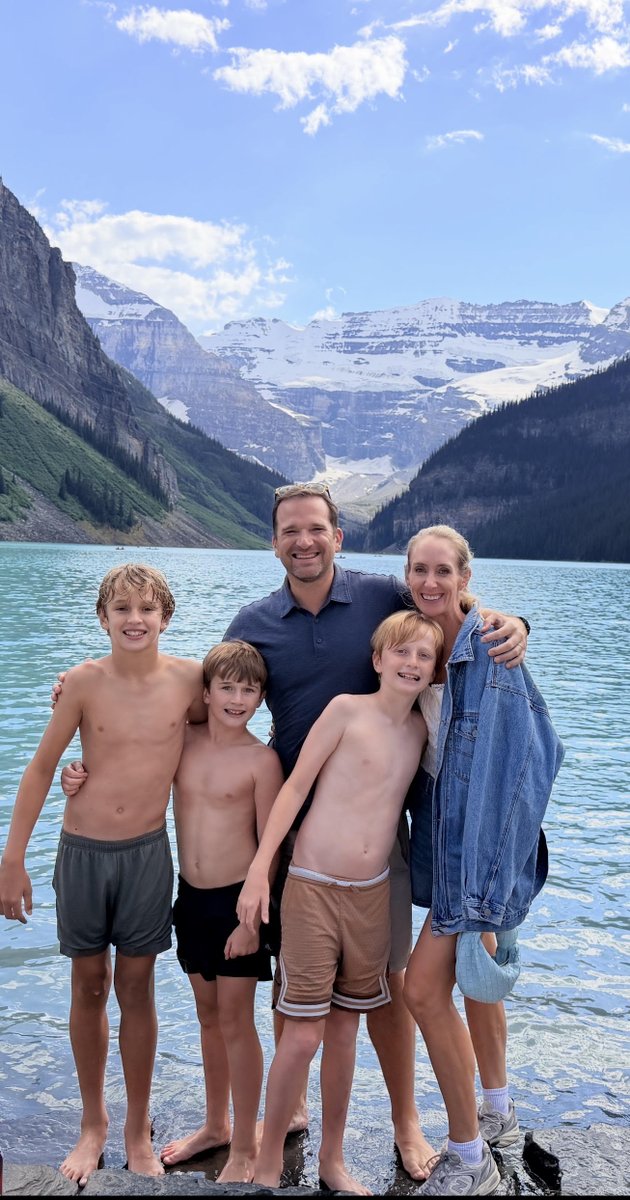
My three boys are approaching 13, 11 & 9, and it's much different than 7, 5 & 3. This summer, for example, they slept until 11am and I hard an unencumbered 6am-12pm to work (being on PT helps), then got another great window 7-11pm, but was able to be present in the heart of the day, then weeks when they were at basketball camp, etc. It gets easier, your time frees up again (there's a sadness to that too), but I'm back to working as intensely as I did pre-kids just because my day to day presence requires fewer hours than it did before (also, my wife is just superbly wonderful). And that is the beautiful gift of entrepreneurship (or at least my sort of business), the ability to deliver still a high level of output but work that around your life rather than the opposite.
TLDR, grind before, and grind after. Prepare for the golden window.
I know why everything sucks...
...and it's because everything is fake
We are voting for fake candidates, who run on fake promises, inside a fake system that was never designed to fix anything.
We are raising kids in fake schools that teach fake history, fake science, which quietly produce fake adults who can't think for themselves.
Then they are getting fake college degrees that cost 4 years and six figures that teach fake education and they get fake jobs.
We are eating fake food, with fake ingredients, funded by fake research.
We are scrolling through fake lives, with fake relationships, who take fake, curated vacations to promote brands that make fake products.
We are watching fake news, about fake crises, produced by fake journalists, for fake outrage.
We are borrowing fake money that was printed from nothing, to fund a fake economy that would collapse in an afternoon if people stopped pretending it was real.
We are buying fake organic food that's just a paid label, and drinking fake juice with two percent juice in it, and putting fake cheese on cheeseburgers that's just "cheese product" on fake burger meat.
We are donating to fake nonprofits where the moeny never makes it to the people and then funding fake foreign aid that buys real weapons to prop up fake governments.
We are going to fake therapy that teaches fake coping skills instead of telling you hard truths.
We are buying fake furniture made of fake wood that's actually compressed sawdust and glue that looks like wood, ships in fourteen boxes with instructions written in a fake language that isn't quite any language, requires tools it doesn't include, takes 4 hours to build, wobbles on day 1, and is totally destroyed in 6 months.
We are downloading fake "free" apps that charge a subscription after three days for AI features that don't work, hidden behind a paywall we didn't see, protected by a privacy policy we didn't read, buried inside Terms of Service written by lawyers specifically so we wouldn't read them, that we agreed to by tapping a button the size of a thumbnail, that gave a company we've never heard of the right to sell our data to companies we'll never hear of, to build a profile on us we'll never see, to influence decisions we'll never know were made.
IT. IS. ALL. SO. FREAKING. FAKE.
And we all yearn for what was once real.
Don't you remember? Did you forget?
There was a time with a simple handshake between men was a contract.
When bread went stale because... well, that's what real bread does!
When kids played outside all day until it was dark, and nobody tracked them.
When a family could live off a single income.
When music was made by people who LIVED something real and you could feel it.
When schools was HARD... and that was the point!
When doctors knew your name and your family, they even came to your house,
When you bought something once... and it was yours forever.
When the chair your grandmother bought once lasted 70 years and she passed it onto your dad.
And now nothing is real, and that's why everything sucks.
Morning, Tiger fans.
Skubal’s gone. Who’s next? Probably Gleyber Torres by Monday.
Sad day in Detroit. The white flag is up. Another rebuild. We all thought we were past this.
The answer was simple all offseason: sign Tarik Skubal. You had the best pitcher in baseball, and instead of building around him, you traded him. That’s baseball malpractice.
Chris Ilitch is one of the wealthiest owners in baseball. If you’re not willing to spend to keep the best pitcher in the game and build around a team that’s already proven it can compete, then sell the team to someone who will.
Here’s what makes this so frustrating: this wasn’t a bad baseball team. They’re still +52 in run differential despite being under .500. Good teams don’t outscore their opponents by that much by accident. The biggest problem wasn’t the starting rotation—it was the bullpen. Fix the bullpen instead of waving the white flag, and this team had a legitimate chance.
And here’s the ironic part: even if they trade Gleyber Torres, this team still has a chance. If they can somehow patch together the bullpen and a couple of relievers get hot, they can still make a run. That’s what makes this decision so frustrating. The window wasn’t closed—they chose to close it.
Instead, they chose another rebuild.
We’ll never know how far this clubhouse could’ve gone because ownership never gave them that chance.
This fan base deserved better. Those players deserved better. Detroit deserved better.
#DetroitTigers #RepDetroit #VandyOnTigers #VandyDandyReport
🎧Patents are often reduced to slogans like "patent monopolies" and assigned the political blame for high drug prices and limited patient access to medical breakthroughs. But as Eira co-director Bo Heiden explains on @AuroraPatents' Patently Strategic podcast, the real story is much more complicated.
Listen to the episode ⬇️
https://t.co/sH0oV7K8WL
A third grader just scored a 5 on AP Calculus BC. The system that trained him contains no LLM. The core is a knowledge graph one man spent 250 hours encoding by hand, two minutes per edge.
The platform is Math Academy. Its "AI" is an expert system that routes each student through nearly 3,000 math topics, from 4th grade arithmetic to the math behind machine learning. Every node, every prerequisite link, every weight was placed manually by a team of mathematicians.
The weights alone took Justin Skycak a full month: 1,500 topics at the time, roughly 5 prerequisite links each, 2 minutes to estimate each one. 8 hours a day of pure encoding, done before ChatGPT existed to ease the load.
Why go through that? Because the graph unlocks mastery learning, the closest thing education research has to a cheat code. In 1984, Benjamin Bloom showed that students with one-on-one tutoring perform two standard deviations above a regular classroom. The average tutored kid beats 98% of the lecture hall.
Nobody could afford a tutor per child, so the finding sat in journals for 40 years. A prerequisite graph with a mastery gate is the workaround. The system always knows the exact next topic a specific kid is ready for, drills it until proven, then moves on. Zero time spent waiting for 29 classmates.
That waiting is most of school. A year of classroom math is roughly 150 hours of instruction, and the majority goes to pacing, review, and re-teaching. Strip it out and a motivated kid covers six grade levels in one calendar year.
The origin makes it better: this grew out of a math program at Pasadena High School where 8th graders were passing AP Calculus BC, back when the founders were still hand-grading the whole thing.
The most effective education AI running today is a graph a few humans built by hand, one edge at a time.
You have noticed it. ChatGPT feels dumber than it used to. Your prompts that worked six months ago produce worse results now. The writing sounds flatter. The ideas sound safer. The internet itself feels like it is shrinking. Every article reads the same. Every email sounds the same. Every answer sounds like it was written by the same voice.
You thought it was you. It is not you.
Researchers at Oxford and Cambridge published a paper in Nature proving what is happening. They call it Model Collapse.
Here is the mechanism in one sentence. AI trained on AI-generated data gets dumber every generation until it forgets what real human data looked like.
The internet is filling with AI-generated content. Blog posts. Articles. Reviews. Comments. Social media. AI companies scrape the internet to train the next generation of models. Which means the next generation of AI is being trained on the output of the current generation.
Each cycle loses information. Not randomly. It loses the rarest, most unusual, most creative parts first. The researchers call these the "tails of the distribution." The weird ideas. The unexpected perspectives. The things that made the internet feel human. Those disappear first.
What remains is the average. The safe. The expected. The bland.
Then the next generation trains on that. And loses more. And the next generation trains on that. And loses more. The researchers proved this is not a slow decline. Major degradation happens within just a few iterations. Even when some of the original human data is preserved.
They tested it on large language models. On image generators. On statistical models. The pattern was the same every time. The output converges toward a narrow, flattened version of reality that looks nothing like the original data.
The lead researcher put it plainly. "Large language models are like fire. A useful tool. But one that pollutes the environment."
The pollution is invisible. You cannot see which sentence on the internet was written by a human and which was written by AI. Neither can the AI that is about to train on it. And once the tails are gone, they do not come back. The damage is irreversible.
This is not a prediction anymore. It is a diagnosis.
The internet you grew up on was built by humans writing things no algorithm would have written. Strange, personal, imperfect, alive. That internet is being diluted. One generation of AI at a time. And the models trained on what remains are learning a smaller and smaller version of the world.
Model Collapse is not a technical problem. It is a cultural one. The thing that made the internet worth reading is the thing that disappears first.
Gilligan’s Island Theme Song in Dark Metal 🎸
This is as weird as it is awesome!
If you’re a Gilligan’s Island kid, you have to listen to it.
What do you think? Leave your review in the comments.
⚡️Children remember the moments when the family becomes fully alive.
That is the core. Vacation is just the common vessel.
A child does not encode childhood as a spreadsheet of responsible parenting.
They encode atmosphere.
They remember the motel pool, the gas station stop, the smell of sunscreen, the weird restaurant, the long drive, the sunset, the parents laughing differently, the feeling that normal life cracked open and something larger appeared.
That is why ages 5 to 10 hit so hard. The child is old enough to form durable narrative memory and young enough for the world to remain enchanted. Parents still feel mythic. A beach, cabin, lake, theme park, road trip, or even a cheap rented house can become sacred geography.
The real mechanism is interruption of routine plus emotional safety.
Ordinary life teaches stability. Trips create myth. The family leaves the repeating loop of school, work, chores, screens, exhaustion, and time pressure. For a few days, the child experiences parents outside their normal roles. Mom and dad are no longer just managers of homework, food, discipline, bedtime, and logistics. They become companions inside an adventure.
That imprints.
The money matters far less than parents think. Luxury is mostly adult vanity. Children remember intensity, freedom, attention, surprise, and togetherness. A $200 trip can beat a $10,000 trip if the child feels wonder and the parents are emotionally present.
Many adults are starved because their childhood had no sacred interruptions. Everything was duty, stress, survival, noise, pressure, or emotional absence. No mythic family scenes. No private homeland in memory. No recurring proof that life could be warm and strange and alive.
That matters for the adult psyche. People draw from childhood memories during loneliness, fear, ambition, loss, and love. Those memories become inner architecture.
Deepest compression: a good childhood is not built only by protection. It is built by unforgettable shared worlds.
Take the kid somewhere. Break the loop.
Make the ordinary world disappear for a few days.
That becomes part of them forever.