You can now query your lakehouse data in real time at <10ms latency! Any table, just faster, at 12,000+ QPS, on the existing open data formats. Powered by what @rxin's team affectionally called Reynold's Dream Engine (Reyden).
Thoughts from delivering with AI.
requirements / intent > trustworthiness > evidence > proprietary data > design > implementation
It feels like everything is changing, but the critical parts are still the same.
You can use @ApacheParquet for Vector Search with embedded indexes:
> We don’t change the file format; we just tune it.
@MOVNTDQ explains how in https://t.co/39IMeYYO7A
Software development is undergoing a renaissance in front of our eyes.
If you haven't used the tools recently, you likely are underestimating what you're missing. Since December, there's been a step function improvement in what tools like Codex can do. Some great engineers at OpenAI yesterday told me that their job has fundamentally changed since December. Prior to then, they could use Codex for unit tests; now it writes essentially all the code and does a great deal of their operations and debugging. Not everyone has yet made that leap, but it's usually because of factors besides the capability of the model.
Every company faces the same opportunity now, and navigating it well — just like with cloud computing or the Internet — requires careful thought. This post shares how OpenAI is currently approaching retooling our teams towards agentic software development. We're still learning and iterating, but here's how we're thinking about it right now:
As a first step, by March 31st, we're aiming that:
(1) For any technical task, the tool of first resort for humans is interacting with an agent rather than using an editor or terminal.
(2) The default way humans utilize agents is explicitly evaluated as safe, but also productive enough that most workflows do not need additional permissions.
In order to get there, here's what we recommended to the team a few weeks ago:
1. Take the time to try out the tools. The tools do sell themselves — many people have had amazing experiences with 5.2 in Codex, after having churned from codex web a few months ago. But many people are also so busy they haven't had a chance to try Codex yet or got stuck thinking "is there any way it could do X" rather than just trying.
- Designate an "agents captain" for your team — the primary person responsible for thinking about how agents can be brought into the teams' workflow.
- Share experiences or questions in a few designated internal channels
- Take a day for a company-wide Codex hackathon
2. Create skills and AGENTS[.md].
- Create and maintain an AGENTS[.md] for any project you work on; update the AGENTS[.md] whenever the agent does something wrong or struggles with a task.
- Write skills for anything that you get Codex to do, and commit it to the skills directory in a shared repository
3. Inventory and make accessible any internal tools.
- Maintain a list of tools that your team relies on, and make sure someone takes point on making it agent-accessible (such as via a CLI or MCP server).
4. Structure codebases to be agent-first. With the models changing so fast, this is still somewhat untrodden ground, and will require some exploration.
- Write tests which are quick to run, and create high-quality interfaces between components.
5. Say no to slop. Managing AI generated code at scale is an emerging problem, and will require new processes and conventions to keep code quality high
- Ensure that some human is accountable for any code that gets merged. As a code reviewer, maintain at least the same bar as you would for human-written code, and make sure the author understands what they're submitting.
6. Work on basic infra. There's a lot of room for everyone to build basic infrastructure, which can be guided by internal user feedback. The core tools are getting a lot better and more usable, but there's a lot of infrastructure that currently go around the tools, such as observability, tracking not just the committed code but the agent trajectories that led to them, and central management of the tools that agents are able to use.
Overall, adopting tools like Codex is not just a technical but also a deep cultural change, with a lot of downstream implications to figure out. We encourage every manager to drive this with their team, and to think through other action items — for example, per item 5 above, what else can prevent a lot of "functionally-correct but poorly-maintainable code" from creeping into codebases.
Super excited about this launch -- every Claude Code user just got way more context, better instruction following, and the ability to plug in even more tools
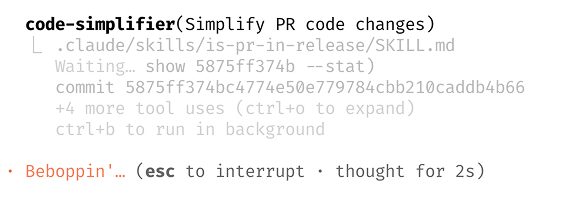
We just open sourced the code-simplifier agent we use on the Claude Code team.
Try it: claude plugin install code-simplifier
Or from within a session:
/plugin marketplace update claude-plugins-official
/plugin install code-simplifier
Ask Claude to use the code simplifier agent at the end of a long coding session, or to clean up complex PRs. Let us know what you think!
I'm Boris and I created Claude Code. Lots of people have asked how I use Claude Code, so I wanted to show off my setup a bit.
My setup might be surprisingly vanilla! Claude Code works great out of the box, so I personally don't customize it much. There is no one correct way to use Claude Code: we intentionally build it in a way that you can use it, customize it, and hack it however you like. Each person on the Claude Code team uses it very differently.
So, here goes.
Today's Future Data Systems Seminar Speaker: Ryan Johnson (CMU PhD'10) will present @DeltaLakeOSS's internal architecture and how it supports multi-statement transactions. Zoom talk open to public at 4:30pm ET. YouTube video available after: https://t.co/7wAvTyHExO
Our SIGMOD paper with @XinyuZeng218 + @huanchenzhang + @wesmckinn + @pateljm on creating a next generation open-source data file format is out. F3 is a future-proof file format avoids the mistakes of Parquet.
📄 Paper: https://t.co/fnFwN9gxbZ
📁 Code: https://t.co/R5nhlVvsea
when you get access to gpt-5, try a message like "use beatbot to make a sick beat to celebrate gpt-5".
it's a nice preview of what we think this will be like as AI starts to generate its own UX and interfaces get more dynamic.
it's cool that you can interact with the synthesizer directly or ask chatgpt to make changes!
I've had preview access to GPT-5 for a couple of weeks, so I have a lot to say about it. Here's my first post, focusing just on core characteristics, pricing (it's VERY competitively priced) and interesting details from the GPT-5 system card https://t.co/c2Xuf69wYB
going to try live-tweeting the GPT-5 livestream.
first, GPT-5 in an integrated model, meaning no more model switcher and it decides when it needs to think harder or not.
it is very smart, intuitive, and fast.
it is available to everyone, including the free tier, w/reasoning!
The new ChatGPT "study mode" feature appears to be entirely implemented as a carefully crafted system prompt - thankfully OpenAI mostly don't take measures to protect those these days so it's easy to extract it and see how it works