"A close companion can tug on Betelgeuse and change how much material the red supergiant loses through its wind in the final stages of its life. That extra mass loss might affect the outer layers of the star and the way it eventually explodes."
1/8
In 2025, Gemini North data gave only a weak 1.5σ hint of a companion near #Betelgeuse — a signal just strong enough to notice.🔭
The new VLT/SPHERE data raise the detection to a solid 6.1σ level (5.1σ with another method), making the result far more convincing & confirming the same location.
https://t.co/d1fwYv9IXt
On this day in 1925, physics laureate Werner Heisenberg submitted a paper that revolutionised quantum mechanics.
Heisenberg was only 23 years old when he submitted the paper "Quantum mechanical reinterpretation of kinematic and mechanical relations". For this theory and the applications of it which resulted especially in the discovery of allotropic forms of hydrogen, Heisenberg was awarded the Nobel Prize in Physics for 1932.
His new theory was based only on what can be observed, that is to say, on the radiation emitted by the atom. We cannot, he said, always assign to an electron a position in space at a given time, nor follow it in its orbit, so that we cannot assume that the planetary orbits postulated by Niels Bohr actually exist. Mechanical quantities, such as position or velocity should be represented, not by ordinary numbers, but by abstract mathematical structures called “matrices” and he formulated his new theory in terms of matrix equations.
Learn more about Heisenberg's work in his Nobel Prize lecture: https://t.co/5QRdnhbX2L
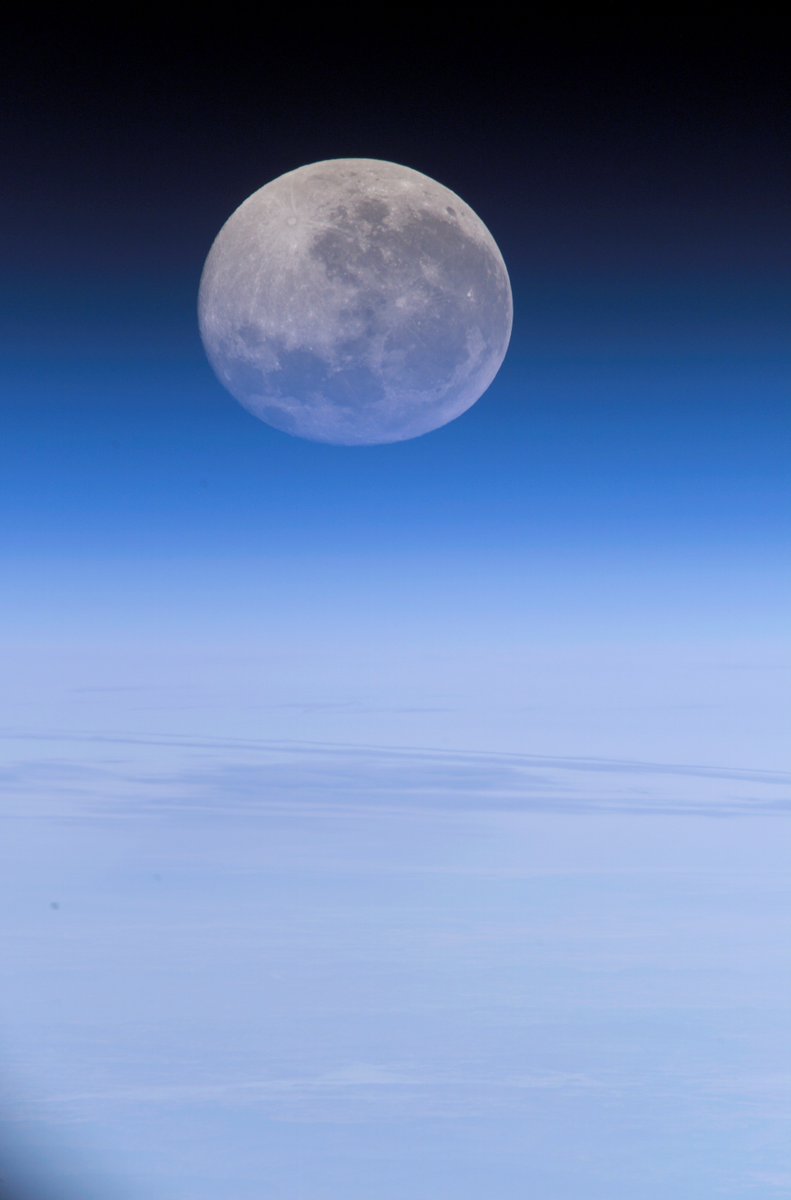
A little extra glow for your summer evening. 🌕
July’s full moon, traditionally called the Buck Moon because this is the time of year when male deer antlers are in full growth, marks a midsummer moment across many cultures. Whether viewed from your backyard or from orbit, tonight’s lunar glow is a reminder of the natural rhythms that connect us all.
“I have come to think that physics is a never-ending quest.”
Isaac Isidor Rabi discovered a method to measure the magnetic properties of atomic nuclei - research that would lead onto the development of MRI and atomic clocks. He was awarded the 1944 Nobel Prize in Physics.
Wandering around snacking? Black holes are just like me.
@NASA’s Swift saw an “orphan” black hole lighting up as it devoured a star on the outskirts of a faraway galaxy. These phenomena are rare, and this was the first seen so far outside a galaxy’s core.
https://t.co/Ghav56xXDF
1/8
In 2025, Gemini North data gave only a weak 1.5σ hint of a companion near #Betelgeuse — a signal just strong enough to notice.🔭
The new VLT/SPHERE data raise the detection to a solid 6.1σ level (5.1σ with another method), making the result far more convincing & confirming the same location.
https://t.co/d1fwYv9IXt
2/8
The companion appears at a tiny angular separation of 52.3 milliarcseconds from Betelgeuse.
On the sky this is an extremely small angle, yet it matches the position predicted for a companion linked to Betelgeuse’s well-known six-year brightness cycle.
3/8
From the measured brightness difference, the companion— Betelgeuse B— turns out to be heavier than first estimated: between 2.6 and 3.1 times the mass of our Sun.
Assuming both stars formed together, it is a young star that has just settled onto the main sequence.
4/8
This projected separation translates to a minimum real distance of about 8.8 astronomical units (a bit less than the Sun–Saturn distance).
The corresponding orbital period fits well with Betelgeuse’s cycle.
5/8
We see no hydrogen-alpha emission from the companion.
That points to a quiet young star already on the main sequence, not one still gathering material.
A second observation is still required for full confirmation — the companion should then appear on the opposite side of Betelgeuse.
6/8
The detection was possible thanks to SPHERE, the high-contrast instrument on ESO’s VLT.
Originally built to find exoplanets, it uses extreme adaptive optics and advanced data processing (including PACO and PCA techniques) to separate the faint companion from Betelgeuse’s overwhelming glare.
7/8
The presence of Betelgeuse B raises new questions about Betelgeuse’s final fate.
Gravitational interactions with the companion could influence mass loss and the way Betelgeuse will eventually explode as a supernova — a topic astronomers will now investigate more closely.
8/8
Putting the 2025 hint next to the clearer 2026 data turns what was only a suggestion into a solid candidate.
There’s still work left on the orbit details and on confirming the companion’s motion around Betelgeuse.
https://t.co/Rzj4dFZ9JU
July's full Moon, called the ‘’Buck Moon’’ is almost here!🌕
It reaches its fullest in the morning of the 29th, but it will still look beautiful at night.
It's named after the time of year when male deer begin growing a fresh set of antlers. 🦌
📷: Simone Capace
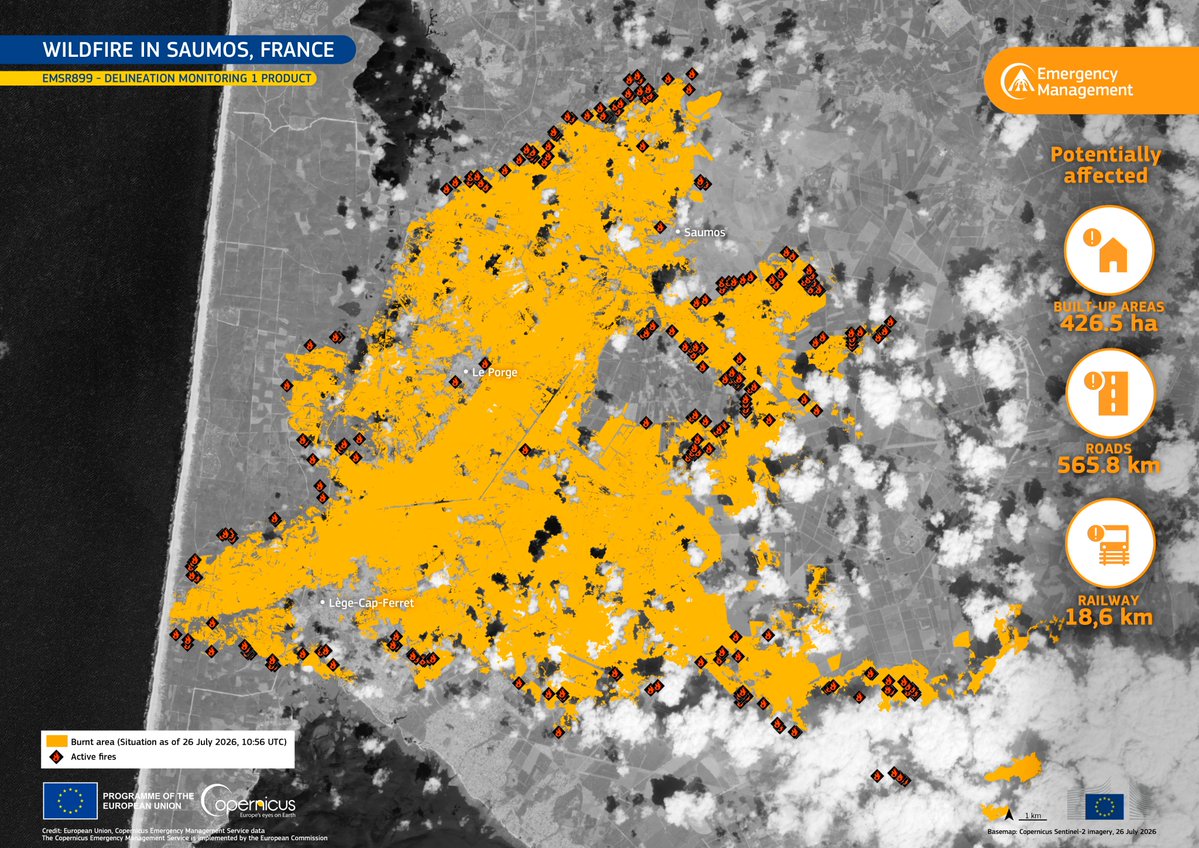
🔥 Wildfires near Saumos and Biscarrosse 🇫🇷 have burned tens of thousands of hectares, prompting the evacuation of around 220K people.
🛰️ #CopernicusEU CEMS Rapid Mapping supports authorities by tracking active fire fronts.
🔗 https://t.co/JxT8yseRRy
"No official definition of an “exomoon” yet deals clearly with an object that orbits a brown dwarf instead of a planet. The body found here has a mass similar to Jupiter’s, so it could count as a planet if it went around a star on its own."
1/6
A team led by Kevin Hoy has published evidence in Nature for a planetary-mass object orbiting the brown dwarf CD-35 2722 B.
It's not yet a definitive confirmation, but the authors describe it as strong evidence & the first plausible detection of this kind.
#browndwarf #science