In 2021, the head of the UN World Food Programme said $6 billion from Elon Musk could solve world hunger.
Elon replied: publish the plan, right here, publicly, and I'll sell Tesla stock on the spot.
The plan came out. And when you read it, it wasn't a plan to solve hunger. It was one year of food for 42 million people. A twelve-month subscription. And the year after? Start over.
A few months later, Elon summed up his view: if you care about the reality of goodness rather than the perception of it, philanthropy is extremely difficult.
"Reality of goodness over perception of goodness."
That line stuck with me for weeks. Does philanthropy actually work?
Gates-style philanthropy is first and foremost institutional capture. Foundations funding NGOs, funding governments, funding programs, producing reports, producing photos. Everyone's happy, and the aid machine keeps itself alive. Sixty years and hundreds of billions later, much of Africa is still dependent on aid. Zambian economist Dambisa Moyo laid it out in Dead Aid: aid breeds dependency, feeds corruption, and short-circuits the only mechanism that has ever lifted a country out of poverty.
So what actually works?
It's been tested. In Kenya, Berkeley researchers working with GiveDirectly randomly selected villages and gave every poor household about $1,000 in cash. No program. No training. No conditions. Just cash.
The result: people bought metal roofs, livestock, started small businesses. Barely any inflation. And every dollar injected generated around $2.50 of economic activity locally, including for neighbors who received nothing.
Why? Because you didn't give them charity. You gave them capital. You primed the pump.
And that's where everything hinges: ownership. Hernando de Soto showed that the world's poor hold trillions of dollars in assets, but without recognized property titles, it's dead capital. You can't borrow against it, pass it on, or grow it. Where property rights are respected, the system starts running. Where they aren't, no amount of aid will ever be enough.
Now reread Elon's post.
"Next year, I will give one of my SpaceX shares to every kid in America. This will be the first of many."
That's not a meal. That's not a handout. That's a property title. A piece of the company building the infrastructure of a multiplanetary civilization, owned directly by millions of kids.
A kid who gets a handout depends on the state. A kid who owns a share of SpaceX owns a piece of the future. He learns what an asset is, he has a stake in the economy working, and one day he'll vote as an owner, not as a client of the state.
Gates buys perception. Musk distributes ownership.
The reality of goodness versus its perception. And it's absolutely brilliant.
I’m French. I want to talk to Americans who are about to vote Democrat. Not to insult you. To warn you.
I come from your future.
In France we did everything your progressive politicians promise. Free healthcare, free college, generous welfare, strong unions, heavy regulation, high taxes on the rich, a state that takes care of everything. Public spending close to 57% of GDP, one of the highest on the planet. On paper, it’s the dream.
Here’s what it looks like from the inside. France hasn’t passed a balanced budget since 1974. Our debt is above 3,300 billion euros. Interest on that debt is becoming one of the biggest items in the national budget. Our hospitals are collapsing despite record funding. Our schools rank lower every year. Young people with degrees can’t afford an apartment in the city they were born in. Our best engineers leave for London, Zurich and San Francisco. And the rich you wanted to tax? They left too, and took the jobs with them.
The promise was protection. The result is stagnation.
The worst part is that nobody in France voted for decline. Every single step sounded generous, compassionate, reasonable. One more program. One more regulation. One more tax to fund it. Each step alone makes sense. Fifty years of them, and you wake up in a country that can no longer build a nuclear plant on time or keep its streets safe.
I love America because it’s the one place on earth where people still believe they can build something from nothing. I came to Silicon Valley as a self-taught kid and it changed my life. That spirit is the most precious thing your country has.
Before you vote, ask yourself one question: is the program you’re voting for making America more like America, or more like France?
Trust me. You don’t want to be France.
🚨Whoah 😳 In less than 20 seconds Dominic Cummings creates stunned silence at Lords Committee this morning.
One of the few remaining centres of excellence in the U.K.?
British Special Forces & who is their biggest enemy? Russia? China? Iran?
No - 20 seconds he doesn’t mince his words ⬇️⬇️⬇️⬇️
There’s a lot of self-serving spin emanating from the UK government about how virtuous it is re fiscal consolidation.
Here are the facts.
Labour inherited an OBR budget deficit forecast of £87bn (3.1% GDP) for FY2024/25. After R Reeves’ 1st disastrous budget the actual deficit was £153bn (5.2%). Massive jump.
Labour inherited OBR budget deficit of £77bn (2.7%) for FY2025/26. After RR’s disastrous 2nd budget that turned out to be £133bn (4.3%).
So in its first two years it added over £120bn to borrowing/deficit (despite huge increase in taxes).
The OBR forecast it inherited for this FY2026/27 was £69bn (2.3%). It is now forecast to be £116bn (3.3%). That looks like an underestimate. More likely to be closer to £130bn again.
Inherited budget forecast for 2027/28: £51bn (1.6%). Latest forecast: £97bn (2.9%).
Inherited budget forecast for 2028/29: £39bn (1.2%). Latest forecast: £86bn (2.5%).
Far from fiscal consolidation Labour is forecast to borrow an incredible £260bn more over the 5 years from 2024/25 than the forecasts it inherited. Despite the tax rises.
Which will continue. Alone among G7 countries the IMF projects the UK tax burden to rise by 3.7% of GDP 2025-31. The only other country with a rising tax burden is France (0.8%). Italy is static. Rest of G7 have falling tax burden.
And let’s not forget Labour’s so-called ‘fiscal consolidation’ is all backloaded to end-decade. Unlikely to happen. So taxes will have to rise by even more.
I don't surmise Danny Dyer is any reader of mine; but I'm gobsmacked that he actually did The Thing. A journalist asked him what he thought of the PM — can you guess his response?
It's the answer I always suggest to such a question:
"I don't know who the PM is mate, do you?"
I thought we were told time and time again not to speculate on motive?
I thought we were not to politicise these sorts of events and inflame tensions?
This government constantly exposes its deep rooted two-tier hypocrisy, literally in black and white.
They are no longer the Labour Party, they are the Welfare Party. It doesn’t matter who is in charge of these people, the party for Benefits Street will tax us all into poverty to pay for more welfare.
Pat McFadden has said in private what he and the Prime Minister deny in public. As I’ve said repeatedly, Labour MPs don’t understand where money comes from. They think our taxes are their money to spend, rather than the result of the hard work of the people in our country who deserve so much better.
The Conservative party is the only party holding Labour to account, as Reform, Lib Dems the SNP and others join Labour in demanding the state pay more and more benefits.
“What kind of a depraved monster slices off a woman’s breast while she is being gang raped, and throws it into the dust to be used as a plaything? What kind of a twisted pervert turns rape into necrophilia by shooting a woman in the head while he is still defiling her?
What kind of ‘freedom fighters’ go into battle with a set of handy Arabic-to-Hebrew phrases, including ‘take off your pants’, ‘lie down’, and ‘spread your legs’?
What self-respecting human being presses nails, scalpels, a hammer, an axe, screwdrivers and other household tools into a woman’s genitals?
How hard do you have to rape someone, and with what, to shatter their pelvis? Who shoots a young girl in the face and then films her mutilated corpse on her brother’s mobile phone?
The answer is: Hamas terrorists. This is the stark reality of what they did to men, women and children on October 7, 2023. And the world must never forget.”
@WestminsterWAG
Absolutely horrific, and even worse than we already knew, which I didn’t think possible. Including clear evidence of appalling sex crimes by Hamas which their deluded defenders have always denied.
.@zarahsultana I assume this is a different Zarah Sultana MP to the one who was recently filmed clapping along to loudspeaker chants for intifada, on a street in Surrey.
https://t.co/J9nLlYtw59
@ZackPolanski - this is magnificent. Three things I can’t deny:
1. It is a video.
2. You are wearing a jacket.
3. Then you aren’t.
4. Then you are again.
Unfortunately that’s where the accuracy ends.
A few corrections for you:
Peter Thiel is not our CEO. Alex Karp is — and has been for 20+ years. (A lifelong Democrat, for anyone keeping score.)
We are not a “spyware company.” Spyware is malware. Malware is illegal. Calling a software company spyware is, technically, defamatory (don’t worry, we are not suing).
We don’t build surveillance technology. We build software that helps organisations make sense of data they already hold. Not the same thing.
There was no “private tour” of our HQ. There was a public photocall to which the media came. Hence, why there are so many pictures of the event.
Our MOD contract is not “the biggest defence contract in UK history.” Ajax armoured vehicles = £5.5bn. Dreadnought submarines = £31bn. We’re grateful for the work, but let’s keep a sense of scale.
We have no more access to NHS data than Microsoft has to the contents of your Word documents. I think you know this by now.
We don’t have access to patient medical records. Same story.
I agree that “nothing matters more than our health.” Which makes it worth reminding you of what Palantir’s software is actually doing in the NHS right now:
->110,000 additional operations
->15% fewer delayed hospital discharges
->7% more patients finding out within 28 days whether they have cancer
Respect again for what you did with that jacket.
Vegans: "Drinking cow's milk is unnatural!"
Great point.
So instead of pulling on some teats for thirty seconds, we've developed a twelve-step industrial alternative.
Step one: grow almonds in California, a drought-afflicted state currently depleting an aquifer that took twenty thousand years to fill.
Step two: ship them to a processing facility.
Step three: soak them in water. California water, specifically, because almonds need 15 gallons per ounce and California is already rationing.
Step four: pulverise them into a slurry.
Step five: filter the slurry through fine mesh, discarding most of the actual almond in the process. That was the bit with the nutrition in it. Gone now.
Step six: add more water, because the resulting liquid isn't watery enough.
Step seven: add sweeteners, because it tastes of nothing.
Step eight: add emulsifiers, because it separates in six minutes otherwise.
Step nine: add synthetic vitamins, because all the natural ones left in step five.
Step ten: add seed oils, because we apparently learned nothing.
Step eleven: homogenise, degas, pasteurise, and sterilise the mixture until it resembles no food that has ever existed in nature.
Step twelve: put it in a carton with a picture of a field on it.
The cow: stands in a field. Makes milk. Has done this for ten thousand years. No factory. No steps. No aquifer.
Unnatural, though. Very unnatural.
‼️ WTF? Whilst you were distracted …
Labour has just voted through powers to FORCE pension funds to invest your money in UK government ‘priorities’.
Meaning Labour effectively takes control of up to 10% of your private pension to invest in bollocks.
I call that theft. How dare the government take MY money for their projects. WTF?
Hermer's Law: How a Non-Binding Opinion Became a £30 Billion Surrender
The Chagos bill is dead. Not delayed, not paused, not pending resolution of a diplomatic disagreement with Washington. Dead. The government has run out of parliamentary time, lost American support, lost a domestic court ruling, and is now appealing against a judgment that grants the very people it claimed to be helping the right to return to their homeland. The deal Keir Starmer signed, the bill his ministers championed, and the legal reasoning Lord Hermer placed at the heart of Labour's foreign policy have together produced a comprehensive and entirely avoidable disaster.
Begin with the legal foundation, because that is where the rot starts. The government's case for surrendering Chagos rested on a 2019 advisory opinion from the International Court of Justice. Not a binding ruling. An opinion. One that carries, in the Spectator's precise formulation, roughly the legal force of a politely worded email. Any government confident in its own sovereignty would have noted the opinion, acknowledged its non-binding status, and proceeded as before. Instead, Lord Hermer, as Attorney General, treated it as an obligation Britain had no realistic choice but to honour. International law was placed at the heart of Labour's foreign policy, and a non-binding advisory opinion became the justification for surrendering a strategic asset Britain has held for two centuries.
The consequences were predictable and have duly arrived. The legal framework constructed to make surrender seem inevitable has since been turned against the deal itself. A domestic court ruled earlier this year that Chagossians expelled from their homeland have a right of abode. The government is now appealing against that judgment, deploying British courts to resist the rights of the people whose welfare the deal was ostensibly designed to protect. The legal reasoning that was supposed to close the argument has reopened every argument simultaneously.
Then there is Trump. His final withdrawal of support came after Starmer refused to allow American aircraft to use British bases to strike Iran. The refusal was consistent with this government's broader posture: cautious, legally constrained, reluctant to act without multilateral cover. But the consequence was the loss of American backing for a deal that required American cooperation to implement. Britain had already committed £30 billion of public money. It had signed. It had staked its diplomatic credibility. And then, when the alliance was tested at the precise moment it mattered, the terms of British foreign policy prevented Britain from meeting the condition on which everything else depended.
The geometry of this failure is worth stating plainly. Starmer signed a deal he could not implement without US consent. He then adopted a foreign policy posture that made US consent impossible to retain. He built his legal case on a non-binding opinion that has since generated binding domestic consequences he is now fighting in court. And he committed billions of public money to an agreement that cannot be ratified, to lease back a base Britain already owned, from a government it was paying to take it.
Lord Hermer bears particular responsibility. The decision to treat the ICJ opinion as effectively binding, to frame sovereignty as a liability and legal compliance as a virtue, set the terms for everything that followed. A government that begins by conceding the argument rarely wins the negotiation. Britain conceded Chagos in principle before a single formal demand had been made, and has spent the years since discovering the price of that concession while failing to collect any of its promised benefits.
The bill is dead. The deal is stranded. The base remains, for now, in British hands. That is not a vindication of the strategy. It is a verdict on it.
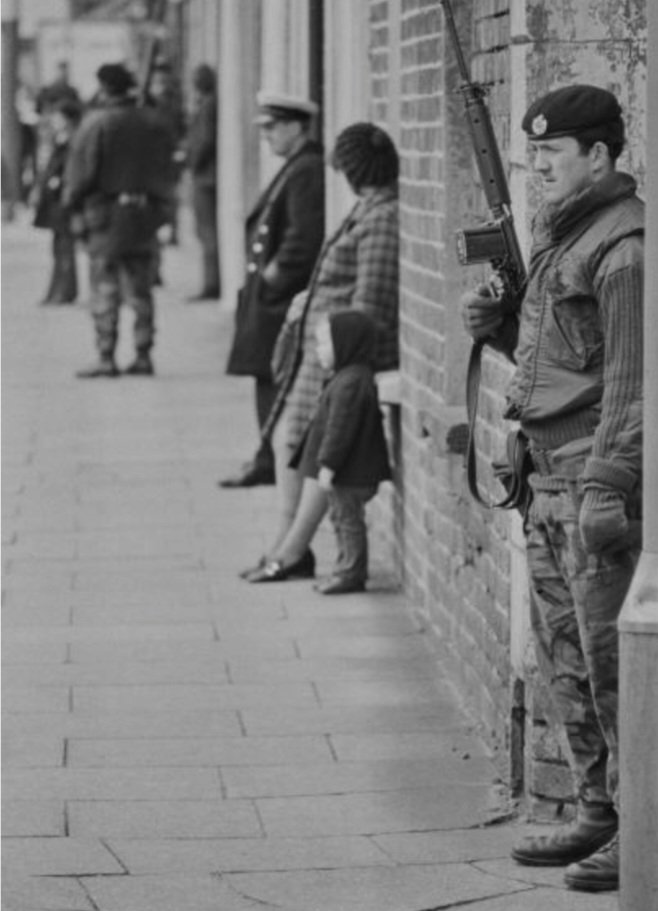
Three former soldiers will appear at Belfast magistrates court on April 20th. One is charged with a killing that took place in May 1972. He is not accused of acting outside his orders. He is accused of acting within them. The distinction no longer appears to matter.
This is the reality behind Labour's Northern Ireland Troubles Bill, a piece of legislation dressed in the language of reconciliation that functions, in practice, as an engine of persecution. The state that sent these men to Northern Ireland, that gave them their orders, that relied on their judgment in circumstances no minister has ever faced, is now the state that funds the machinery pursuing them through the courts half a century later.
That is not a technicality. It is the central fact. Taxpayer money flows to the lawyers challenging the actions of soldiers whose actions were sanctioned by the taxpayer. The government calls this justice. General Sir Peter Wall, who commanded the British Army for four years, calls it something without moral backbone. He is right.
The operational consequences are already visible. Elite soldiers are leaving the SAS and SBS rather than face the prospect of prosecution decades hence for missions carried out under government orders. The crisis has become sufficiently acute that reservists are being brought into the regular SAS to fill roles vacated by those walking out. Britain's most capable fighting force is being quietly hollowed out by a bill whose architects appear indifferent to the result. Seven former SAS commanders have warned that the legislation is doing the enemy's work, that operational secrets exposed through inquiries give hostile states a narrative of lawless troops. Moscow, Tehran and Beijing do not need to discredit British special forces. Westminster is doing it for them.
The asymmetry at the heart of this legislation is not incidental. It is structural. IRA members were released under the Good Friday Agreement. Many destroyed evidence, stayed silent, or received letters guaranteeing they would not be pursued. Soldiers kept records, gave statements, and remained traceable. Decades later, only one group remains available for scrutiny. Not because they are more culpable, but because they are more reachable.
The Coagh ambush of June 1991 illustrates the logic perfectly. Three IRA men were stopped by the SAS on their way to murder someone. A coroner ruled the force used was justified. Years later a family challenged that ruling, arguing the soldier should have paused after each shot to consider whether to fire the next one. A judge described that argument as ludicrous and utterly divorced from reality. The challenge continues, funded by legal aid, heard at the Court of Appeal just days ago. No verdict ends the process. The process is the punishment.
Keir Starmer has said publicly he is absolutely confident there will be no vexatious prosecutions. Three soldiers will be in a Belfast court in sixteen days. His confidence has not reached them.
The government insists its bill provides robust protections for veterans. General Sir Nick Parker, who oversaw the final operations in Northern Ireland, says ministers do not understand the duty of the state to stand by those who serve it. The duty to stand by those who serve is contractual, not sentimental. A soldier who follows orders in a war the state authorised cannot later be offered up as payment for political convenience.
What is being constructed here is not a legacy process. It is a permanent legal industry, sustained by public money, targeting the most traceable participants in a conflict the state itself waged. The soldiers kept their records. That is now their liability.
A serious country does not behave this way. This one, apparently, does.
"Keir Starmer has said publicly he is absolutely confident there will be no vexatious prosecutions. Three soldiers will be in a Belfast court in sixteen days. His confidence has not reached them."