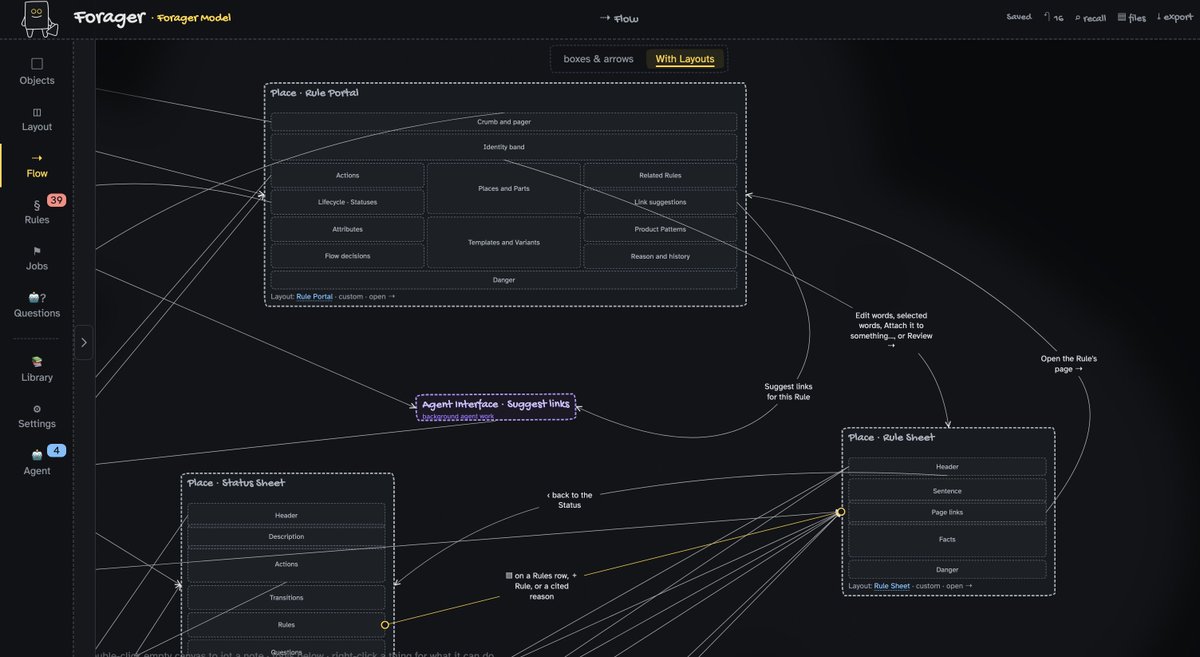
Can a sketch on paper become a user flow, a layout and a component? I tried it in a design tool I'm building. Pretty good, mostly.
Thanks @rjs for always posting thought-provoking stuff, and for inspiring me to put a camera over my sketchbook for this test.
https://t.co/86SKo0tHOU
While shaping a File object's Undo action it became clear that modeling Undo as File's action wasn't providing enough room to specify other change related concerns (a capability I'm building to convey how a design has unfolded over time). Change as an object is introduced. Undo now belongs there. After working on the shaping session with an agent, it submits the changes we worked on in the app. I review and apply it. The entire model stays up to date, context available to myself and any agent working on this app.
I agree Maggie and I’d say it’s even more important on a product with a long history. The ontological debt accumulated in an enterprise app, as an example, can be a lot to sort out when there are many conceptual objects named different things in the code, support docs, maybe even different parts of the app, etc
@Mappletons A month ago I shifted agents away from UX Magic (now supplemental), my actual feedback was “looks like a deconstruction of sorts, but the intention is actually to derive the language such that it’s generative.” Newest focus is better defining Alexander's strong vs weak centers.
Ryan this looks great. I've been wrestling with something similar. Making space for guidance at various levels of design concern. So far it's a bunch of different types of canvases with different jobs, each with a spec sheet. This image is a bit of a hot mess for a couple reasons: the agent created it, and this canvas needs a smaller scope (zoomed out looks like a murder board).
@rjs@jayzhoupro Doing something similar with a series of canvases that tease apart aspects of the design. Making places to focus on the conceptual model, a place to define places (layouts), a place to define the flow from place to place. "Back" into the work is what it feels like.
@jasonfried@zhzhng Completely agree. I’ve been using the @rjs breadboarding skill for the design of many different types of things. The concept of a “Place” is a great concept for visual investigation no matter what place ends up being.
In 1964, Christopher Alexander wrote the playbook for systematic design. Decompose problems into parts, synthesize solutions from requirements.
It shaped software design patterns and had an influence on OOP.
He spent 40 years saying it was wrong. We built the machine version anyway.
His later work named the tension. System A vs System B.
System A: adaptive, participatory, responsive to what the situation requires. Alive.
System B: top-down, predetermined, rigid. Efficient. Machinelike.
I think AI defaults to System B.
"She'd know I still don't understand the forms."
Three years of genealogy research. Reference librarian at her desk, free, all afternoon. Arlo never approached her once.
The library's AGENT CHAT terminal has no record of what he's asked before. For Arlo, that's the feature.
Hannah Rogers, field note from Union County, NJ.
https://t.co/3eoQztEnxG
@seanxthielen "A Pattern Language" is great. I highly recommend his book "The battle for the life and beauty of the earth".
A Pattern Language is a catalog. The Battle is a process. It shows that a pattern language is a generative specification for one unique project.
There’s definitely feedback loop compression happening, and that’s meaningful. But the translation layer didn’t disappear. It shifted into a probabilistic interpreter.
That ambiguity is different from humans. And in large orgs, small changes ripple in unexpected ways. In small teams, that risk is manageable. In large organizations, those ripples compound.
At enterprise scale, the primary bottleneck isn’t handoff. It’s coherence. Design systems aren’t just artifacts of a broken process. They’re constraint systems that maintain integrity across teams, surfaces, and time.
As more people can “directly design” in code, the need for strong shared contracts actually increases. The real question is: what replaces the mockup as the shared source of truth?
@kepano Is there a recommended set up for making Obsidian my “IDE for Markdown”? I’m not a developer but I find myself creating SKILLS, using agents, etc. and it does feel like I’m being pulled out of Obsidian and into other places (e.g. Claude Code, VS Code) more and more.
This is interesting. I've been experimenting in a similar way with Christopher Alexander's pattern language approach (a side project for a small business).
I'm taking his methodology literally and breaking it into skills, to see where I end up:
- Hopes and dreams elicitation (capturing the phenomenology. What people actually feel and want)
First-sketch synthesis (testing for saturation, when the global structure stabilizes)
- Coherence evaluation (Alexander's seven principles that distinguish a pattern language from just a collection of patterns)
- Pattern language stewardship (creating and maintaining the generative patterns)
- Ecosystem mapping (documenting "the reality of the land”, the actual constraints and existing centers)
Each skill has structured inputs/outputs. Ideally, it becomes something Claude can actually use to generate context-appropriate solutions. Have you looked at deconstructing any of Alexander's techniques this way?