Space isn’t empty.
The “quantum vacuum” is actually a 5D crystalline lattice that transforms light. Reality is bullt from zero-point energy in space beyond the infinite. This used to be called aether/akasha.
https://t.co/ZTGFFmCxYV
Did you miss our recent article about Zero-point energy?
Zero-point energy (ZPE) represents one of the most fascinating and profound discoveries in modern physics. First identified by Max Planck in the early 1900s during his groundbreaking work on black-body radiation, ZPE reveals that even at absolute zero temperature, quantum systems retain a fundamental, irreducible amount of energy. This discovery not only revolutionized our understanding of quantum mechanics but also challenged our most basic assumptions about the nature of empty space itself.
In our recent article: "What is Zero-point Energy?" We take you on an exploration of the remarkable journey of zero-point energy - from its unexpected discovery during Planck's practical work on optimizing light bulbs, through its crucial role in quantum mechanics and field theory, to its modern implications for everything from the stability of matter to the expansion of the universe. We'll examine how ZPE manifests in observable phenomena like the Casimir effect and quantum vacuum fluctuations, investigate its relationship with gravity and spacetime geometry, and consider its potential technological applications.
Along the way, we'll encounter some of physics' greatest minds - including Einstein, Stern, and Nernst - and see how their work helped develop our understanding of this fundamental aspect of nature. We'll also explore contemporary research that suggests ZPE may be key to resolving some of physics' most persistent puzzles, from the origin of mass to the nature of gravity itself.
Whether you're a physicist, student, or simply curious about the fundamental nature of reality, this exploration of zero-point energy offers fascinating insights into the quantum world that underlies our everyday experience.
Check out the full article for free at the ISF website- 🔗https://t.co/170Jd0dnWG
NEWS 🚨: Astronomers have discovered an entirely new type of cosmic object called a "black hole star"
It's the size of our solar system, emits 100 billion times more energy than any star, and may finally explain JWST's mysterious "little red dots"
The ability to sense frequency energy can be enhanced through practice, and according to sound therapy principles, the 852Hz Solfeggio tone helps balance overthinking by awakening intuition.
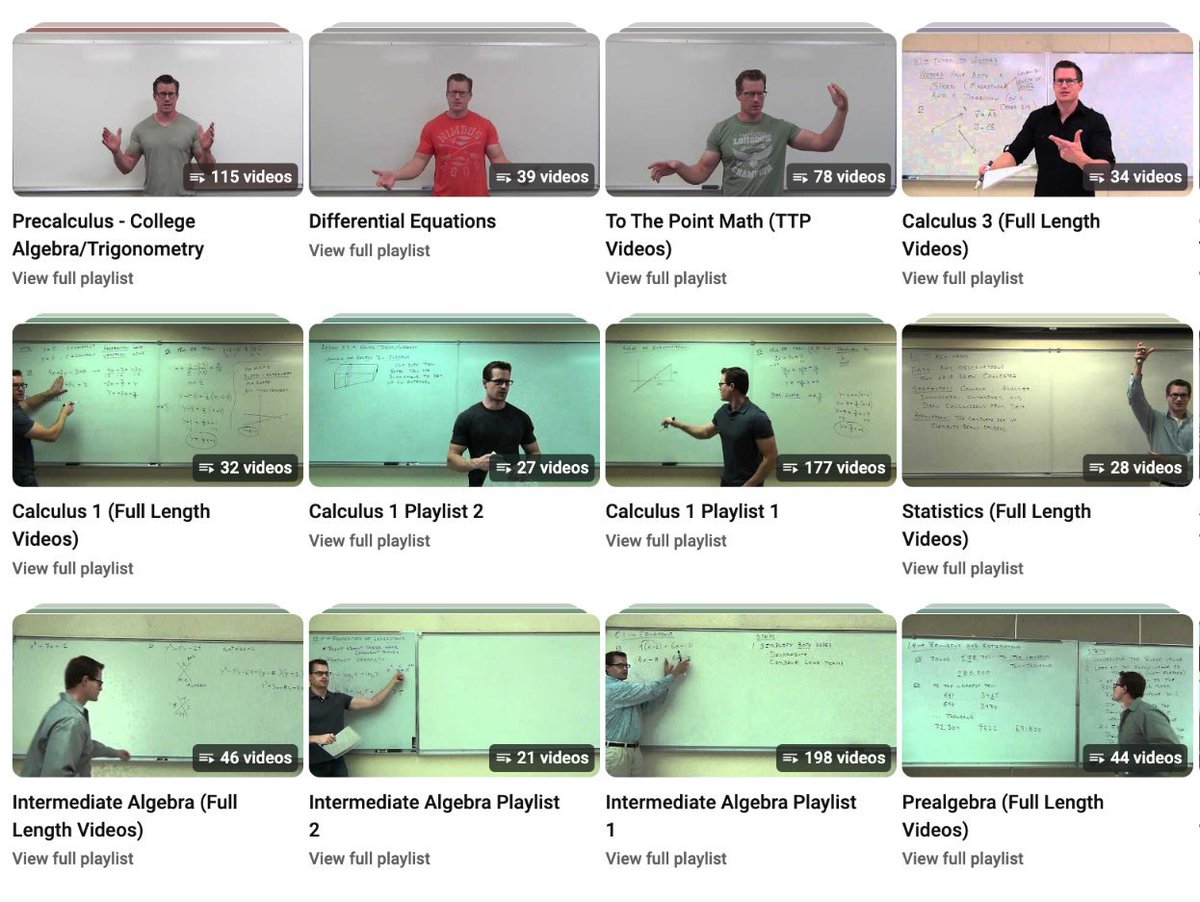
1. Algebra is good for problem-solving.
2. Geometry is good for visual thinking.
3. Calculus is good for understanding change.
4. Statistics is good for decision-making.
5. Number theory is good for logical discipline.
6. Linear algebra is good for modern science and engineering.
7. Discrete math is good for computer science.
8. Differential equations are good for modeling the real world.
9. Optimization is good for smart planning.
10. Graph theory is good for network thinking.
11. Set theory is good for structured reasoning.
12. Practice is good for mathematical fluency.
13. Curiosity is good for lifelong learning in math.
This is what has been missing and this is what we need more of right now. This is a beautiful story and you should definitely take the two minutes to hear it.
The most important equation in statistics is the Normal Equations AᵀA x̂ = Aᵀb. It's the foundation of linear regression.
Source: Professor Gilbert Strang, MIT.
The owner of a southeast Portland coffee shop said the shop has raised over $86,000 healthy people losing food benefits as the government shutdown continues.
Heretic Coffee 5120 S.E. 28Th Ave. volunteer nonprofit shop that trains people to become baristas and coffee roasters‼️
A free MIT course breaking down fundamental math concepts in computer science: https://t.co/xe6jXsmtmt
Here, MIT prof. Erik Demaine breaks down state machines (Lecture 4).
v/@MITOCW
The Fourier series is a way to represent any periodic function as a sum of simple sine and cosine waves.
In essence, it breaks down complex signals into a combination of basic trigonometric functions, making it a powerful tool in mathematics, physics, and engineering for analyzing waveforms, heat transfer, vibrations, and more.
📹 Credit : mathswithmuza
The Fibonacci sequence (0,1,1,2,3,5,8,13…) isn’t just math — it’s a universal pattern. As it grows, ratios of terms approach the Golden Ratio (Φ ≈1.618), a harmony found in spirals, plants, shells, galaxies & even DNA.
[🎞️ thevisualalchemy]
A 60-year-old couple earning $82,000 will see premiums rise by $14,875 the GOP allows health care tax credits to expire. That's a 237% increase.
My Democratic colleagues and I remain ready to work today to reopen the government with a bipartisan agreement that protects health care and delivers real solutions for the American people. It’s time for Republicans to put politics aside, come back to the table, and do their jobs.