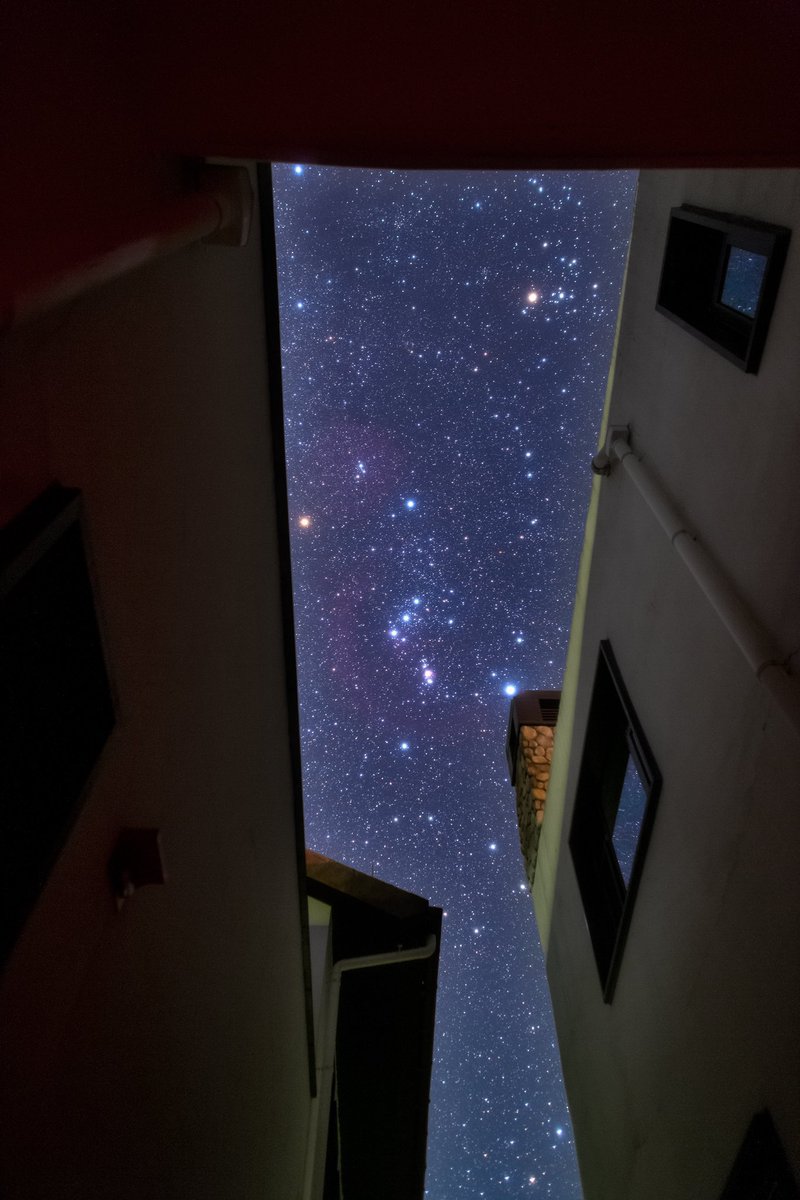
While you slept last night, completely motionless in your bed, our galaxy shifted millions of kilometers through the cosmos.
You woke up in the same room, on the same planet, but unimaginably far from where you were the night before.
The Milky Way does not glide silently through the universe. It is racing through space at about 600 kilometers per second, carrying with it billions of stars, planets, and everything they contain on the journey. It is a good reminder that, even when life seems motionless, you are always in motion.
The math on this black hole should mass-humble every physicist who thinks we understand gravity.
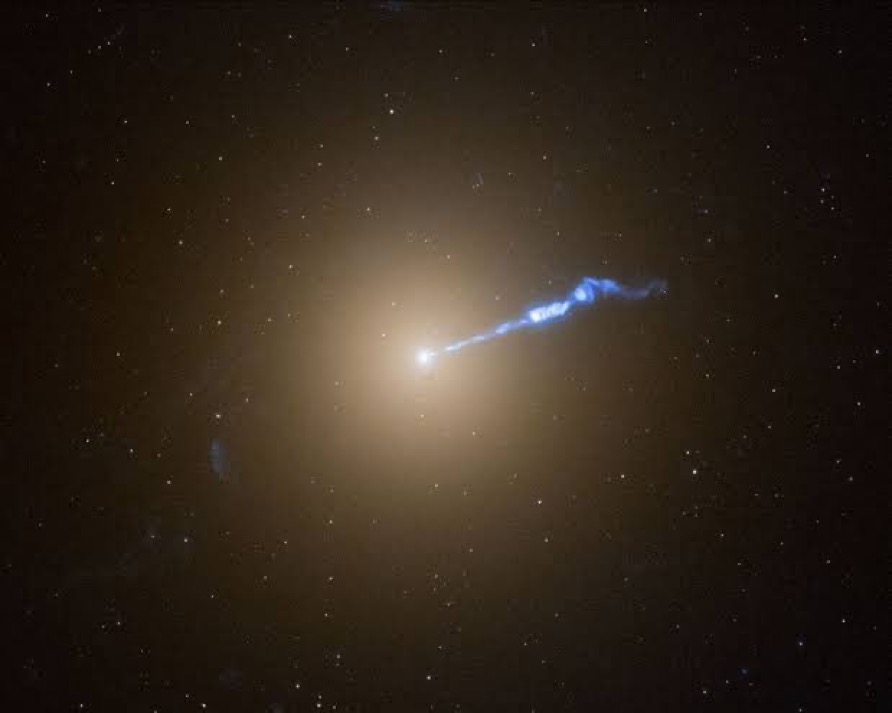
M87's central black hole is 6.5 billion times the mass of our Sun. It's 38 billion kilometers across. It spins at 80% of the theoretical maximum speed allowed by physics. And it's firing a plasma beam at near light speed that stretches 5,000 light-years into space.
To put 5,000 light-years in perspective: if you started driving at highway speed when the Egyptian pyramids were built, you'd have covered roughly 0.0005 light-years by now. This beam covers ten million times that distance.
The plasma travels in a spiral along a coiled magnetic field. Hubble watched it for 13 years just to confirm the motion pattern. And the beam isn't just decorating empty space. Stars near its path explode twice as often as stars elsewhere in the galaxy. Nobody knows why. The lead researcher at Stanford said they don't understand the mechanism at all.
The black hole eats roughly 90 Earth masses of material per day. The energy output from that feeding process matches the power of the jet itself, somewhere between 10^33 and 10^37 joules per second. The upper end of that range is a number so large it has no human analogy.
Your brain runs on 20 watts. This thing outputs more energy per second than every star in the Milky Way combined. And we photographed it with a telescope in 2019.
On 12 August 1755, a 19-year-old in Turin wrote a letter to Leonhard Euler, then the greatest mathematician alive.
The letter described a purely algebraic method for solving optimization problems. No geometry. No diagrams. Just analysis.
Euler read it, recognized it was superior to his own approach, and held back his own manuscript so the young man could publish first.
That 19-year-old was Joseph-Louis Lagrange.
The origin:
His family had lost everything to bad investments. Lagrange later said:
"If I had been rich, I probably would not have devoted myself to mathematics."
By 19, he was a professor. By his mid-twenties, recognized across Europe. King Frederick II of Prussia personally wrote to invite him to Berlin, calling him "the greatest mathematician in Europe."
Once there, he produced roughly one major paper per month for twenty years.
What he built:
1./ The Lagrangian
Newton described motion through forces. Lagrange described it through energy.
For a classical mechanical system:
L = T − V
T is kinetic energy. V is potential energy.
This single function encodes everything about a physical system. Feed it into one equation, and all of mechanics falls out.
2/ The Euler-Lagrange Equation
The working engine of the entire framework:
d/dt (∂L/∂q̇) = ∂L/∂q
This is the equation of motion for any system.
q is the generalized coordinate, Lagrange's second genius move. Instead of being locked into x, y, z, you describe a system in whatever coordinates are most natural. Angles for a pendulum. Orbital elements for a planet. The equation works in all of them.
Give it the Lagrangian. Get back the equations of motion. Automatically. No forces needed.
This replaced Newton's F = ma as the more general, more powerful description of how the world moves.
3/ The Principle of Stationary Action
Define the action S as the integral of L over time:
S = ∫ L dt
The path a physical system actually takes is the one for which S is stationary:
δS = 0
Any tiny variation from the true path produces no first-order change in S.
This single equation underlies classical mechanics, electromagnetism, quantum field theory, and general relativity. Every fundamental theory in physics is derived from it.
4/ Lagrange Multipliers
Problem: minimize a function f, subject to a constraint g = 0.
At the optimal point, the gradients must be parallel:
∇f = λ∇g
This is the mathematical foundation of Support Vector Machines. Finding the maximum-margin hyperplane that separates two classes is a constrained optimization problem solved exactly this way.
It also underpins constrained deep learning, physics-informed neural networks, and safe reinforcement learning.
Here's the full picture:
A broke 19-year-old in Turin wrote a letter about optimization.
His L = T − V runs inside every physics simulation ever built. His d/dt(∂L/∂q̇) = ∂L/∂q is how those simulations compute motion. His δS = 0 is the single equation from which all modern physics is derived. His ∇f = λ∇g solves constrained optimization at the heart of ML.
He didn't set out to build tools for AI.
He was just trying to find the most elegant way to describe the world.
That's what pure mathematics does. It finds the truth, and engineers catch up centuries later.
Today we debate how much work is enough work, Poincaré had a system for his day. He worked exactly from 10:00 AM to 12:00 PM & 5:00 PM to 7:00 PM.
He believed that working more than 4 hrs a day was harmful to the brain's ability to synthesize. He spent the rest of his time reading/walking/simply sitting in silence. He was a living rebuttal to the modern grind culture proving that 4 hrs of extreme deep work could out-produce a lifetime of 80 hr weeks.
We're not going to travel beyond the solar system, according to Leonard Susskind. And neither are aliens, coming to visit us.
We may not be alone, but we are stuck here for, essentially forever.
1. The nearest star is 4.24 light years away. The fastest spacecraft ever built would require 6,600 years to get there.
2. Surely we can just build faster spacecraft. The problem is to get to anywhere close to the speed of light, we need exponentially more energy.
3. Chemical rockets will just not work. Even fusion rockets won't work. Even 10% of the speed of light is not achievable. The Tsiolkovsky Rocket Equation prevents it.
4. Interstellar dust becomes hand grenades when traveling anywhere close to the speed of light. Ships break.
5. Space radiation will kill us over the time need to travel interstellar distances. Impossible to protect without massive shields, which require massive energy to accelerate and de-accelerate.
In 1783, English clergyman John Michell proposed that a star with extremely high density and a diameter 500 times greater than the Sun would have an escape velocity exceeding the speed of light. Pierre-Simon Laplace independently described a similar idea in 1796.
In 1915, Albert Einstein introduced the General Theory of Relativity, showing how mass curves spacetime and providing a deeper framework for understanding extreme gravity beyond Newtonian physics.
Soon after, in 1916, Karl Schwarzschild solved Einstein’s field equations, revealing that if a mass collapses within a critical radius not even light can escape which is now known as the Schwarzschild radius.
In 1939, J. Robert Oppenheimer and Hartland Snyder demonstrated how a massive star, after exhausting its fuel, could undergo gravitational collapse to form a singularity, providing a physical mechanism for such objects.
Finally, in the 1960s, the term “black hole” was popularized by John Archibald Wheeler, marking the transition of the concept from a theoretical curiosity to an accepted astrophysical reality.
Through the 20th century, what began as a speculative idea evolved into one of the most profound and well-established phenomena in modern astrophysics.
: Exploring the Vast Distances to Our Galactic NeighborsThe cosmos stretches our imagination with its staggering scales. While the Milky Way feels immense, other galaxies lie at mind-bending distances—some tantalizingly close, others echoing the dawn of time itself.The closest major galaxy to our own is the majestic Andromeda Galaxy (M31), shining about 2.5 million light-years away. In a few billion years, it will dance into a spectacular collision with the Milky Way, birthing a new elliptical giant. Yet even closer are the smaller, fragile dwarf galaxies orbiting or being gently torn apart by our galaxy's gravity:Canis Major Dwarf Galaxy — Currently the nearest known galaxy to our Solar System, tucked roughly 25,000 light-years from the Sun. It's a modest irregular galaxy already being shredded by the Milky Way's tidal forces, leaving behind streams of stars.
Sagittarius Dwarf Spheroidal Galaxy — Located about 70,000 light-years away, this elongated dwarf is on a polar orbit around the Milky Way and is also in the process of being absorbed, its stars scattering into vast stellar streams.
Andromeda Galaxy (M31) — The largest and nearest major spiral galaxy, a cosmic sibling hurtling toward us at hundreds of kilometers per second.
These distances aren't just numbers—they reveal how our galaxy interacts with its neighbors through gravity, mergers, and cannibalism. Astronomers measure them using clever techniques like Cepheid variable stars, parallax, and standard candles, all while piecing together the universe's expansion.For a deeper dive, check out educational videos on galactic collisions, the intricate structure of the Milky Way's arms and halo, and the graceful (yet chaotic) motion of stars within https://t.co/UEdjJvIqlx put everything in perspective: some of the most distant galaxies we've detected, like GN-z11, sit around 32 billion light-years away in today's expanded universe (with the light itself having traveled for about 13.4 billion years). That faint glow shows us the cosmos as it appeared just a few hundred million years after the Big Bang—when the first stars and galaxies were still igniting in the infant universe.
most people read physics.
few actually solve it.
• you can watch lectures
• read textbooks
• understand concepts
and still fail when faced with a real problem.
because physics is not recognition.
it is construction under constraints.
1000 solved problems in modern physics vy ahmad a. kamal
forces you into the real game:
→ take a messy situation
→ choose the right model
→ apply the math
→ reach a result that either works or collapses
again. and again. and again.
after enough problems:
formulas stop being symbols
they become tools
intuition stops being vague
it becomes mechanical
you stop asking “what is this?”
and start knowing “what to do.”
These are the REAL distances to distant galaxies from our Milky Way!
1 light year = 9.5 trillion km
Watch till the end; the scale will completely humble you. How small do you feel right now?
Buckle up—your mind is about to get cosmically blown! This is the Milky Way, our breathtaking home galaxy—a majestic barred spiral masterpiece stretching roughly 100,000 light-years across. From a bird's-eye view (if only we could hitch a ride far above!), it reveals graceful, sweeping spiral arms studded with brilliant stars, glowing nebulae, and lanes of dark dust, all swirling around a bright, bar-shaped core.
But tilt your perspective sideways, and it transforms into a razor-thin, glowing disk with a prominent central bulge—a dense, golden heart packed with ancient stars blazing around a supermassive black hole.
And here's the wildest part: the entire galaxy is spinning! Our Solar System—tucked along the modest Orion Arm—is hurtling around the galactic center at an incredible ~220–250 km/s (roughly 500,000–560,000 mph or about 800,000–900,000 km/h). We're cosmic speed demons without even feeling the rush!
One full lap around the Milky Way—known as a galactic year—takes about 225–250 million Earth years. Think about that: the last time our Solar System was in this exact spot in its orbit, dinosaurs were just beginning their epic reign in the Jurassic period. We've barely completed a fraction of one galactic year since those massive reptiles roamed (and vanished). Humanity? We're newborns—mere milliseconds on this grand cosmic clock!So the next time you step outside and stare up at the starry band across the sky, remember: you're not just standing on a tiny planet—you're a passenger aboard a colossal, rotating star city, racing through the Universe at mind-boggling speeds. We're all galactic travelers in an ever-turning spiral of wonder!
The James Webb Space Telescope (JWST) has delivered compelling evidence that a longstanding puzzle in cosmology—the Hubble tension—is not merely a measurement glitch but a genuine challenge to our understanding of the universe.
For over a decade, cosmologists have grappled with conflicting values for the Hubble constant (H₀), which quantifies the current rate of cosmic expansion. Measurements anchored in the early universe, derived from the cosmic microwave background (CMB) radiation via the Planck satellite, yield approximately 67 km/s/Mpc (roughly 46,200 miles per hour per million light-years). In contrast, "local" observations of nearby galaxies—using Cepheid variable stars as standard candles to calibrate distances and then Type Ia supernovae as further rungs on the cosmic distance ladder—consistently indicate a higher value around 73–74 km/s/Mpc (about 51,000 miles per hour per million light-years).
This discrepancy, though seemingly modest, is statistically significant and grows more pronounced with improved data, potentially signaling that the standard ΛCDM model of cosmology is incomplete.
Early skepticism focused on possible systematic errors in the local ladder, such as crowding effects in Cepheid observations or calibration issues with Hubble Space Telescope data. However, JWST's superior infrared resolution and sensitivity have now provided decisive cross-checks. By observing hundreds of Cepheid variables in galaxies spanning up to hundreds of millions of light-years away, JWST measurements align closely with Hubble's optical results—confirming the higher local expansion rate with unprecedented precision and ruling out major instrumental or methodological flaws as the culprit.
Joint analyses from teams like SH0ES (led by Adam Riess) show that JWST's data on Cepheids, combined with Hubble's long baseline, eliminate explanations tied to measurement artifacts with high confidence. The tension persists, implying that something fundamental may be amiss: perhaps new physics beyond the Standard Model, such as evolving dark energy, early-universe modifications (e.g., extra relativistic particles or changes in neutrino properties), or even exotic early dark energy components.
In essence, JWST has transformed the Hubble tension from a potential observational artifact into a profound hint that the universe may harbor undiscovered principles governing its evolution from the Big Bang to today. Future observations—with instruments like the Nancy Grace Roman Space Telescope—may help pinpoint the resolution, but for now, this cosmic mismatch stands as one of the most intriguing open questions in modern physics.
["JWST Observations Reject Unrecognized Crowding of Cepheid Photometry as an Explanation for the Hubble Tension at 8σ Confidence." The Astrophysical Journal Letters, 2024]
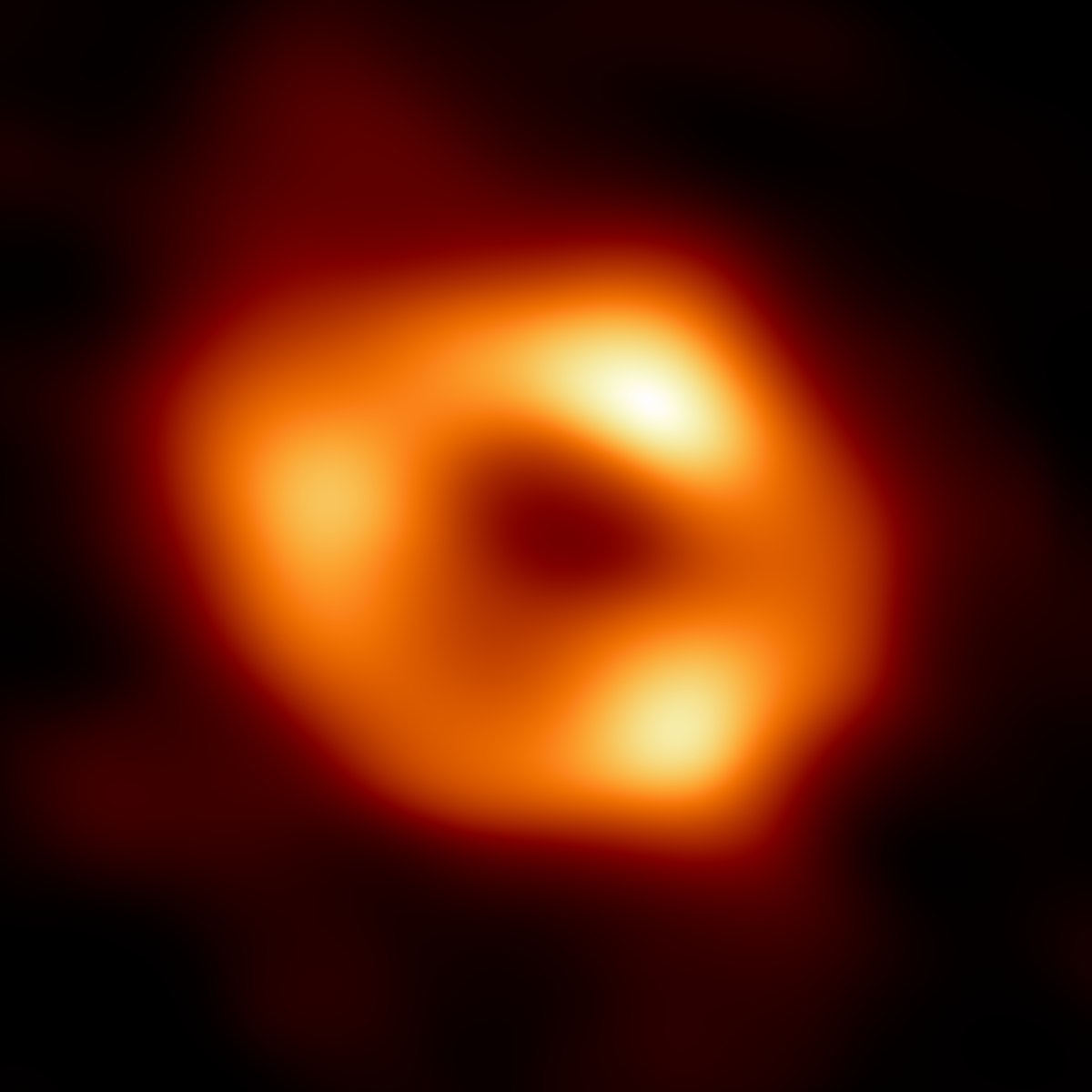
Black holes are the universe's ultimate enigmas—places where gravity reigns supreme, silence swallows everything, and the laws of physics scream their wildest truths.Nothing escapes, not even light. Time stretches to a crawl near the edge, distances warp into nonsense, and matter meets its most extreme fate. Yet black holes don't merely destroy; they expose the raw boundaries of reality itself.Right in the heart of our Milky Way, roughly 26,000 light-years away, lurks Sagittarius A*—the supermassive black hole anchoring our galaxy. Clocking in at about 4 million solar masses, it's invisible to direct sight, but its gravitational grip is unmistakable: stars whip around it at mind-bending speeds, their frantic orbits tracing the invisible curvature of spacetime predicted by Einstein.For years, Sagittarius A* has been remarkably quiet, a sleeping giant not gorging on much material. But recent revelations paint a more dramatic picture: evidence from telescopes like XRISM shows it erupted violently in X-rays—blazing up to 10,000 times brighter than today—perhaps just a few hundred years ago, with gas clouds acting as cosmic mirrors reflecting that ancient flare. Meanwhile, James Webb Space Telescope observations catch its unpredictable flickering light show, and new data hint at powerful outflows and magnetic fields spiraling at its edge. Our once-calm neighbor might be stirring.Then there's the cosmic heavyweight: TON 618, one of the most monstrous black holes humanity has ever glimpsed.Nestled at the core of a blazing quasar some 18 billion light-years distant (with light traveling to us from over 10 billion years ago), this ultramassive beast boasts an estimated mass of 40 to 66 billion solar masses—depending on the latest modeling of its surrounding gas motions and luminosity. Its event horizon alone could swallow our entire Solar System multiple times over. Here, spacetime is stretched to breaking point, and the quasar's ferocious glow outshines entire galaxies, powered by matter spiraling in at insane rates.TON 618 isn't just big—it's a challenge to our theories of how black holes grow so colossal so early in cosmic history, pushing the limits of accretion physics and perhaps even hinting at exotic formation pathways in the young universe.These two extremes—one our galactic neighbor, the other a distant titan—remind us that black holes aren't voids of nothingness. They're engines of evolution, sculptors of galaxies, and testbeds for the deepest secrets of the cosmos. With telescopes like the Event Horizon Telescope refining their portraits and new missions probing further, we're only beginning to hear what these silent giants have to say.
A
A one-in-a-million chance—and it happened.
A team from the Technical University of Munich spent six years compiling a list of promising gravitational lenses and waiting for a supernova to explode behind one of them. In August 2025, it happened.
A superluminous supernova 10 billion light-years away was located precisely behind two foreground galaxies—and its light, bent by gravity, produced five images of the same explosion. Typically, lenses produce two or four—five was a surprise even to the authors. The supernova was named SN Winny.
The odds of such a coincidence are less than one in a million. But the value of the discovery is enormous. Light from the supernova travels to us along different paths around the lensing galaxies, and each path has its own length. Because of this, the five copies appear with different time delays. By measuring these delays and knowing the mass distribution in the lensing galaxies, one can directly calculate the Hubble-Lemaître constant, or the rate of expansion of the Universe.
How is this better than existing methods? The classic "cosmic distance scale" is a multi-step process, with errors accumulating from step to step. Microwave background radiation measurements are precise, but depend on models of the evolution of the Universe. The lensed supernova method is a single-step process, with completely different sources of error. SN Winny is particularly convenient: it is lensed by just two individual galaxies with a simple mass distribution, rather than a complex cluster.
SN Winny is currently being observed by telescopes around the world. The results could bring us closer to resolving the Hubble controversy—the discrepancy between the two main methods for measuring the expansion rate.
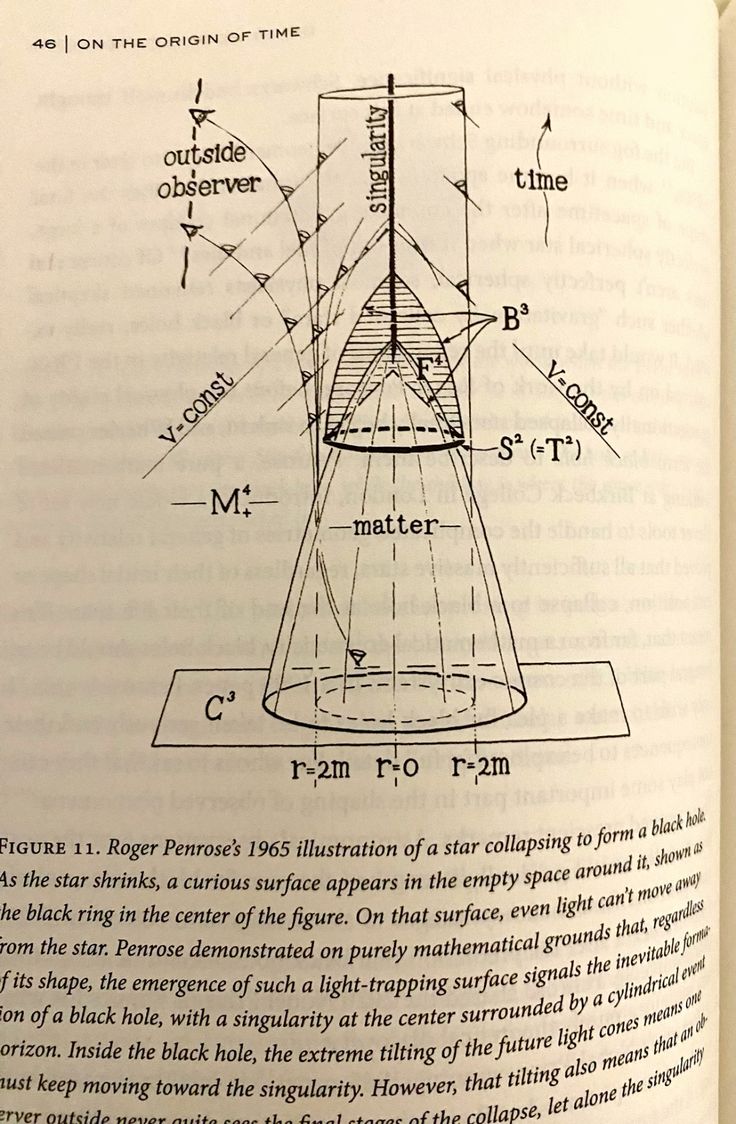
Roger Penrose's 1965 diagram from his seminal paper, "Gravitational Collapse and Space-Time Singularities". It was a key part of the work that earned him the 2020 Nobel Prize in Physics.
It represents the evolution of a star's gravitational collapse into a black hole and the subsequent formation of a singularity.
Before this paper, many physicists believed singularities might only form in perfectly symmetrical stars. Penrose used "global techniques" to prove that once a trapped surface forms, a singularity is inevitable, regardless of the star's shape or symmetry.
Why Is the Milky Way’s Black Hole So Small?
At the center of the Milky Way lies Sagittarius A*, a supermassive black hole containing ~ four million times the mass of the Sun.
Although that figure sounds immense, in galactic terms it is surprisingly modest. Galaxies broadly comparable to ours often host central black holes tens or even hundreds of times more massive.
This difference has drawn increasing attention because it challenges the long-standing idea that galaxies and their central bhs grow in close synchrony throughout cosmic history.
We have found that the mass of a galaxy’s central bh is closely linked to how stars move in the dense central region. In galaxies where stars near the core move faster under stronger gravitational influence, the central bh is typically more massive.
This empirical connection, known as the M–sigma relation, points toward a shared evolutionary process: as gas flows inward and fuels star formation, part of that material also feeds the black hole.
Energy released during accretion can then regulate further growth by heating or expelling gas, creating a feedback loop between the galaxy and its nucleus. Within this broader pattern, Sagittarius A* sits near the lower edge of expectations for a galaxy the size of the Milky Way.
One likely explanation is that our galaxy has lived a relatively quiet life. Supermassive bhs grow most efficiently during violent episodes, particularly major galaxy mergers.
When large galaxies collide, gravitational disturbances drive vast quantities of gas toward their centers, triggering intense accretion and sometimes transforming the nucleus into a bright quasar visible across the universe.
Current evidence indicates that the Milky Way has avoided such major mergers for billions of years, experiencing mostly minor interactions instead. Without repeated large inflows of gas, the central black hole simply may not have received enough fuel to grow rapidly.
Even today Sagittarius A* remains unusually inactive. Compared with actively feeding bhs elsewhere, it accretes matter at an extremely low rate. Gas exists near the Galactic Center, but much of it is turbulent, heated by stellar winds, or dynamically stirred in ways that prevent efficient infall. Only a tiny fraction ultimately crosses the event horizon.
In practical terms, the black hole is surrounded by material yet receives very little of it.
Past activity may also have limited its later growth. Observations in gamma rays and X-rays reveal enormous bubble-like structures extending above and below the Milky Way’s disk, suggesting that the Galactic Center experienced a more energetic phase a few million years ago.
Outbursts like these can heat or disperse surrounding gas, suppressing future accretion for long periods. A brief active episode can therefore shape the evolution of a galaxy long after the activity itself fades.
Another important point is that galaxy evolution is not uniform. The correlations linking bh mass and galactic structure describe statistical trends rather than strict laws. Different merger histories, environments, and gas dynamics naturally produce variation.
From this perspective, Sagittarius A* may not be anomalous at all; it may simply reflect a calmer evolutionary pathway than that followed by many similar galaxies.
Precise measurements of stellar orbits and observations from instruments such as the Event Horizon Telescope leave little uncertainty about the black hole’s true mass. Rather than indicating missing physics or observational error, its relatively small size likely preserves a record of the Milky Way’s past, a history marked more by stability than by catastrophic growth events.
Understanding why Sagittarius A* is comparatively small therefore refines our broader picture of galaxy formation, reminding us that cosmic evolution is governed not by a single predetermined track but by a range of possible histories shaped by environment, chance, and time.
The Schwarzschild Metric is a solution to Einstein's field equations that describes the geometry of spacetime around a static, spherically symmetric, non-rotating, and uncharged mass, such as a black hole or a star.





![Rainmaker1973's tweet photo. The James Webb Space Telescope (JWST) has delivered compelling evidence that a longstanding puzzle in cosmology—the Hubble tension—is not merely a measurement glitch but a genuine challenge to our understanding of the universe.
For over a decade, cosmologists have grappled with conflicting values for the Hubble constant (H₀), which quantifies the current rate of cosmic expansion. Measurements anchored in the early universe, derived from the cosmic microwave background (CMB) radiation via the Planck satellite, yield approximately 67 km/s/Mpc (roughly 46,200 miles per hour per million light-years). In contrast, "local" observations of nearby galaxies—using Cepheid variable stars as standard candles to calibrate distances and then Type Ia supernovae as further rungs on the cosmic distance ladder—consistently indicate a higher value around 73–74 km/s/Mpc (about 51,000 miles per hour per million light-years).
This discrepancy, though seemingly modest, is statistically significant and grows more pronounced with improved data, potentially signaling that the standard ΛCDM model of cosmology is incomplete.
Early skepticism focused on possible systematic errors in the local ladder, such as crowding effects in Cepheid observations or calibration issues with Hubble Space Telescope data. However, JWST's superior infrared resolution and sensitivity have now provided decisive cross-checks. By observing hundreds of Cepheid variables in galaxies spanning up to hundreds of millions of light-years away, JWST measurements align closely with Hubble's optical results—confirming the higher local expansion rate with unprecedented precision and ruling out major instrumental or methodological flaws as the culprit.
Joint analyses from teams like SH0ES (led by Adam Riess) show that JWST's data on Cepheids, combined with Hubble's long baseline, eliminate explanations tied to measurement artifacts with high confidence. The tension persists, implying that something fundamental may be amiss: perhaps new physics beyond the Standard Model, such as evolving dark energy, early-universe modifications (e.g., extra relativistic particles or changes in neutrino properties), or even exotic early dark energy components.
In essence, JWST has transformed the Hubble tension from a potential observational artifact into a profound hint that the universe may harbor undiscovered principles governing its evolution from the Big Bang to today. Future observations—with instruments like the Nancy Grace Roman Space Telescope—may help pinpoint the resolution, but for now, this cosmic mismatch stands as one of the most intriguing open questions in modern physics.
["JWST Observations Reject Unrecognized Crowding of Cepheid Photometry as an Explanation for the Hubble Tension at 8σ Confidence." The Astrophysical Journal Letters, 2024]](https://pbs.twimg.com/media/HDELfX3X0AEK-Ew.jpg)