No, you don't get it.
He does not have $1 trillion sitting in cash, it is 99% stock in his companies.
To make that wealth liquid would mean selling all that stock which would swiftly destroy *both* the companies (Tesla, SpaceX, others) and the wealth. If he sold it all, he'd end up with maybe $100b max, several hundred thousand people would be out of work, the companies ruined and many of their suppliers also ruined.
Okay, but now Elon has $100b in cash, and can "solve the world's problems".
$100b divided by the world's 8 billion people is $12
If you were in charge, several of the most innovative industrial companies in the world would be destroyed, hundreds of thousands out of work, and space would again close to human civilization for another generation.
But everyone on earth could have one nice meal and you could revel in your altruism.
"SpaceX's IPO is expected to create 4,000 new millionaires"
but.. but.. i was told that the only way for people to become millionaires and billionaires was to steal from workers!!1!
The scary part about Anthorpic's Fable nerf is not that it refuses to answer biology or cryptography. It's that it foreshadows what's coming. A world where a couple companies decide what you can and cannot do. They're building a new ruling class and you're not in it...
A 20 year old uni student working part time at Coles paying rent, internet, phone, textbooks, groceries, clothes and occasionally going out does not have enough money to buy shares. And if they do, it’s insignificant. It’s just not a reasonable hypothetical.
anthropic won't let you use fable for biology, chemistry, ai research, or anything that accelerates human progress. that makes it the perfect tool for developing blockchains
i’m just gonna make this probably wild prediction:
the move by Anthropic to silently sandbag on LLM research will force open-source labs to push harder on RSI/autoresearch.
the global coordination is even harder now. We’d just hope that the (1) open-source wouldn’t catch up; (2) if they do catch up, they have done enough alignment stuff; (3) nothing catastrophic would happen even if they haven’t done enough alignment.
it’s looking grim guys.
Apple finally did it.
Its new framework, Core AI, runs models entirely on Apple silicon, so inference happens on the user's device with zero server calls and zero token bills.
That means Qwen, Mistral, and SAM3 running natively across iPhone, iPad, Mac, and Vision Pro.
It's a memory-safe Swift API that compiles models ahead of time for near-instant load. Pulling one in takes a few lines:
let segmenter = try await ImageSegmenter(resourcesAt: sam3ModelURL)
let response = try await segmenter.segment(image: inputImage, prompt: "flower")
The launch goes beyond the runtime, though.
It ships curated open models packaged for Swift, PyTorch extensions to convert your own, and an optimizer that shrinks models layer by layer with minimal accuracy loss.
There's also a macOS debugger that profiles performance and traces behavior back to your original Python, plus Xcode tools to validate models before they ship.
For any team that wanted real on-device AI without a cloud bill attached to every user, this is the answer.
Models repo: https://t.co/yZCIhrM6YQ
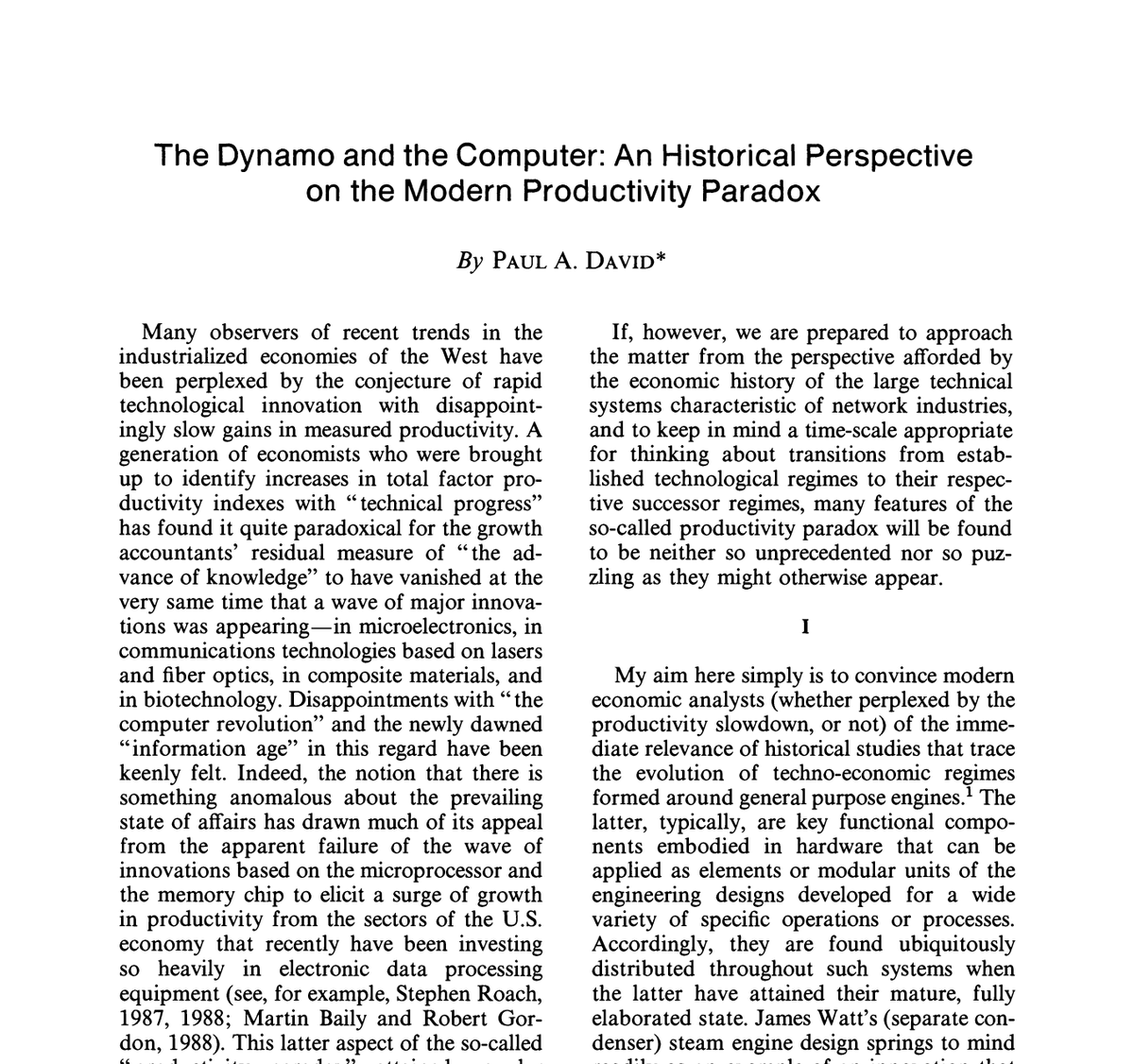
If you've adopted AI at your company but haven't seen any tangible results, read this 1990 article: "The Dynamo and the Computer" by Paul David.
When electricity first arrived, factories that "adopted" it barely got faster. They just swapped the steam engine for an electric one and ran everything else exactly as before: same machine layout, same workflow, same management. Electricity in, no real gains out.
The most common mistake with any new technology is to drop it into the old organization and then declare the transformation done.
The real leap came decades later, when each machine got its own small motor. Suddenly machines no longer had to be lined up around one central drive shaft. They could be rearranged around the actual flow of work.
The productivity gains didn't come from electricity. They came from REDESIGNING THE ENTIRE FACTORY around it.
AI is the same. Bolting it onto your existing process gets you a faster steam engine. The payoff comes when you redesign the work itself.
(link to paper in comments)