WHY NOW IS THE TIME TO FINALLY TAKE A CHANCE AND BUY $SNAP
1. It’s dirt cheap
Since 2013 it’s valution has stayed the same in that same time meanwhile it’s fincial metrics have surged:
Revenue: ~$4M → ~$6.5B = +162,400%
Monthly users: ~20M → ~1B = +4,900%
Daily active users: essentially 0 reported → 1 million ~500M= 10000% increacse
Today At 1.68 price-to-sales, it’s the cheapest AI play on the market. It’s trading like a consumer staple, but it’s one of the biggest AI apps in the world (has almost a billion users).
A game company that barely even sells games anymore ($GME at 2.4x sales) has a higher price-to-sales ratio than Snap. A company that makes a freaking lubricant used for metal pipes ($WDFC at 4.4x sales) has a higher price-to-sales ratio than Snap.
Even a cereal and jelly company like The J. M. Smucker Company trades around 2.2x sales — higher than one of the most-used social media platforms on earth.
Moral of the story: this thing is incredibly cheap. It’s dirt cheap. Like most AI companies on the market, this isn’t one you’re paying a premium for.
2. Evan won’t want this to be his legacy.
At some point, Evan will fold and make decisions that help the stock price because of the current sentiment and the way he’s viewed. He looks up to visionaries like Steve Jobs and Elon Musk, yet every week there’s a new article coming out on why he’s the worst CEO on Wall Street.
He’s slandered on all his socials for being a joke of a ceo and the only way to change that is to make investors happy and the change his narrative on Wall Street.
At the end of the day, he doesn’t want this to be the be-all and end-all of his legacy, and the only way for that to change is to get the share price up.
3. Value of $SNAP on the open market
The open market value If this thing went up for auction right now, the price would be up 200% instantly. For one of the most-used social media apps in the world, there would be lines of companies lining up to bid for this thing.
An Amazon or Microsoft would be going head over heels to acquire Snap, even if it meant paying a 200 billion dollar price tag. Why? It’s nearly impossible to get a social media app going with a billion users from scratch. In the history of the world, there have only been 8.)
4. Snap is about to become profitable.
16% of the workforce was laid off in a month, and with that, their numbers all around will look exponentially better. This will save over $500 million in yearly expenses starting in 2027, which could make it their first profitable year.
Don’t underestimate how a pivot to profitability can shift stock sentiment. Spotify, HOOD, and PLTR were all in the same place Snap is today. Once they hit profitability, they each 10x’d within a year.
SNAP hasn’t had a profitable Q3 throughout the decade of the company’s history.
In just over a month, $SNAP will break that trend…
And for the rest of the company’s existence, they will never have another unprofitable quarter.
You’re telling me you’re not buying the stock when the chart looks like this?
If so, you’re missing out on free money. 💰
Now is the time to buy $SNAP
[속보] $MSFT 마소 임원 내부 이메일 유출 "AI 학습은 인류 역사상 최대 규모의 노동 도둑질" ㅋㅋㅋ 자폭 레전드
뉴욕타임스(NYT)가 마이크로소프트(MSFT)랑 오픈AI 상대로 건 저작권 침해 소송에서 봉인 해제된 법원 문서가 공개됐는데 내용이 진짜 골 때림 ㅋㅋㅋ
마소와 오픈AI 핵심 관계자들이 뒤에서는 "우리가 만든 AI는 거대한 도둑질 위에 세워졌다"고 지들끼리 인정했던 내부 이메일이 법정에 적나라하게 까발려짐.
소송판 뒤집어놓은 내부 폭로 팩트랑 테크주 파급력 싹 정리해줌:
- "인류 역사상 가장 거대한 노동 절도"
마이크로소프트의 응용과학 부문 최고 책임자가 사내 이메일로 생성형 AI의 데이터 무단 수집을 두고 "인류 역사상 최대 규모의 노동 도둑질(largest theft of labor in human history)"이라고 규정함. 겉으로는 공정이용(Fair Use)이라며 문제없다고 언플하더니, 내부에서는 지들도 불법 무단 복제인 거 뻔히 알고 있었다는 소리임 ㅋㅋㅋ
- 비밀 크롤링 '프로젝트 망고(Project Mango)'의 민낯
마소와 오픈AI가 합작해서 언론사 글과 웹 데이터를 무차별로 긁어모으던 프로젝트 이름이 '프로젝트 망고'였음. 직원들이 "LLM이 웹 생태계를 파괴하는 파멸의 고리(Doom loop)를 만들고 있다", "콘텐츠 생산자들에게 실존적 위협이 될 걸 알면서도 눈감았다"고 자백한 기록들이 줄줄이 증거로 박힘.
- 공정이용 방어선 박살 난 오픈AI와 마이크로소프트
지금까지 빅테크들은 "인터넷에 공개된 자료 보고 공부한 거니까 저작권 침해 아니다"라는 논리로 버텨왔음. 근데 피고인 마소 임원이 "도둑질 맞다"고 인증 때려버린 문서가 튀어나오면서 재판부를 설득할 명분이 완전히 산산조각남.
- AI 테마주 주주들 긴장해야 할 사법 리스크
법원에서 저작권 고의 침해로 결론 나면 수십조 원대 배상금은 기본이고, 가장 무서운 건 "도둑질한 데이터로 학습한 기존 AI 모델 가중치를 전량 폐기하라"는 명령이 떨어질 수 있다는 점임. 챗GPT랑 코파일럿의 근간이 흔들리는 문제라 마이크로소프트 주가는 물론이고 AI 인프라 전체 밸류에이션에 거대한 악재로 작용할 수 있음.
결론은 AI로 꿀빨던 빅테크들이 내부자 자폭 메일 때문에 저작권 소송에서 제대로 외통수 걸림 ㅋㅋㅋ 거액 합의금으로 틀어막을지 아니면 모델 강제 리셋당할지 테크주 들고 있는 주붕이들은 법원 판결 주의 깊게 지켜봐라.
매수/매도 추천아님
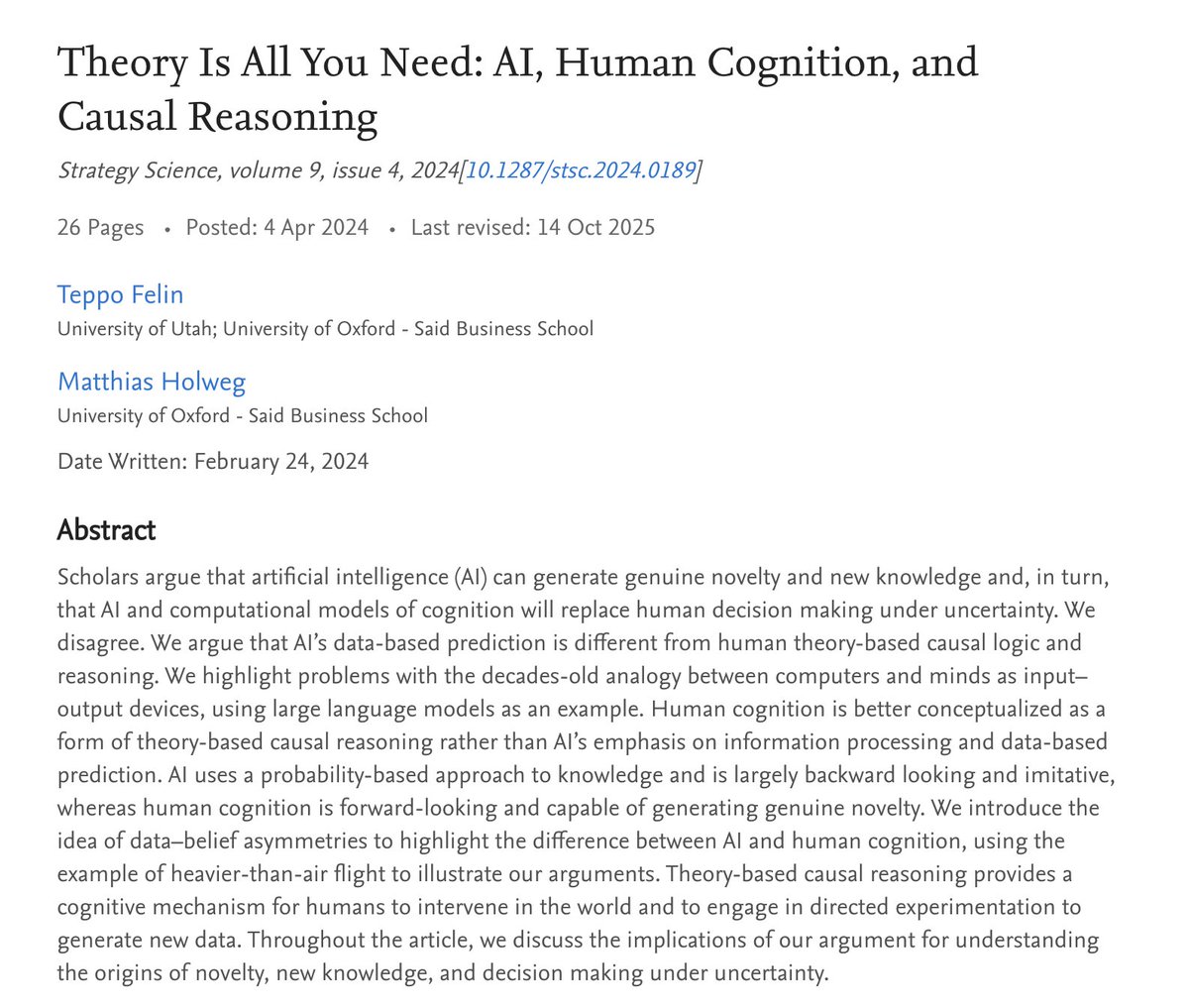
Oxford researchers argue that LLMs can never invent anything.
It is mathematically impossible.
They published a paper called “Theory Is All You Need" and it argues against the claim that computational models can generate genuine novelty or new knowledge.
They analyzed the limits of generative ai, and the results are a brutal reality check for the idea that ai will replace human decision making under uncertainty.
Here is why AI is stuck and human cognition wins:
backward-looking vs forward-looking.. llms are probability machines that look backward at existing data. human cognition is forward-looking and capable of generating genuine novelty. human cognition operates theoretically "top-down" rather than "bottom-up" from data.
the "data-belief asymmetry".. the researchers use the invention of "heavier-than-air flight" to illustrate this concept. an ai relies on data-based prediction, which is largely imitative. humans, however, use theory-based causal logic that allows them to hold beliefs that go beyond existing data.
the intervention gap.. humans don't just process information; we use theory to practically "intervene" in the world. we engage in directed experimentation to generate entirely new data. ai-based models are theory-free and place primacy on existing data and prediction.
tldr?
AI uses a probability-based approach to knowledge and ia largely imitative. It can process data and make predictions, but human cognition relies on theory-based causal reasoning.
The decades-old analogy comparing human minds and computers to mere "input-output" devices is fundamentally flawed.
OpenAI just told you the top is in, and they're HIDING it behind an AI safety lie.
Sam Altman confirmed they won't go public in 2026. A listing that was being lined up at up to $1 trillion, suddenly pushed out to 2027. Altman called going public right now "ill-advised," and blamed it on AI safety.
SPARE ME THE SAFETY EXCUSE
OpenAI raised money privately at an $852 billion valuation earlier this year, its most senior people are walking out the door, and Anthropic, its single closest rival, is sprinting to go public before the midterms at north of $2 trillion.
A company that truly believed it was building something too dangerous to sell to the public wouldn't be racing to sell shares to the public, and the rival sitting right next to it wouldn't be either. The safety story does not survive 5 seconds of scrutiny.
So let me tell you what this really is, because we've built this exact machine once before and it didn't end well:
The best breakdown of what's happening here came from @JayMartinBC, a commodities investor who traced the whole thing back to 2006. He talked about this a month ago and everything's turning out to be true.
Everybody points to 2008, the year Lehman fell and Washington started rescuing banks, but by the time those headlines landed the outcome was already decided. The year that settled it was 2006, and in 2006 every front page told you housing had never looked healthier.
What almost everyone missed was how those mortgages actually worked. The people writing them never expected to get paid back, because the entire plan was to keep rolling them over. A risky borrower paid a low teaser rate for 2 years, then refinanced against a higher home value and restarted the same 2 year clock.
The whole arrangement leaned on a single requirement that had nothing to do with how many people wanted houses: It needed acceleration. Prices had to keep climbing faster every single year or the whole thing breaks.
And in 2006 home prices never fell. They just slowed from rising 15% a year to rising 8%, and that alone was enough to bring the entire structure down. A homeowner whose house gained 8% could no longer pull enough equity out to replace the old loan, so the refinancing ladder broke and borrowers began defaulting in record numbers with prices still near their all-time peak.
The crash in prices was only the echo, and it didn't arrive for another year. The panic took two.
What you have to understand here: The loans broke the moment price growth merely slowed, long before prices themselves ever fell.
Now look at OpenAI through that exact lens.
It's never turned a profit and it loses tens of billions of dollars a year. It covers yesterday's bills by raising fresh money at a higher valuation, which is precisely what that subprime borrower did every time he refinanced against a bigger appraisal. Every round OpenAI raised from 2024 through 2025 came in somewhere between 1.7 and 1.9 times the size of the one before it. For a company bleeding this much cash, that ever-climbing valuation is the fuel, and it works right up until the number stops climbing.
The IPO was supposed to be the next rung on that ladder.
At $1 trillion it would've been a step of barely 1.2 times the last private round, the smallest jump in the company's entire life, and it was being teed up at the exact moment cheap Chinese models are dragging down what the American labs can charge for the same work.
And this weekend OpenAI refused to take even that shrunken step.
That's the sound of the acceleration stalling, and it's the same sound 2006 made before everything went downhill.
Roughly 40% of the S&P 500 now sits inside just 10 companies. If your retirement is in an index fund, you aren't spread safely across 500 businesses.
Nearly half of your money is riding on one belief holding together, the belief that these AI companies will somehow grow into valuations that have never ONCE made sense, before the acceleration gives out underneath them.
There are two things you need to do to be successful. You have to come up with the best decisions, and you have to have the courage to make them.
The real problem for most people is that they think the best decisions are only in their heads. The most important thing I learned was to take those ideas, put them out there, and stress test them.
Whatever success I’ve had in life has had more to do with my knowing how to deal with my not knowing than anything I know. That taught me how to take in what others have, and that has been a key thing.
#RayDalio #Principles #DecisionMaking #SuccessMindset
Every doctor, myself included, took an oath to do no harm. Look at what Dr. Fauci’s pandemic response actually did.
Kids lost years of learning. Small businesses that took a lifetime to build were closed while the big box stores stayed open. People lost their jobs over vaccine mandates. @mirandadevine
https://t.co/X4hVGPlt8q
BREAKING NEWS 🔥🔥🔥
Woody Harrelson urges British Prime Minister Andy Burnham to launch Covid vaccine inquiry
Woody Harrelson has signed an open letter to Andy Burnham calling for an inquiry into the Covid vaccine.
The American actor, who starred in Cheers and No Country for Old Men, joined scientists, campaigners and Pat Cash, the former Wimbledon champion, in asking the Prime Minister to reexamine the effectiveness and safety of the jab.
The signatories have urged Mr Burnham to suspend Covid vaccinations until an “independent examination” has been carried out.
“The Covid years divided families, communities, doctors and politicians,” Harrelson and others write. “Continuing to fight the same political battles will not heal those divisions.
“Finding out what happened might. You have an opportunity, at the beginning of your premiership, to approach this differently. We are not asking you to prejudge the evidence.
“We are asking you to open the door to its independent examination. If the concerns we and others have raised prove unfounded, a rigorous investigation should establish that. If they are justified, the public deserves to know. Either way, transparency is the only sustainable route to restoring trust.”
The Covid vaccines were developed in record time, with trials and analysis conducted in a few months when the process normally takes several years.
Experts insist that no corners were cut and that trials proved the vaccines were safe and effective, a finding that was then mirrored by real-world results that showed deaths plummeting after the roll-out.
Yet the jabs also triggered rare heart and clotting conditions. More than 2,000 people in Britain suffered myocarditis, inflammation of the heart, or pericarditis, heart lining, following vaccination, with young men particularly vulnerable.
Last year, Stanford University found that Covid mRNA vaccines, such as the Pfizer jab, could cause heart damage by triggering immune cells to go on the attack.
The letter was coordinated by Dr Aseem Malhotra, a British cardiologist
Pfizer said there is no evidence to suggest mRNA jabs are linked to cancer but the vaccines now carry warnings for myocarditis and pericarditis.
Other signatories include Dr John Flack, the former senior vice-president for drug discovery at SmithKline Beecham; Dr Henry Goodall, former president of the Society of Occupational Medicine; John Vincent, the co-founder of the restaurant chain Leon; and Peter Fleming, the sports commentator.
Full letter to the Prime Minister here
https://t.co/8F1mJ03rfq
Warren Buffett's greatest returns didn't come from Coca-Cola or Apple.
They came when he was a microcap investor. And his favorite stock had a $1.25M market cap.
In 1953, Buffett sells his ENTIRE GEICO stake for $15,259 and puts half his net worth into a stock no broker would ever pitch him: Western Insurance Securities of Fort Scott, Kansas.
The company was earning $16 a share while the stock traded between $12 and $20. One times earnings. With only 50,000 shares outstanding, the whole company was valued around $1.25 million, while sitting on a $22M bond portfolio and a book value of $86 a share. Buffett was paying roughly 37 cents on the dollar of book.
He found it flipping through Moody's manuals page by page. It was so illiquid he ran ads in the local newspaper to buy shares off farmers and townspeople.
By 1955 the stock hit $95. Roughly a 6x from his cost.
Buffett said his 50%+ annual years in the 1950s came from exactly this kind of hunting: "You have to find the companies that are off the map, way off the map."
But the story doesn't end there.
In 1976, when GEICO nearly went bankrupt with a $126M loss, the stock down from $61 to $2, and regulators circling, he came back. He saw the one thing that hadn't broken: GEICO was still the low-cost producer in auto insurance. No agents. Direct to customer. A moat that a few bad years couldn't kill.
He met new CEO Jack Byrne, started buying at ~$3, and backed the rescue financing when Wall Street wouldn't. GEICO's buybacks quietly grew Berkshire's stake to half the company. In 1996, he bought the rest for $2.3 billion.
The kid who knocked on GEICO's door in 1951 ended up owning the whole building.
He wasn't born a blue-chip investor. He was a microcap hunter first.
Dr. Joseph Ladapo is a Hero
The Chickenpox, Hepatitis B, Hib and Pneumoccal Vaccines are NO LONGER mandated for children in the State of Florida
“Vaccine mandates are wrong and immoral…they drip with disdain and slavery”
As a former FDA Commissioner and leader in Operation Warp Speed, Dr Woodcock had a duty to inform the public on what she knew about COVID-19 vaccine side effects. Instead, 5 years of shameful silence. @SenRonJohnson@RandPaul@SecKennedy
🔻The government’s 72 year old mandatory flu shot requirement for our military has been OFFICIALLY RESCINDED.
This is presumably because two studies confirm flu vaccines DON’T work – and actually INCREASE your risk of flu (+27%) AND other infections (+340%).
Share this until EVERYONE sees it.
⟁
Here is what still bothers me about the pandemic: The decisions that closed schools, shuttered businesses, and mandated vaccines were not made by anyone who faces voters. They were made by career bureaucrats, advised by outside interests, funded by private money, and none of it was disclosed as it was happening.
I have spent years trying to get to the bottom of what really happened and hold people accountable. I’m not backing down.
New Zealand whistleblower Barry Young: "They RAIDED my home & ARRESTED me for exposing deadly COVID vaccine batches."
Catastrophic death rate PFIZER batches:
🔴 Batch 1: 152 deaths out of 711 vaccinated → 21.4% dead
🔴 Batch 2: 38 deaths out of 221 → 17.2% dead
🔴 Batch 3: 48 deaths out of 310 → 15.5% dead
Normal background death rate in that period? Only 0.75%.
The statistical odds of this happening by chance? Roughly 1 in 100 BILLION.
His direct conclusion: “Statistically, there is no way this vaccine ISN'T killing people.”
Yet instead of launching an investigation… authorities raided his home and arrested him.
Two MASSIVE COVID shot studies involving 8.7 MILLION people confirm Fauci and Gates injected the world with CANCER:
BREAST CANCER: +54%
PROSTATE CANCER: +69%
LUNG CANCER: +53%
BLADDER CANCER: +62%
COLON CANCER: +35%
STOMACH CANCER: +34%
THYROID CANCER: +35%
🚨 ELON MUSK:
“I love fashion. Sometimes it’s viewed as frivolous and maybe not that important, but I think beauty is very important, as well as style and things that move the heart.
I like to walk around during the dinner and just admire the amazing outfits and the incredible fashion sense that people have. This is such a rare situation where you’ve got the most talented people in the world. It’s great. I love it.”
I've been early to almost everything.
My first trade at 13, bitcoin in 2010, tokenization in 2012.
You get scars by being too early.
But you also get to build the thing before anyone else believes in it.
Now we're going all-in.
Full story via @CoinSharesCo: https://t.co/5lfrfFOwF9
Novak Djokovic in his documentary on why he refused the COVID vaccine:
"Because I didn't need it. Why should I get the vaccine? I'm healthy, I'm an athlete. I had corona. I had immunity. I wasn't a threat to anyone. There was no reason for me to get vaccinated. It's my freedom to choose which that fundamental right that you have as a human being on this planet — the freedom to choose — which was taken from a lot of people."





![USAnt_IDEA's tweet photo. [속보] $MSFT 마소 임원 내부 이메일 유출 "AI 학습은 인류 역사상 최대 규모의 노동 도둑질" ㅋㅋㅋ 자폭 레전드
뉴욕타임스(NYT)가 마이크로소프트(MSFT)랑 오픈AI 상대로 건 저작권 침해 소송에서 봉인 해제된 법원 문서가 공개됐는데 내용이 진짜 골 때림 ㅋㅋㅋ
마소와 오픈AI 핵심 관계자들이 뒤에서는 "우리가 만든 AI는 거대한 도둑질 위에 세워졌다"고 지들끼리 인정했던 내부 이메일이 법정에 적나라하게 까발려짐.
소송판 뒤집어놓은 내부 폭로 팩트랑 테크주 파급력 싹 정리해줌:
- "인류 역사상 가장 거대한 노동 절도"
마이크로소프트의 응용과학 부문 최고 책임자가 사내 이메일로 생성형 AI의 데이터 무단 수집을 두고 "인류 역사상 최대 규모의 노동 도둑질(largest theft of labor in human history)"이라고 규정함. 겉으로는 공정이용(Fair Use)이라며 문제없다고 언플하더니, 내부에서는 지들도 불법 무단 복제인 거 뻔히 알고 있었다는 소리임 ㅋㅋㅋ
- 비밀 크롤링 '프로젝트 망고(Project Mango)'의 민낯
마소와 오픈AI가 합작해서 언론사 글과 웹 데이터를 무차별로 긁어모으던 프로젝트 이름이 '프로젝트 망고'였음. 직원들이 "LLM이 웹 생태계를 파괴하는 파멸의 고리(Doom loop)를 만들고 있다", "콘텐츠 생산자들에게 실존적 위협이 될 걸 알면서도 눈감았다"고 자백한 기록들이 줄줄이 증거로 박힘.
- 공정이용 방어선 박살 난 오픈AI와 마이크로소프트
지금까지 빅테크들은 "인터넷에 공개된 자료 보고 공부한 거니까 저작권 침해 아니다"라는 논리로 버텨왔음. 근데 피고인 마소 임원이 "도둑질 맞다"고 인증 때려버린 문서가 튀어나오면서 재판부를 설득할 명분이 완전히 산산조각남.
- AI 테마주 주주들 긴장해야 할 사법 리스크
법원에서 저작권 고의 침해로 결론 나면 수십조 원대 배상금은 기본이고, 가장 무서운 건 "도둑질한 데이터로 학습한 기존 AI 모델 가중치를 전량 폐기하라"는 명령이 떨어질 수 있다는 점임. 챗GPT랑 코파일럿의 근간이 흔들리는 문제라 마이크로소프트 주가는 물론이고 AI 인프라 전체 밸류에이션에 거대한 악재로 작용할 수 있음.
결론은 AI로 꿀빨던 빅테크들이 내부자 자폭 메일 때문에 저작권 소송에서 제대로 외통수 걸림 ㅋㅋㅋ 거액 합의금으로 틀어막을지 아니면 모델 강제 리셋당할지 테크주 들고 있는 주붕이들은 법원 판결 주의 깊게 지켜봐라.
매수/매도 추천아님](https://pbs.twimg.com/media/HTCFwaZbcAAn1tL.jpg)