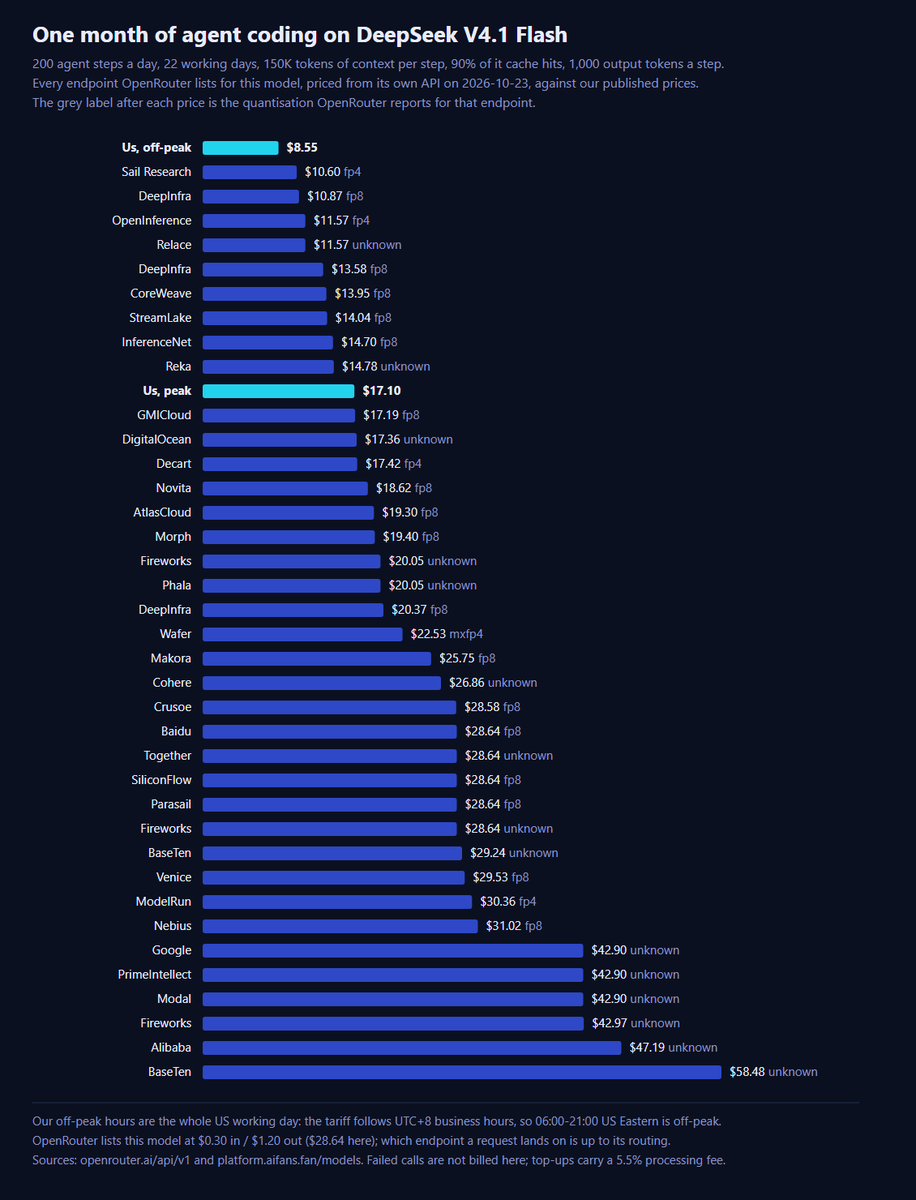
5/ Method, table and a calculator you can put your own cache-hit rate into:
https://t.co/mgRhbpAFkZ
Prices captured from OpenRouter's own API on 2026-10-23. Both sides change prices, so it's a snapshot, not a feed.
4/ Two bars are mine - I run the gateway. Off-peak we're the lowest line, because DeepSeek's tariff follows UTC+8 business hours and the US working day sits in its cheap window. At peak we're mid-table and 5 quantised endpoints beat us. The chart shows that too.
3/ Cheapest to dearest for one model name: 5.5x ($10.60 to $58.48). Everything more than 2x below OpenRouter's listed price is a quantised endpoint. The dearest are the big clouds: Google, Modal, Alibaba, BaseTen at $42-58.
2/ At a 90% cache-hit rate the cached-input price IS the bill, not the headline price.
CoreWeave: $0.15 input, $0.002 cached -> $13.95/month
InferenceNet: $0.103 input, $0.008 cached -> $14.70/month
Sorting providers by input price gives you the wrong answer.
1/ OpenRouter lists 40 endpoints for one model name (deepseek-v4.1-flash). 24 of them labelled fp4, fp8 or mxfp4. Prices 8x apart. I priced the same month of agent coding through every single one of them.
8 days ago, while jogging, I asked Claude to solve the Riemann Hypothesis
It didn’t. 1.5 days later, it proved >= 67% of the zeros are on the line (prev: 41.6%)
Still not sure what that means, but some analytic number theorists seem excited
https://t.co/vN10oM22HI
近期对 AI 编程的一些认识:
一、编辑器即将消失,Cursor 或将没落。
事实就是,现在已经没多少人去动手敲代码了,工程师们大量使用 Codex 和 Claude Code 来处理编码工作,然后通过 Git 对比新旧代码,如果没问题就直接提交。
二、代码质量变得廉价,将来没人会在意 AI 编程的“屎山”问题。
AI 编程会带来明显的性能和代码膨胀问题。但“屎山”是源自人类自身脑容量的局限,而不是 AI 的局限。以 GPT 5.4 举例,单次可以处理高达 1M 的上下文。
所以,你所认为的屎山,在 AI 面前可能从从容容。另外现有的硬件可以毫不费力的运行这些 AI 生产的软件,所以“屎山”不是问题,它只是工程师们的洁癖。
三、编程技能变得廉价,没有编码经验的人,使用 AI 编程的生产效率更高。
俗话说,乱拳打死老师傅,从古法编程过来的人,学过设计模式、快速排序的 N 种写法,以及所谓的程序设计艺术等等。但现在它们都不再奏效了,有了 AI,没人会在乎这些。
反而是没有编程概念的新手,不关注代码质量,只关注结果,往往能 Vibe 的更快更好。这对小型项目来说,是完全没问题的。
四、软件变得廉价,越来越多的软件公司正在倒闭
AI 编程让人人都有了生产软件的能力,这在过去是程序员们的特权,但现在每个人都有掌握 AI 编程这个杠杆的权力。
可以预见,随着AI 大语言模型的迭代,这些杠杆能撬动的价值只会越来越高。你只要掌握这种杠杆,不需要刻意学习专业技能,就能变得越来越强。
软件将会变成快消品,变得价格低廉,生命周期短,同时也更强调精细化竞争。
This is quite an impressive experiment. Vibe-coding the entire 2030 roadmap within weeks.
Obviously such a thing built in two weeks without even having the EIPs has massive caveats: almost certainly lots of critical bugs, and probably in some cases "stub" versions of a thing where the AI did not even try making the full version. But six months ago, even this was far outside the realm of possibility, and what matters is where the trend is going.
AI is massively accelerating coding (yesterday, I tried agentic-coding an equivalent of my blog software, and finished within an hour, and that was using gpt-oss:20b running on my laptop (!!!!), kimi-2.5 would have probably just one-shotted it).
But probably, the right way to use it, is to take half the gains from AI in speed, and half the gains in security: generate more test-cases, formally verify everything, make more multi-implementations of things.
A collaborator of the @leanethereum effort managed to AI-code a machine-verifiable proof of one of the most complex theorems that STARKs rely on for security.
A core tenet of @leanethereum is to formally verify everything, and AI is greatly accelerating our ability to do that. Aside from formal verification, simply being able to generate a much larger body of test cases is also important.
Do not assume that you'll be able to put in a single prompt and get a highly-secure version out anytime soon; there WILL be lots of wrestling with bugs and inconsistencies between implementations. But even that wrestling can happen 5x faster and 10x more thoroughly.
People should be open to the possibility (not certainty! possibility) that the Ethereum roadmap will finish much faster than people expect, at a much higher standard of security than people expect.
On the security side, I personally am excited about the possibility that bug-free code, long considered an idealistic delusion, will finally become first possible and then a basic expectation. If we care about trustlessness, this is a necessary piece of the puzzle. Total security is impossible because ultimately total security means exact correspondence between lines of code and contents of your mind, which is many terabytes (see https://t.co/boM9vZs3dh ). But there are many specific cases, where specific security claims can be made and verified, that cut out >99% of the negative consequences that might come from the code being broken.