Richard Feynman, Nobel Prize in Physics, gave a free 1-hour class on physics and imagination that made it clear most people know many things but don't know how to think.
Bookmark & watch today, no matter what.
Richard Feynman stood at a Cornell blackboard in 1964 and explained the problem every AI lab is fighting in 2026. The BBC filmed it. Almost nobody watches it.
The lecture is about why nature only answers in mathematics. Every team forcing language models to reason is hitting the wall he mapped 62 years ago.
He was 46. The Nobel Prize came 11 months later. The footage survived on film reels and now sits free on YouTube with fewer views than a keyboard unboxing.
Watch the blackboard section near the middle. He takes 1 of Kepler's laws and rebuilds it from nothing, with notation a 12-year-old can follow.
No slides. No jargon. 1 piece of chalk.
An ML engineer I know paused it 4 times and made his whole team watch it before standup.
You're 62 years late. The lecture is still free.
Persi Diaconis - Professor of Mathematics at Stanford University.
a coin toss isn't 50/50. it's biased ~51% to land the way it started. "flip it to the moon" - the bias stays. it's not a guess, it's a theorem.
Diaconis shows a "random" flip is pure physics: know the coin's speed and spin and you'd know the outcome. he measured it - ~5.5 mph, ~40 spins per second, half a second in the air. and he counted the spins with dental floss.
the beautiful part is the scale: a coin also precesses, so an honest description of its flight is a 12-dimensional problem. childish "randomness" hides physics at the edge of what can be computed. the takeaway: if it started heads, bet heads.
Andrew Ng dropped a 2-hour masterclass on how to scale and debug AI systems:
he got 93% of his training data for free - he never recorded it
here's the whole playbook:
step 1 → engine + fuel. a big model on small data never leaves the ground. both have to grow together
step 2 → does it fit the training data? no → build a bigger network
step 3 → does it fit the test data? no → that's overfitting. get more data
step 4 → out of data? don't collect more. copy what you have and add noise
step 5 → loop until both pass. "this is maybe 50% of my job"
most people go hunting for more data - theirs is already on the disk
the same rule runs Claude today: the fuel decides the ceiling, not the model
watch & bookmark - this 2-hour masterclass ↓
This recent paper posted by @MillerLabMIT got my attention.
It shows how abstraction could emerge in PFC. If you are in CS/AI, it's a fun one.
The paper is hard, but the main idea can be reduced to a low-d space, so I made a little animation.
Here is my toy model and notes:🧵
Emotions are fundamental to human life, but when dysregulated, they can contribute to anxiety and trauma-related mood disorders.
In a new #SciencePerspective, researchers dive into new approaches to understand emotions across species and how these insights could be used to advance treatments for psychiatric disorders.
Learn more: https://t.co/3RRhdCBNOq
Bumble bees are hardly nature’s most graceful creatures, and their name reflects it. But it turns out these bees show a surprising knack for rhythm.
The fuzzy insects can not only recognize a rhythm but also identify the same pattern when scientists change the tempo, according to recent research—the first time this ability has been documented outside of a few mammals and birds.
Learn more: https://t.co/5rdK3yWhzC @NewsfromScience
Information Geometry a la carte!
IG is about ***dual geometry***:
Build your own information geometry by choosing
(1) manifold M,
(2) metric g
(3) affine connection ∇, torsion-free
Dual connection is simply ∇*=2∇^g- ∇ using Levi-Civita connection ∇^g
see pinned tweet
At maximum likelihood estimator, observed Fisher information = (expected) Fisher information.
From 2nd Taylor expansion of likelihood:
- likelihood curvature = Fisher information.
- radius of osculating circle=Variance of MLE for large sample size
A Visual Introduction to Information Theory
(bookmark it)
Information Theory is such an beautiful and powerful subject.
In the era of AI, it's worth spending time learning about it.
Here is a highly-recommended read for anyone who wants real intuition for entropy and mutual information.
It's a visual, intuition-first guide to information theory.
It assumes only familiarity with basic probability, so it stays accessible while still reaching the fundamental limits of compression and transmission.
Paper: https://t.co/ydLqsF9ag8
Learn to build effective AI agents in our academy: https://t.co/1e8RZKs4uX
"The Foundations of Geometry"
by David Hilbert
Introduces "Hilbert's axioms" which are a set of 20 assumptions proposed by David Hilbert in 1899 as the foundation for a modern treatment of Euclidean geometry.
PDF: https://t.co/U2hqqS23Om
Wikipedia: https://t.co/8cml3YPMwJ
MIT's "Street Fighting Mathematics"
This course teaches the art of guessing results and solving problems without doing a proof or an exact calculation.
Book: https://t.co/n8o2YlrT7Q
Most explanations of the Kalman filter stop at the equations.
This paper goes further connecting it to Hidden Markov Models, replacing the standard EM algorithm with CMA-ES optimization, and testing the entire framework against trend following in live financial markets.
The result: Kalman filter based trend detection wins.
Bookmark & Must Read!
I illustrated the summary of my contributions to
"Non-Euclidean Computational Geometry and Its Applications in Machine Learning"
with many figures!
see pdf: https://t.co/9aMUFNkPGS
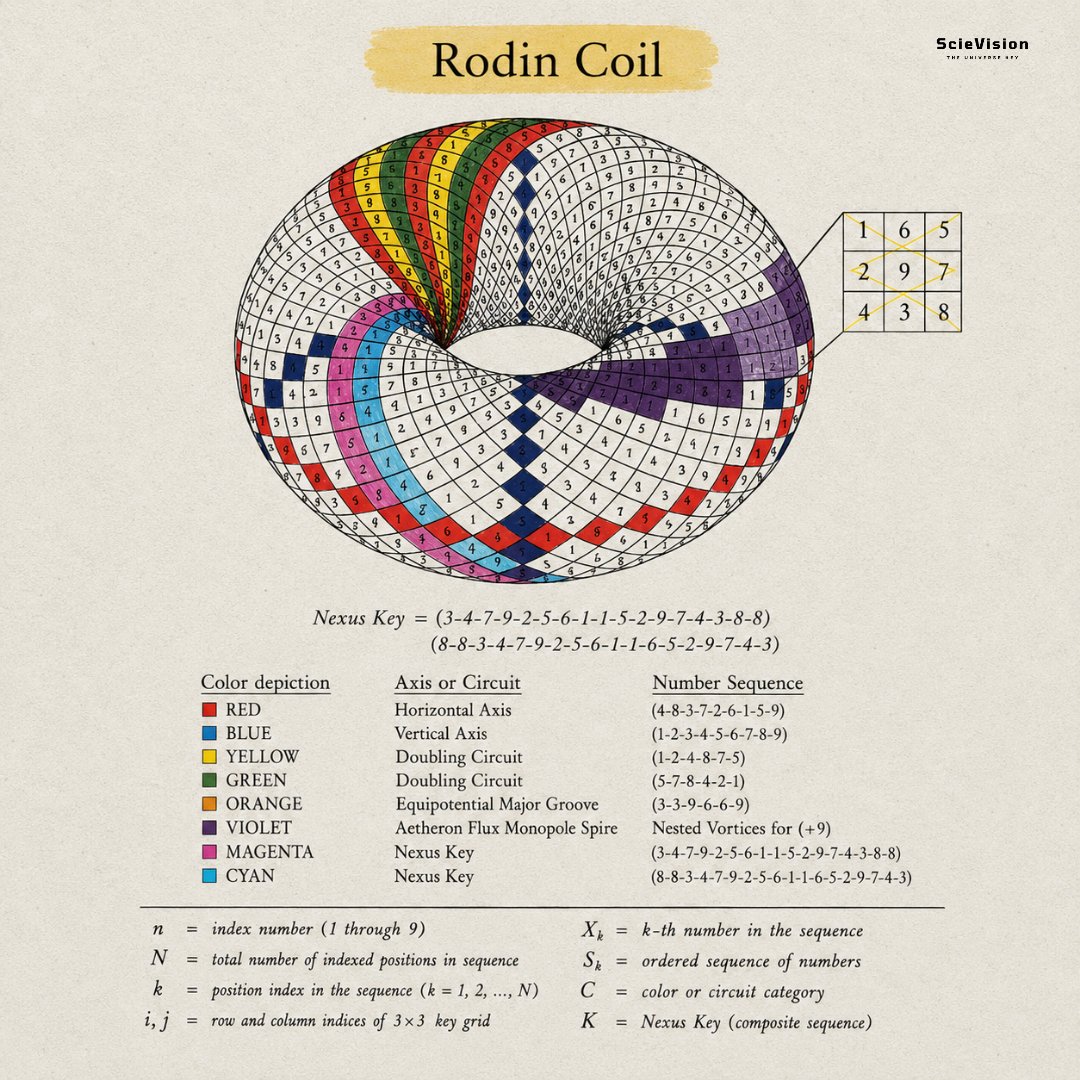
Rodin Coil ✍️
The Rodin Coil is a concept developed by Marko Rodin, an independent researcher outside mainstream academic science. He suggested that a pattern in how numbers behave when doubled and reduced to single digits reveals a hidden structure. This structure is visualized across the surface of a donut shape, called a torus, covered with colorful spiraling pathways of digits. It is important to be clear that this is not part of mainstream, peer-reviewed mathematics or physics. Professional scientists widely regard it as numerology rather than established theory, though it is genuinely based on one small piece of real mathematics. That real mathematics involves something called the digital root. This is the process of repeatedly adding up a number's digits until only one digit remains. If you start with one and keep doubling it, then reduce each result down to a single digit, something true and verifiable happens. The sequence falls into a repeating six-number loop: one, two, four, eight, seven, five. The numbers three, six, and nine never appear in that loop, forming a separate pattern of their own. This split is a real and checkable fact about modular arithmetic. It became the seed for Rodin's elaborate visual system, which traces eight different colored pathways around the torus. These include a horizontal axis, a vertical axis, two opposite-spiraling doubling circuits, a groove traced by the three excluded numbers, and a long composite sequence called the Nexus Key that supposedly unifies everything. The diagram shifts from real mathematics into speculation with additional physical claims layered on top. This is particularly true for the pathway labeled with terms like "aetheron flux monopole spire," which borrow from physics concepts that are either outdated, such as the nineteenth-century aether theory disproven by experiments in 1887, or never confirmed, like magnetic monopoles that have never been detected despite extensive searches. Proponents have built physical coils wound according to these number patterns, claiming unusual electromagnetic properties. However, these claims have not been validated through peer-reviewed scientific testing. The broader scientific community recognizes no electromagnetic effects beyond what standard physics predicts for a coil of that geometric shape. The honest way to view this image is as two separate layers: a real and elegant mathematical pattern in how doubling sequences behave, dressed up in an elaborate speculative framework of hidden energy and physics that falls well outside what the underlying arithmetic actually demonstrates.
The spinocerebellar pathways carry unconscious proprioceptive feedback and spinal motor-circuit signals to the cerebellum. There, this information is integrated with an internal copy of the motor command: the predicted consequences of the intended movement are compared with the sensory feedback returning from the body. From that comparison, the nervous system detects the mismatch between command and execution and adjusts the movement as it unfolds. This regulation supports smooth, coordinated movement, together with stable posture and gait.
Four tracts carry these signals. The cuneocerebellar and rostral spinocerebellar tracts mainly serve the upper body, while the dorsal and ventral spinocerebellar tracts mainly serve the lower body. The dorsal and cuneocerebellar tracts relay high-fidelity proprioception from muscles, tendons, and joints; the ventral and rostral tracts report instead on the activity of the spinal motor circuitry itself.
Footnote 🤭: The "four" is a functional convenience, not a clean anatomical count.
Los futbolistas de élite tienen habilidades cognitivas superiores al promedio de la población:
- Mejor memoria de trabajo (tanto en modalidad directa como inversa)
- Mejores funciones ejecutivas, especialmente flexibilidad cognitiva
- Mayor eficiencia en planificación y resolución de problemas (menor número de movimientos en la Torre de Hanoi)
- Mayor fluidez figural (generación de diseños nuevos en el Five-Point Test)
- Mayor velocidad de reacción manual (Simple Manual Reaction Time)
En cuanto a rasgos de personalidad (Big Five), muestran:
- Niveles significativamente más altos de conciencia (conscientiousness), extraversión y apertura a la experiencia.
- Niveles reducidos de neuroticismo y agradabilidad (agreeableness).
Además, algunas de estas habilidades y rasgos predicen de forma significativa el rendimiento real en el campo: número de goles, asistencias, regates exitosos...
Constructor theory's concept of "superinformation" shares many of the properties associated with consciousness. I think a reasonable "inference to the best explanation" is that consciousness requires a superinformation medium
Voronoi diagram (black points) computed by projecting vertically lower envelope of n 3D graphs of functions {(x,y_i(x))} with y_i(x)=D(x_i,x) (pink).
When distance D(x,x')=‖x-x'‖^2, graphs of y_i are paraboloids and Voronoi cell borders are linear