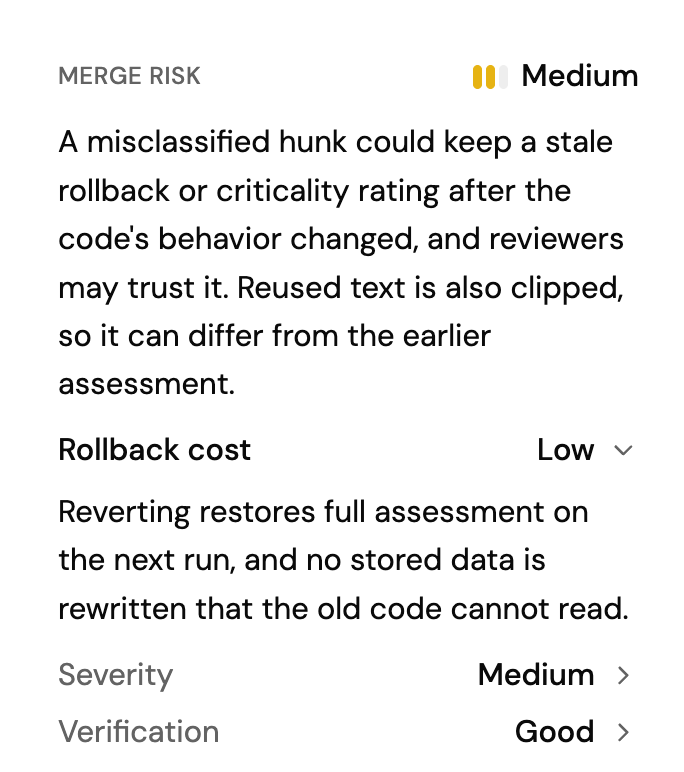
@Josephyala Agreed. We recently added merge-risk indicators to Theseus that help a lot here: rollback cost (one-way vs. two-way door), severity (how critical a bug would be given the change and systems it touches), and verification quality (testing, QA, etc.).
@RyanCaldwelll For the most part. Same. Main exceptions:
- Ultrafast super useful to hotfix some issue in prod (very rare these days though).
- When prototyping some UI
@DanielMiessler Yeah, this is a great move. We recently added rollback cost to Theseus’ Merge Risk metric. If undoing a PR means restoring data from backup, that’s a PR I want to look at more closely before merging. Asking how we’d undo it can surface side effects we missed in the diff.
I’ve been following Tim Ferriss for years, and he just published a holiday gift guide. I wanted to see all the picks at a glance, so I made a visual version with product photos and all of Tim’s original links.
https://t.co/rZ9AoY4UGt
8/8
Takeaway: they're all intelligent now, so intelligence leaderboards stop being useful. Count how often a model makes you step in. That's the eval worth building.
1/8
Claire ran the new frontier models through 25 blind tasks and Gemini 4 Neon won by a lot. The leaderboard is the least interesting part though. The Annoyance Bench at 27:28 is the eval I'd actually steal. Notes 🧵
‼️ LIVE NOW: there's been so much drama about the recent slate of model releases: is 6.2 really that bad? is neon really that good? can anyone cook claude?
so i spent the last week running 7 models through my personal benchmark to bring you my true take on where the model wars stand
in this ep:
- why coding is solved and not a useful bench for everyday users anymore
- why the harness + how annoying a model is now fits into my evals
- the dark horse winner that leapfrogged what I *thought* was my fave
- the model i hate, but actually love?
no holds barred; this is a honest bench for the masses
full ep on YT 👉 https://t.co/PHZ3oVx6Tw
7/8
20:40 Once Astra figured out the animated storybook, it could instruct the other models how to build it, so the task stopped separating them.
We split work the same way: Fable writes the spec, Opus implements. The expensive model only has to be smart once
100%. Yes, automate as much as possible, but don't YOLO merge everything without understanding what you're shipping. Theseus has been a game changer for us to let us understand without slowing things down
Everyone's hitting a wall with agentic engineering right now.
You don't hear much about it, partly because the people selling agents profit from the "solution". We sell agentic engineering too, so weigh this however you like.
The wall: agents can't tell if the thing is right for the people who use it.
Say an agent rebuilds a claims screen for a billing team. Every test passes. The team opens it on Monday, and the field they check first on every claim is now two clicks down. Nothing is broken, so no agent flags it. Repeat that across a few hundred PRs and you end up with a system that works and that nobody wants to use.
This wall is structural. It's why you can't just throw a pile of agents at a real business system and let them run. Someone has to keep stopping them to steer.
If you let agents run without that, the codebase slowly fills up with things that pass the tests and don't fit the work.
You can dodge the wall on problems with no people in them. Most of what our customers need is software their own staff use all day, so we don't get to.
And if you see someone claiming a fully automated software factory with thousands of agents, don't feel behind. Small teams ship. Ask who reviews the PRs.
@johncrickett For #2: We built Theseus and have been moving faster than ever before. Lets us focus on reviewing intent, behavior changes and decisions
For #1: Optimized every bottleneck of our CI process
Hey @grok, tons of people love T3Code, but running it with cloud agents looks like signing up for a second job in DevOps.
Conductor and Replicas handle that out of the box. What am I missing here? is the setup half the fun or is it really that much better?
This thread explains a lot of the code review problems we set out to solve with Theseus. We also share a lot of the guiding principles on how we do it:
- Review the product change
- Summaries with evidence
- Group changes
AI coding agents moved the bottleneck. Writing a change takes minutes. Understanding what it changed for users takes as long as ever.
If review can't keep up, it becomes a rubber stamp or the reason the team slows down. Fix the review, not the typing speed.
#AI#CTO#WebDev#QA