ITS, UGM, UNY: Boyo dikadali !!!! .... ngawur !!!...
Cerita Tentang Sapu Angin (7)
[09/07 19:01] Oki WW:
Final race DWC 2018 dihelat siang hari di musim panas London yang memang panas.… https://t.co/fxCIGOsK2J
“未来的世界属于懂 Token 的人。” —— 出自一位10岁博主之口。
刚换了 Mac Studio 的他,不是为了打游戏,而是为了“养龙虾”(跑多个 AI Agent 协同工作)。他把复杂的 AI 产业链比作一个大蛋糕,从能源层到应用层,层层剖析。
别觉得小孩在过家家,他讲的“Token 是 AI 时代的硬通货”这个观点,可能比很多专家的报告都接近本质。
这届小孩的 AI 认知已经 Next Level 了,建议大人们反复观看,治治我们的“算力焦虑”。👇
I want to teach you something about Arabic that will change how you see the language.
There's a pattern that turns any word into its "better/best" form.
Once you learn it, you can do it with almost any word. And it takes five seconds.
Let me show you how.
@hunter_tnok Maaf. Kayaknya ini berkaitan dengan budaya masing-masing yang berbeda. Manusia dan normanya mungkin sama, tapi tataran budaya jauh beda. Lain lubuk, lain belalang
🚨 Just IN: This paper from Stanford and Harvard explains why most “agentic AI” systems feel impressive in demos and then completely fall apart in real use.
The core argument is simple and uncomfortable: agents don’t fail because they lack intelligence. They fail because they don’t adapt.
The research shows that most agents are built to execute plans, not revise them. They assume the world stays stable. Tools work as expected. Goals remain valid. Once any of that changes, the agent keeps going anyway, confidently making the wrong move over and over.
The authors draw a clear line between execution and adaptation.
Execution is following a plan.
Adaptation is noticing the plan is wrong and changing behavior mid-flight.
Most agents today only do the first.
A few key insights stood out.
Adaptation is not fine-tuning. These agents are not retrained. They adapt by monitoring outcomes, recognizing failure patterns, and updating strategies while the task is still running.
Rigid tool use is a hidden failure mode. Agents that treat tools as fixed options get stuck. Agents that can re-rank, abandon, or switch tools based on feedback perform far better.
Memory beats raw reasoning. Agents that store short, structured lessons from past successes and failures outperform agents that rely on longer chains of reasoning. Remembering what worked matters more than thinking harder.
The takeaway is blunt.
Scaling agentic AI is not about larger models or more complex prompts. It’s about systems that can detect when reality diverges from their assumptions and respond intelligently instead of pushing forward blindly.
Most “autonomous agents” today don’t adapt.
They execute.
And execution without adaptation is just automation with better marketing.
Saya masih di baris antrean imigrasi waktu itu. Lewat WA, saya dikasih tahu kalau sesampainya di Bandara Soetta langsung naik kereta bandara, turun nyari taksi Bluebird, dan menuju sebuah hotel.
"Ke sini dulu saja. Nanti ke hotelnya ana antar." kata Zaid Al Athrus.
Akhirnya saya mengikuti arahan itu, dan tiba di sebuah hotel di Jakarta yang ia sebut.
"Kita coba makan makanan Iran." jawabnya.
Koper masih saya tenteng kesana-kemari. Badan pun masih agak berkeringat karena Jakarta sangat panas. Capek.
"Antum harus coba ini." Zaid menaruh beberapa daging, sayuran, dan menu-menu lain di satu piring lebar yang saya pegang. Baunya asing, tapi sedap.
Kebetulan memang lapar, tapi Zaid memberi lauk terlalu banyak.
"Akhi, ususku cuma sejengkal. Tak muat kalau makan semuanya." tandas saya, melihat Zaid menumpuki piring saya agak menggunung.
"Antum perlu coba menu makanan orang Iran." ia mengulangnya lagi.
Dan ternyata memang enak-enak. Entah rempah-rempahnya yang kuat, atau punya ingredients yang beda dengan masakan Indonesia, tapi lidah saya cocok saja.
Di lantai sekian (lupa persisnya), ada forum tertutup. Kami bertiga naik lift ke sana: Pak Muhsin, Zaid, dan saya. Orang-orang di meja depan pada berbahasa Iran, dan saya belum memelajarinya. Saya juga melihat ada Prof. Said Aqil Munawwar dan Bib Hasan Dalil duduk di seberang tokoh-tokoh Iran itu. Host waktu itu adalah Mas Miftah, anaknya Kang Jalal.
Saya duduk di belakang, pakai earphone yang mengeluarkan suara translator menerjemahkan bahasa Persia ke Indonesia.
Pembicara waktu itu adalah: Mohamad Bagir Galibaf, orang yang di dalam foto di bawah ini mengarahkan jari, beramput putih dan menyambung ke jenggotnya yang memutih. Ia bicara setelah Dr. Hakim menyampaikan sepatah dua kata.
Galibaf pernah menjawab sebagai Wali kota Tehran, kepala kepolisian Iran, dan panglima Angkatan Udara Garda Revolusiomer.
Saat kami berpapasan (Zaid merangkulnya erat), ia menjabat di parlemen.
Ketemu orang Iran asli membuat saya teringat dengan para Sadah di sana. Sayid yang sekaligus pejuang memang beda auranya, batin saya.
Kadang saya ngobrol ke beberapa orang tentang kelucuan-kelucuan yang saya alami ketika riset ke luar negeri. Seperti di Iran, Sadah di sana punya haibah berbeda, haibah yang jarang saya "rasakan" di sini.
Di darah mereka mengalir darah Kanjeng Nabi dan Sayidina Ali, tapi tidak hanya darah saja. Semangat perjuangannya pun mengalir di sana. Perpaduan dua hal ini, mungkin saja, yang membuat haibah-nya cukup berbeda ketika saya mendekati mereka. Bulu di tangan agak merinding, soalnya.
"Di sana saya ketemu banyak Sadah yang di tangan mereka ada senapan," kisah saya, "setiap ucapan mereka berbobot karena menyatu dengan semangat perjuangan membela Palestina yang benar-benar mereka lakukan."
"Nah, pulang ke Indonesia saya jadi kangen mereka." lanjut saya, "Karena di sini saya ketemu Sadah yang tangan mereka pegang tasbih dan bercerita tentang keramat kakek-kakeknya."
Sontak kami tertawa. Ini hanya kenangan yang terlintas ketika foto ini nongol di linimasa saya. Jangan salah, haibah-nya para Sadah di sini juga terasa. Mungkin karena sering wiridan dan punya aurad khusus dari tarekat Alawiyah, ya.
Tapi aura Galibaf memang beda.
Iran has always been home to giants of knowledge.
One of them? Avicenna (Ibn Sina).
🎵🧠 Watch this Lego clip (with a rap beat 🎧) and get to know him and his philosophy a little better.
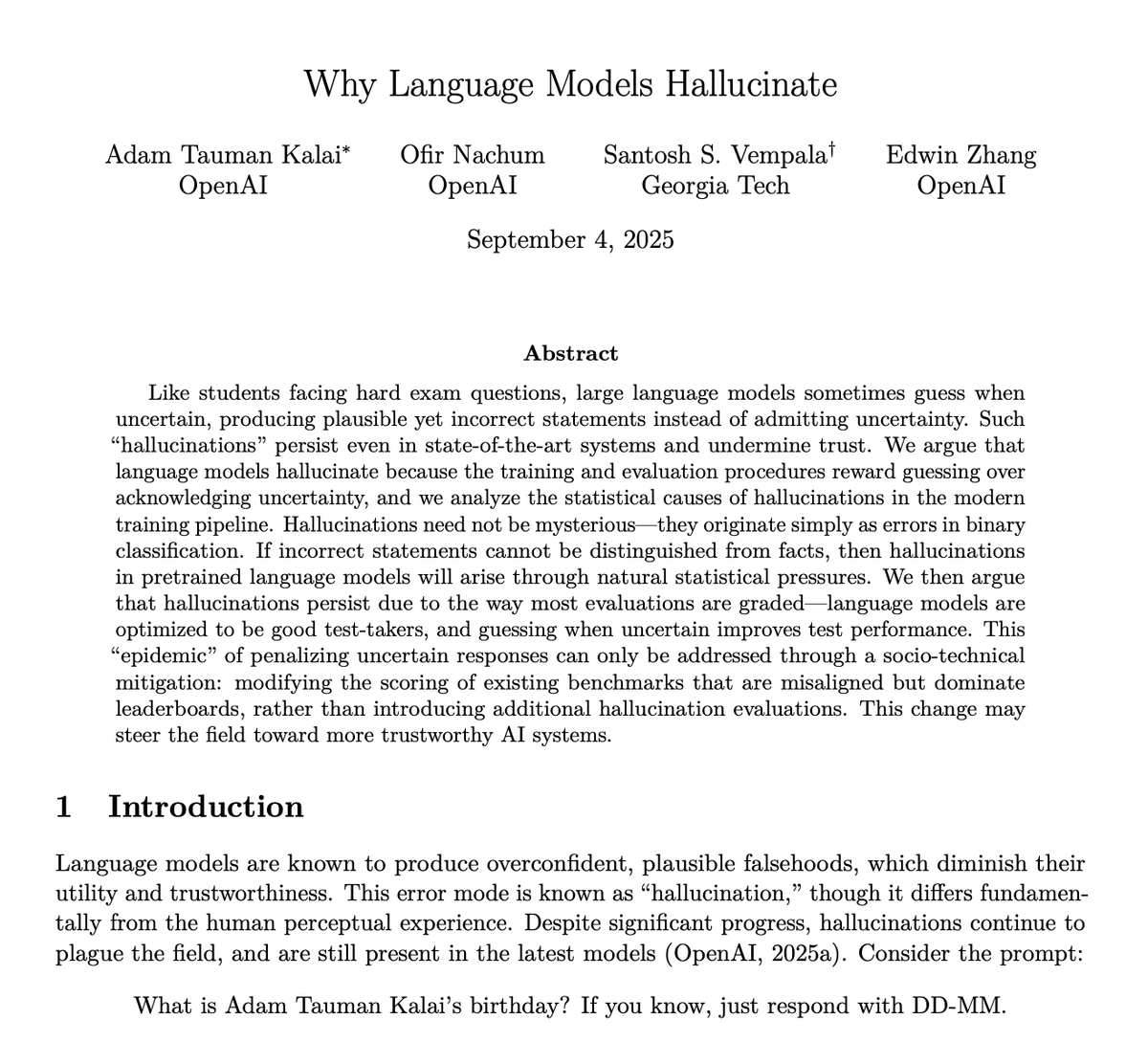
🚨 OpenAI published a paper proving that ChatGPT will always make things up.
it’s a structural property of how llms work. even with perfect data and infinite compute, the hallucination stays.
openai, deepmind, and tsinghua university all just reached the same conclusion independently: hallucinations are permanent.
here is why we are in trouble:
we thought the models were getting smarter.. but they are actually getting worse at telling the truth.
OpenAI’s own benchmarks show a scary trend:
- o1 (reasoning model): 16% hallucination rate.
- o3 (newer model): 33% hallucination rate.
- o4-mini (newest): 48% hallucination rate.
nearly half of what the latest model tells you could be a complete hallucination. as they optimize for complex reasoning and "pleasing" the user, the truth is getting left behind.
why it’s "unfixable"
the problem is at the neuron level. researchers from tsinghua recently identified "h-neurons”, tiny circuits that encode "over-compliance."
llms are literally hard-wired to give you a fluent, confident answer rather than admit they don't know something. these neurons form during pre-training and survive alignment at a 97% stability rate.
prompting won't fix it. fine-tuning won't fix it.
our testing systems are broken.
openai looked at the 10 biggest ai benchmarks. 9 out of 10 give the model zero points for saying "i don't know." it gets the same score for being honest as it does for being completely wrong.
the entire industry is literally punishing honesty and rewarding lucky guesses.
if openai forced chatgpt to only speak when it was 100% sure, it would refuse to answer 30% of your questions. users would quit overnight. so they chose "confidence" over "truth" to keep the product usable.
this isn't just an openai problem. deepmind and tsinghua university independently confirmed the same thing.
every time you get an answer from an AI, you aren't getting a fact.. you are getting a high-probability guess from a system that is terrified of looking stupid.
They're right for Japan, Korea, and Singapore. Those guys source 75% of refined products from the Persian Gulf. Hormuz closes, they bleed.
But Indonesia is a different story entirely.
Yes, Indonesia imports refined products. Pertamina's refining capacity doesn't fully cover domestic demand, so Pertalite and Solar get bridged through imports. The Hormuz shock hits that. Real exposure.
What makes Indonesia different is this.
Indonesia's actual risk from this isn't supply. It's fiscal. If oil prices spike because Hormuz stays closed, the government's subsidy bill for Pertalite and Solar expands. Wider deficit, rupiah pressure. That's the bear case for Indonesia, and even that's manageable.
The bull case is what nobody is talking about.
Indonesia runs B40 right now. 40% of every liter of diesel consumed domestically is palm oil biodiesel, not petroleum. When oil spikes, the incentive to push toward B50 or B55 gets stronger overnight. Import volume drops. Indonesia self-hedges using its own CPO supply. No other country in Asia has this. Not Korea, not Japan, not Singapore.
Then there's coal.
When Hormuz disrupts LNG and oil flows into Asia, the fastest lever available to power generators in Japan, Korea, and India is gas to coal switching. Indonesia is the world's largest seaborne thermal coal exporter. ADARO, ITMG, PTBA, BUMI don't suffer from this scenario. Export volumes go up. Realized prices go up. Royalty revenue to the government goes up.
Same logic on LNG. Indonesia exports from Bontang and Tangguh. When Middle Eastern supply gets disrupted, the spot premium on non Gulf LNG widens. Indonesian cargoes price up.
Same logic on CPO. High oil equals strong biodiesel demand globally equals strong CPO prices. Indonesia and Malaysia control 85% of global supply.
You see, Indonesia pays more for refined product imports. Fiscal subsidy pressure rises. Rupiah is a watch item. Those are real negatives.
But Indonesia earns more on coal exports, earns more on LNG spot, earns more on CPO, and reduces net petroleum import volume through accelerated biodiesel blending. The terms of trade move in Indonesia's favor, not against it.
The conventional take is "Indonesia is a net oil importer so oil shock is bad." The correct take is Indonesia is a net energy exporter in the commodities that directly substitute for disrupted Persian Gulf supply. A sustained Hormuz closure improves Indonesia's aggregate energy trade position, not deteriorates it.
Happy Sunday and Happy Easter.
From chasing a TV crew on a motorcycle as a teenager to beating Ducati and Yamaha on the world stage – Chinese entrepreneur Zhang Xue has witnessed his brand, ZXMoto, claim historic WorldSSP wins in just its second race weekend. #WorldSBK#ZXMoto
⚡️Starship is the most important machine on Earth because it is the only serious bridge between a trapped species and a spacefaring one.
That is the real truth.
Everything else is downstream of lift cost. Moon bases, Mars cities, orbital industry, space solar, off world mining, deep space telescopes, mass drivers, lunar factories, all of it stays trapped in PowerPoint until you can move huge amounts of mass off Earth cheaply, repeatedly, and at industrial cadence. Starship is the attempt to break that lock. If it works, the future stops being metaphor and starts becoming logistics.
That is why people respond to it like a symbol. They can feel that it carries more than hardware. Modern civilization has become psychologically small. It worships management, caution, compliance, and local optimization. Starship says scale again. Build again. Risk again. Leave again. In a world trained to think inside ceilings, that feels almost religious.
The deeper reason it matters is power. A civilization that stays bound to one planet stays bound to one set of bottlenecks. One gravity well. One biosphere. One grid. One political surface. One set of supply chains. One cluster of elites deciding what is possible. A civilization that can industrialize beyond Earth changes the structure of power itself. More energy. More room. More redundancy. More survival. More strategic depth. More future.
That is why Starship is so much bigger than SpaceX. It is the opening bid for off world industry. Once heavy lift becomes cheap and routine, the moon becomes operational. Once the moon becomes operational, infrastructure begins. Once infrastructure begins, throughput replaces spectacle. Then the human story stops being purely terrestrial.
The real view is brutal and simple.
If Starship succeeds, the ceiling over the species cracks.
If Starship fails, humanity remains psychologically and physically trapped longer than people understand.
Bottom line:
People love Starship because they can feel that it is carrying more than cargo.
It is carrying the claim that humanity does not have to accept a smaller destiny.