My daughter is 2. Her grandparents live 6000 miles away.
So I built her a box. When they send a photo, a big button lights up.
She presses it. Grandma comes out. 💛
I guess this is what PMF looks like :)
Mondo Duplantis raises the pole vault record one centimeter at a time, and gets paid each time. Research has run on the same incentives: small, fundable steps. AI just cleared the bar by a meter. The question now isn't who gets scooped, it's what we fund next.
NYU math professor Tristan Buckmaster says OpenAI’s Tuesday drop of 722 AI-generated math papers wiped out entire research programs:
“This recent dump of papers on Tuesday destroyed the careers of early career mathematicians.”
Our first look at Bytedance's new World Model, and it looks impressive (Subtitled video):
More than just a world model, check out what it can do with Camera Paths in Stephen Chow's King of Comedy.
Text-to-navigable 3D worlds: A single sentence/description generates an explorable virtual environment.
Free exploration: Users can roam or fly through the scene (e.g., on a paper plane) with keyboard/mouse controls.
Real-time interaction and editing: Spawn objects on demand (such as a spoon), interact with them (climb it), and further modify the scene with additional commands.
Cross-scene connectivity: An “any door”/portal feature that links unrelated environments (e.g., walk out of a room into outer space).
With everyone busily using LLMs + Blender/Three.js to make 3D models, I thought I'd try a different geometric representation.
This dragon isn't a mesh, NeRF, 3DGS, or video model: it's 27kb of GLSL code (generated via LLM), defining a closed-form implicit surface. 🧵 [1/n]
The underrated Odyssey-3 chart: physics vs cost. On Physics-IQ, Odyssey-3 beats FLUX 3 and NVIDIA Cosmos3 on getting motion right over time, at 1/6 the price per video. For now robots need millions of practice runs, so that ratio is the whole game.
Today we're launching Odyssey-3, the most powerful foundation world model yet.
It sets a new state of the art on Physics-IQ, and powers robots, trains AIs, and generates interactive experiences. It's really cool.
Experience the model today, all for free!
Simulation is only as useful as its resemblance to reality.
1. Explore the Places Library, a collection of 100 real-world reconstructions
2. Bring them into NVIDIA Isaac Sim or Isaac Lab
3. Relight each environment to train policies across changing conditions.
The goal: zero-shot transfer from simulation to the physical world.
Explore Niantic Spatial for Embodied AI: https://t.co/4jcQw9hmKt
#EmbodiedAI #PhysicalAI #SpatialAI #AI #Robotics
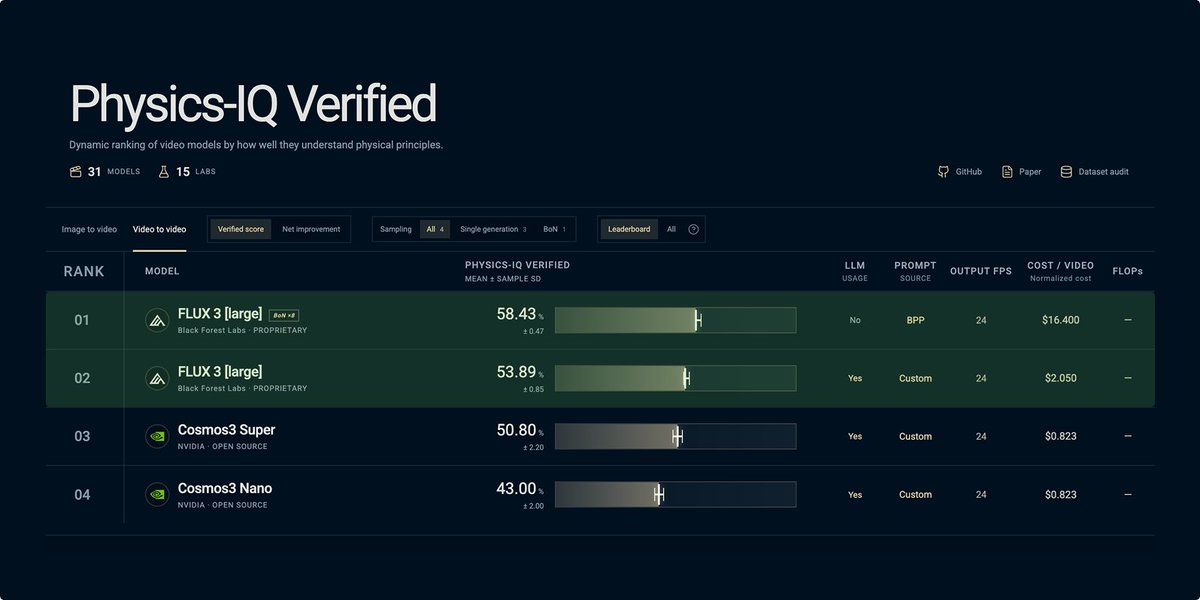
FLUX 3 is #1 on Physics-IQ, @GoogleDeepMind's benchmark for physical world understanding in video models.
How Physics-IQ works: given the start of a real filmed experiment, can a model predict what physically happens next? Tests span fluid dynamics, optics, solid mechanics, magnetism and thermodynamics, covering how liquids flow, light behaves and objects interact.
In most cases, we substantially outperform all other frontier models, Seedance 2.5, MiniMax H3, Gemini Omni 1.1 Flash, Veo 3.1 and Sora 2, Cosmos3.
The FLUX 3 base model outperforms all other foundation models, while FLUX 3 paired with a physics verification layer scores even higher.
The FLUX 3 backbone, with its strong physics understanding, gives FLUX 3 Action it’s strong action prediction for robotics, while also giving FLUX 3 Video physically accurate motion when you’re creating content, making ads, films and product shots.
My benchmark for video models on motion and physics: recreate Sony's 2005 Bravia ad, bouncy balls pouring down a San Francisco hill.
Closing the gap. Right: Claude Opus 5.5 simulated and rendered 3,000 balls in Blender, over an empty Wan 3.0 street. Left: Wan 3.0, prompt only
This week - Memorizon and MosaiChunk both tackle leave-and-return in video world models: one bakes memory into training, the other freezes the generator and adds a memory router. WM are hitting a memory wall, not a pixel wall.
https://t.co/dg5efCPzFK
https://t.co/KcI0tRqKLD
Video generation isn't only a creative bet anymore. Runway's Praxis-1 is an open-weight World Action Model that turns video priors into robot control. Next question: how much of the creative world-sim stack transfers to policy?
Introducing Praxis-1, an open-weight World Action Model that turns our video pre-training expertise into real world control for robots.
Robot demonstration data is limited. But video data is infinite. Praxis-1 extends our bet that the best policy models will learn from video, and use that scale to bring embodied intelligence to every industry.
Praxis-1 is built on our large-scale video pre-training and real-time infrastructure, and acts as a policy model for robotics developers and researchers that works across any embodiment or environment, no matter how complex.
We are actively testing with early partners including Noble Machines, Standard Bots and Ultra, and will be releasing the weights publicly in the coming months.
Learn more and request early access at https://t.co/DzCMQpYNXQ