Like many scientists of my generation, I entered the cell death field inspired by the work that came from Genentech, especially from @dixitvishva , Kim Newton, and their colleagues.
Their discoveries did more than define apoptosis, necroptosis, pyroptosis and inflammatory signalling. They showed us what rigorous, elegant, and transformative science looks like. They also demonstrated that deep, curiosity-driven basic research could thrive within biotechnology and change medicine.
Watching these departures is therefore not just news. For many of us, it feels personal.
Yet the cell death field has taught us an important lesson: death is rarely the end of the story.
In biology, death creates opportunities for renewal, adaptation, and transformation. The scientific legacy built by these extraordinary scientists cannot be erased by a reorganisation chart. Their discoveries have shaped an entire field and inspired generations of researchers who will carry those ideas forward.
This is not the end.
#GenerationDixit
https://t.co/vniRmg9az0
Join us at the 32nd ECDO Conference
“Death on the Beach: Cell Death & Disease” 🌊
📍 Favignana, Italy
📅 Sept 16–19, 2026
3 Nobel Laurates, 4 days of science, networking & Mediterranean vibes 🇮🇹
Don’t miss it!
#ECDO2026#CellDeath#ScienceSA
https://t.co/6K39qkM7nK
ECDO IN FAVIGNANA 🌊
Save the date! 16-19 Sept 2026
Amazing program on Protein Degadation, Death Modalities, Metabolism, Precision Medicine.
Join us on a beautiful and historic island off the Sicilian coast, a place marked by the battles of the First Punic War.
Carthago delenda est.
Excited to share our new work uncovering a previously unknown mechanism identifying ANKIB1 as the E3 ligase that writes a critical new letter of the ubiquitin code central for immune signalling: K11-linked ubiquitin https://t.co/B9BQpsaVeV
Thrilled to share our latest paper in Cell Death Discovery!
👉 https://t.co/tNwJoXX5Fc
Together with my fantastic co-senior and co-corresponding author @vonKarstedtLab , we uncovered that the BTK inhibitor ibrutinib has a previously unrecognized role in disrupting redox balance and priming DLBCL cells for ferroptosis.
We show that ibrutinibchemically scavenges glutathione (GSH) and represses GPX4 translation, thereby amplifying lipid ROS and triggering ferroptotic cell death. This defines ferroptosis as a mechanistic foundation for additive therapy in aggressive and apoptosis-resistant DLBCL.
This was a truly collaborative effort, driven by the exceptional first author Anuschka Langpape. Deep thanks also to all authors and our brilliant collaborators across Cologne for their creativity, hard work, and committment.
#Ferroptosis #DLBCL #CellDeath #RedoxBiology #BTK #Ibrutinib #CancerResearch #Oncology #TeamScience #CellDeathDiscovery
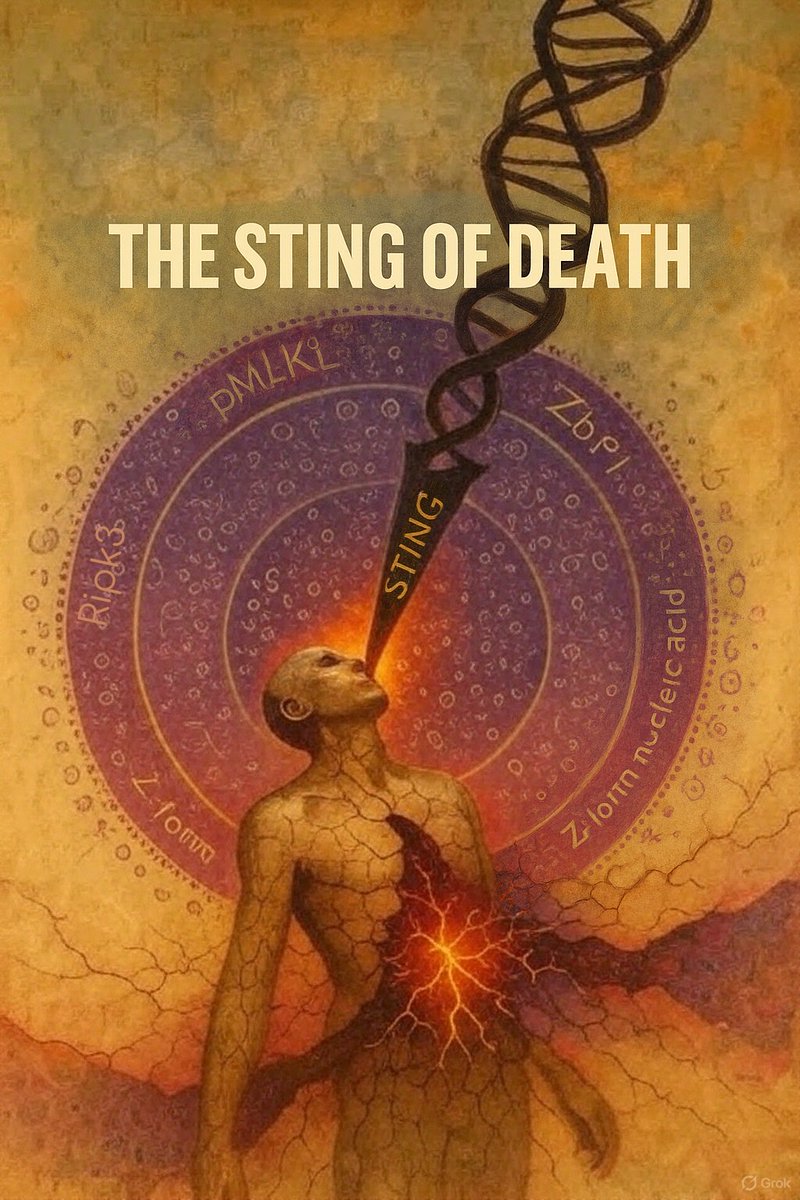
The STING of death continues!
Thanks to @NatRevRheumatol (https://t.co/MgX76zHKU0) for highlighting our recent @Nature (https://t.co/mR4zXRjY1C) paper showcasing cell death as a therapeutic avenue in autoimmunity & autoinflammation, (SAVI syndrome).
(The image below is our own)
#immunity #celldeath #rheumatology #vasculitis #vasculopathy #lungdisease #pediatric #autoimmunity #infection #diseases #science
Staring at death! Have a look at our first publication where we provide a protocol for a robust and reproducible in situ detection of pMLKL-s345 in vivo!
We have a lot of opportunities for young & talented students to support our research via internships, predoctoral orientation fellowships & PhD positions. All paid 😎. If you are interested in cell death & inflammation with a spark of Genomic Instability, GET IN TOUCH !