Something I have been thinking about: in the past, the best engineers I knew spent a lot of time automating their work in various ways. Better vim/emacs automations, writing lint rules to catch repeat code issues, building up a suite of e2e tests so they don't need to smoke test the app manually. These kinds of things were the highest leverage activities an engineer could do, because it multiplied their own output, which in turn meant they could build more things.
I think many of these automations have become even more important now. This is true for a number of reasons.
First, infra and DevX automation speeds you up. And if you are running an army of agents, each of those agents will be sped up also. More automation == more output per unit of time.
Second, moving things to code improves efficiency. Your agent could fix an issue every time it sees that issue happen, but that uses tokens and might miss cases. If Claude instead writes a lint rule, CI step, or routine, that class of issue can be fully automated forever. This is really what people are talking about when they talk about loops -- it's about automating entire types of busywork rather than solving them one off. This isn't a new idea at all. Engineers have been doing this for a long time!
Third and most importantly, automation makes it possible for others to contribute to the codebase more easily. Increasingly what I am seeing is engineers are contributing to codebases on day one because Claude can navigate the codebase for them, and that non-engineers are able to contribute to a codebase as effectively as engineers can. What gets in the way of both of these is domain knowledge that lives in peoples' heads rather than in automation -- the stuff you used to have to learn when ramping up. What has changed thanks to agents is the domain knowledge that can be encoded as infrastructure is no longer limited to what is expressible in lint rules and types and tests; it can now capture nearly all domain knowledge, encoded as code comments and skills and CLAUDE.md rules and memories. If I put up a PR for an iOS codebase I don't know and a code reviewer rejects it because it doesn't use the right framework, or if a designer builds a new feature and it gets rejected because it doesn't follow the right architectural patterns, these are failures of automation.
Every team should be writing the CLAUDE.md's, REVIEW.md's, skills, and docs that enable agents to productively work in their codebase with zero additional context from the prompter. This sounds crazy, and at the same time is a natural extension of the stuff engineers have always done: automate, and encode domain knowledge as infrastructure. As the model gets smarter and as the harness matures, this task becomes easier. In the meantime, it is on every team to look for ways to convert their domain knowledge to infra so that Claude can write code better, so that code review catches issues automatically, and so the next person working on your codebase can contribute more easily.
Many people think any given ML project is 99% training.
In reality, it’s 50% evaluation, 40% data cleaning, 8% integration, and 2% training.
The first two set the noise floor for learning. No ML magic matters; the model cannot lower the noise floor, as that’s the optimal bound of Shannon encoding of your data.
Thus, not a single day goes by without me thinking about ontology. Even the old labels have to be constantly reviewed.
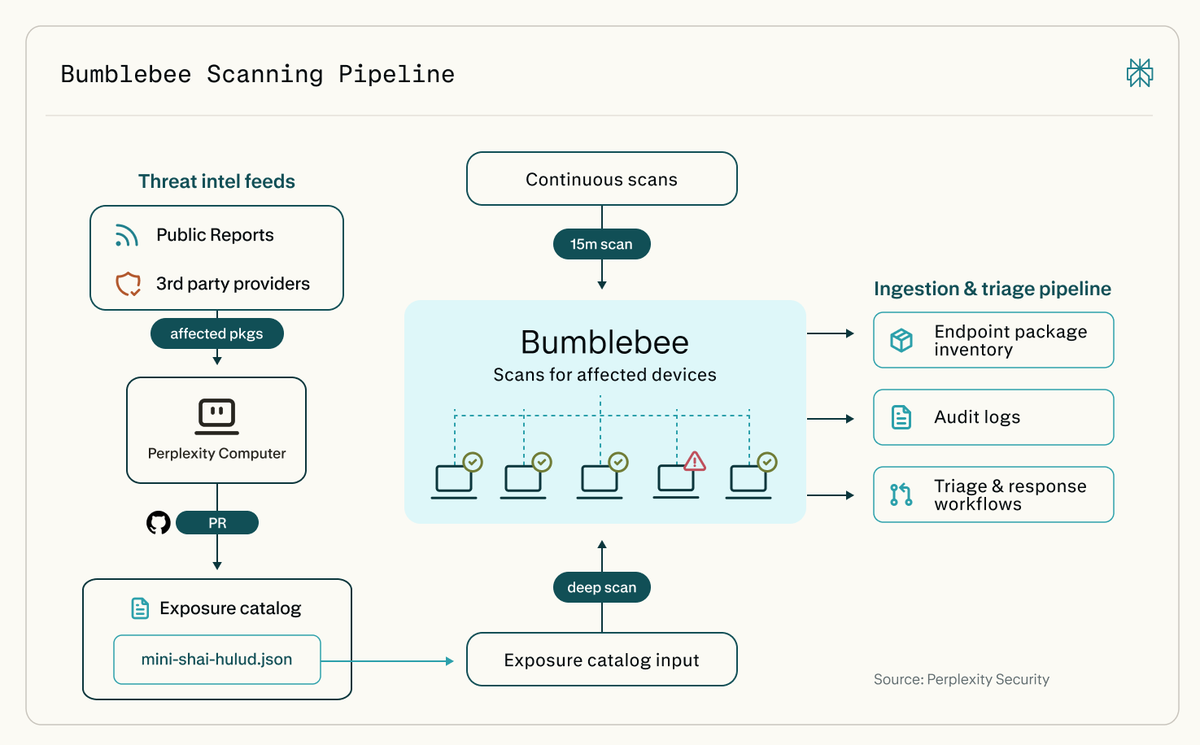
Today we're open-sourcing Bumblebee, a read-only scanner for macOS and Linux.
It checks developer machines for risky packages, extensions, and AI tool configs.
Connected to Computer, it can trigger deeper scans whenever a new supply-chain risk emerges.
https://t.co/FOaWnF1yQy
Indonesian authorities used online disinformation campaigns to brand activists and journalists as "foreign agents" and silence dissent, sometimes leading to physical threats, Amnesty International said. https://t.co/sFoBm6AbMx
Gua baru visit diaspora Indonesia di New York & San Francisco.
Ini alasan mereka gak pulang:
Di Indonesia, power and wealth are determined by who your family is and who you know, bukan dari ability atau prestasi.
Indo is a place where you can be in government or run a VC fund -- just by being golf buddies with the right people.
Jadi gak heran, smart people refuse to work for bosses who don't deserve to be there.
You've been asking for this one...
Now in preview: Codex in the ChatGPT mobile app.
Start new work, review outputs, steer execution, and approve next steps, all from the ChatGPT mobile app. Codex will keep running on your laptop, Mac mini, or devbox.
Introducing Higgsfield Supercomputer
The first ever cloud-native, self-learning AI agent for end-to-end task execution.
40+ built-in tools. Three layers of memory. Access via browser or Telegram.
Powered by enhanced Hermes Agent.
This works really well btw, at the end of your query ask your LLM to "structure your response as HTML", then view the generated file in your browser. I've also had some success asking the LLM to present its output as slideshows, etc.
More generally, imo audio is the human-preferred input to AIs but vision (images/animations/video) is the preferred output from them. Around a ~third of our brains are a massively parallel processor dedicated to vision, it is the 10-lane superhighway of information into brain. As AI improves, I think we'll see a progression that takes advantage:
1) raw text (hard/effortful to read)
2) markdown (bold, italic, headings, tables, a bit easier on the eyes) <-- current default
3) HTML (still procedural with underlying code, but a lot more flexibility on the graphics, layout, even interactivity) <-- early but forming new good default
...4,5,6,...
n) interactive neural videos/simulations
Imo the extrapolation (though the technology doesn't exist just yet) ends in some kind of interactive videos generated directly by a diffusion neural net. Many open questions as to how exact/procedural "Software 1.0" artifacts (e.g. interactive simulations) may be woven together with neural artifacts (diffusion grids), but generally something in the direction of the recently viral https://t.co/z21CP5iQfu
There are also improvements necessary and pending at the input. Audio nor text nor video alone are not enough, e.g. I feel a need to point/gesture to things on the screen, similar to all the things you would do with a person physically next to you and your computer screen.
TLDR The input/output mind meld between humans and AIs is ongoing and there is a lot of work to do and significant progress to be made, way before jumping all the way into neuralink-esque BCIs and all that. For what's worth exploring at the current stage, hot tip try ask for HTML.
Usage limits are up, effective today we're:
1) Doubling Claude Code's 5-hour limits for Pro, Max, Team and seat-based Enterprise plans
2) Removing peak hours limit reduction on Claude Code for Pro and Max plans
3) Substantially raising our API rate limits for Opus models
I'm 22 years old and Claude Code is deteriorating my brain.
Every single day for the last 6 months I've had 6 to 8 Claude Code terminals open, waiting for a response just so I can hit 'enter' 75% of the time. And it's doing something to me.
In convos with a couple of friends, it's been a point that's been brought up pretty frequently.
None of us feel as sharp as we used to.
I don't know if it's just us, or others in their 20s are feeling the same thing, but it's something I've been thinking about a lot.
P.S. I know this is a problem with my reliability/usage of it, not Claude Code itself, but the effects are real nonetheless
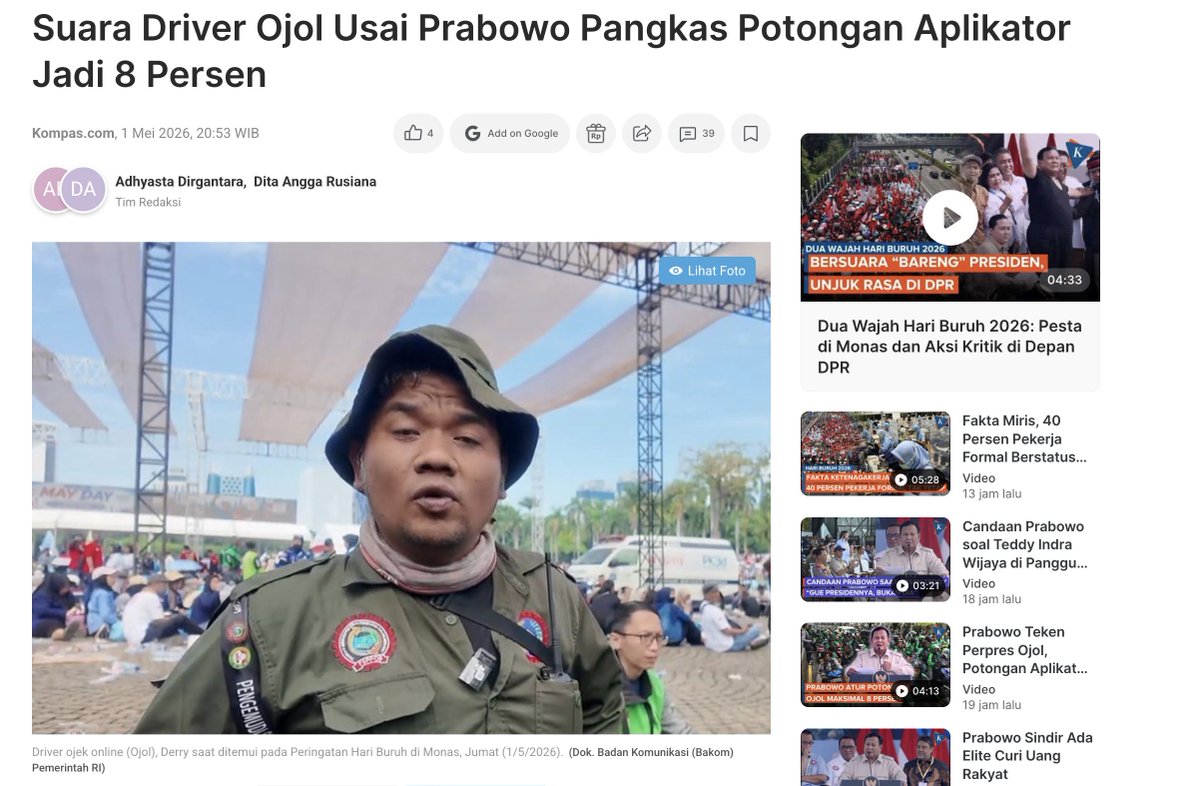
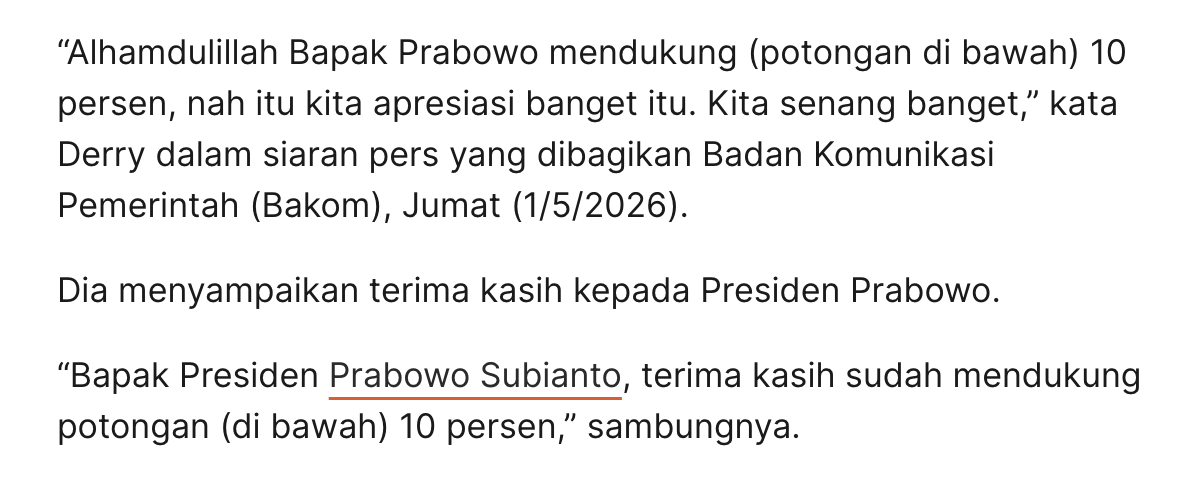
1. Gw pernah kerja di bagian product & tech selama lebih dari 5 tahun untuk Food Delivery / ojol companies (Uber & Delivery Hero). Gw mau kasih argumen bahwa kebijakan baru untuk penghasilan ojol ini hanya populis dan tidak akan efektif untuk menaikkan taraf hidup mereka.
Prabowo: "Kita dibikin apalagi, Indonesia gelap? Matanya burem! Indonesia gelap, Indonesia terang! Ada yang mau kabur, kabur aja, kau kabur aja ke sana! Mungkin ada yang mau kabur ke Yaman, silakan!"