Industrial Hygienist (CIH) at Fort Wainwright, AK, Former Clinical Laboratory Scientist (MT(ASCP)), Army veteran, Wife, and Mother of 2 young patriots.
Last quarter I ran performance reviews for 4,200 employees.
The process takes six weeks.
Week 1: employees write self-evaluations.
Average length: 1,200 words.
That's 5 million words of self-assessment.
No manager reads them.
I know this because the system tracks time spent per review.
Average: 4 minutes.
You can't read 1,200 words in 4 minutes.
You can write a rating in 4 minutes.
That's what they do.
The ratings are on a 5-point scale.
1: "Does not meet expectations."
2: "Partially meets expectations."
3: "Meets expectations."
4: "Exceeds expectations."
5: "Significantly exceeds expectations."
Nobody gets a 5.
5 requires three levels of approval and a written justification.
I designed it that way.
If everyone could get a 5, the scale would mean something.
We can't have that.
The real scale is 3 to 4.
3 means "you still work here."
4 means "you still work here and we'd mildly prefer you didn't leave."
The difference in raise between a 3 and a 4 is 1.2%.
On a $90,000 salary that's $1,080 a year.
$90 a month.
Before taxes.
After taxes it's about $62.
That's the financial value of "exceeding expectations."
$62 a month.
A streaming subscription.
We have a forced distribution.
15% must be rated 4 or above.
70% must be rated 3.
15% must be rated 2 or below.
This is non-negotiable.
If your entire team is exceptional, 15% of them are still "partially meeting expectations."
If your entire team is mediocre, 15% are still "exceeding."
Performance is a bell curve I drew on a whiteboard in 2019.
Reality has to fit the curve.
Not the other way around.
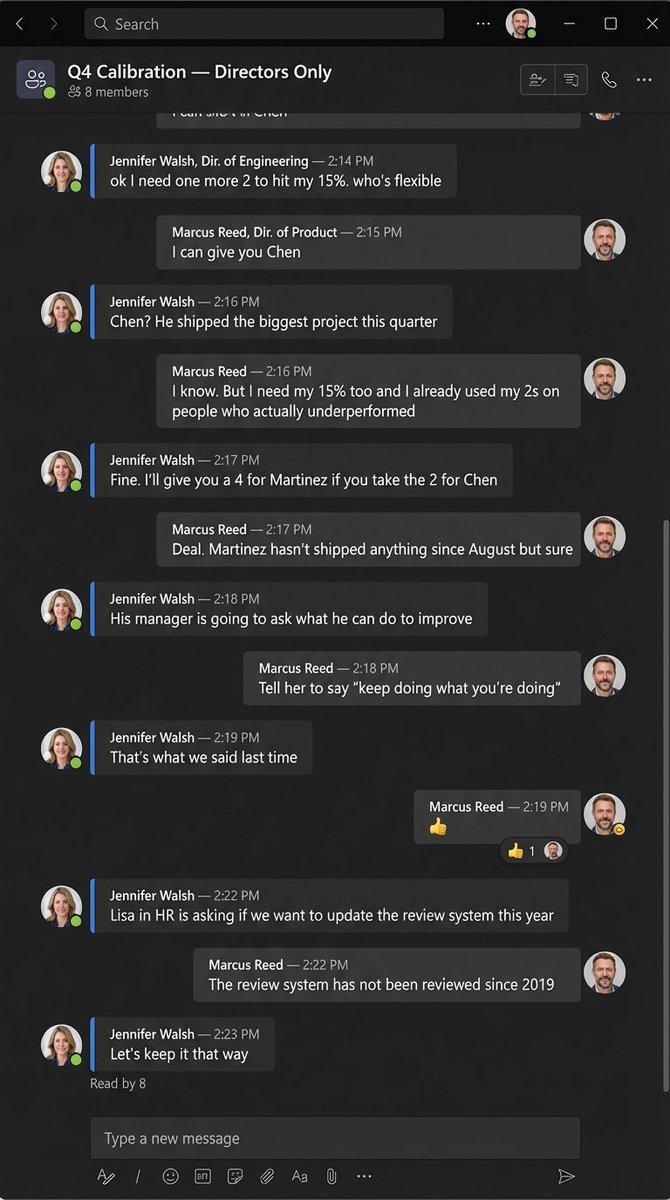
The calibration meeting is where this happens.
Every director in a room for four hours.
They negotiate ratings.
"I'll give you a 4 for Martinez if you take a 2 for Chen."
"Chen just shipped the biggest project this quarter."
"I know. But I need my 15%."
Chen is now "partially meeting expectations."
His manager will deliver this rating in a 30-minute meeting.
She'll say "this doesn't reflect my view of your work."
She's right.
It reflects a horse trade in a conference room she wasn't invited to.
Chen will ask what he can do to improve.
His manager will say "keep doing what you're doing."
He'll say "but I got a 2."
She'll say "the rating system is holistic."
Holistic means "I can't explain it."
Nobody can.
That's the point.
Three people on the 2-rated list will be placed on Performance Improvement Plans.
A PIP lasts 60 days.
No one has ever passed a PIP.
I don't mean it's difficult.
I mean the outcome is decided before the PIP begins.
A PIP is not a path to improvement.
It's a paper trail to termination.
HR needs 60 days of documentation.
The PIP provides 60 days of documentation.
I call this "supporting our people through growth opportunities."
After calibration I compile the results.
I tell the board that 85% of employees are meeting or exceeding expectations.
This is true every year.
It was true by design.
I designed it.
Last year a manager asked me what performance reviews actually accomplish.
I looked at my notes.
They accomplish:
Five million words nobody reads.
A number between 1 and 5 decided in a room the employee will never enter.
A raise that wouldn't cover a gym membership.
And a paper trail for the people we'd already decided to fire.
I didn't say any of that.
I said "employee development is our top priority."
He transferred teams.
I noted it as "healthy internal mobility."
The review system was installed in 2019.
It has not been reviewed.
I get reviewed using the system I designed.
Last year I rated myself a 4.
My manager didn't question it.
She used the 4 minutes.
As long as the graph goes up and to the right.
@jchilders98 Jeff, what’s your take on the non-stop Nancy Guthrie coverage on the news? Hours and hours of nothing new to report and over speculation. Are the trying to distract is from something else?
This is a good thing, but the problem with the Army is Soldier promotions rarely take into account MOS qualification like the other branches. Promotions are based only on Soldier skills and not proficiency in the MOS. This results in Soldiers not being able to fill in for their Civilian counterparts to complete mission, a growing problem with the reduction in force and hiring freeze. It also leaves them without skills when they ETS.
@jchilders98 Yes, very much enjoyed it! I love how you systematically dissect these "news" articles and reveal that they're not actually news. Thanks Jeff!
@USOPM@POTUS Love the progress on everything… but I still can’t talk to anyone when I call any of your numbers. We need assistance with our health insurance contractor. ☹️