We are warming up for some new content formats in the near future. Right now is our exploration phase, please share with us what you'd like to see content-wise to help shape where we go next!😎
"We offer a step-by-step, contextualized tutorial on the practical application of mediation analysis"
Jia & Hui (in press). Modeling relationships between learning conditions, processes, and outcomes: An introduction to mediation analysis in SLA research
https://t.co/SDp8asWFg3
EuroSLA 35 (#EuroSLA35)
- Location: Lisbon, Portugal
- Dates: 24–27 June 2026
- Deadline for abstract submission: 5 December 2025
- Keynote speakers: Melissa Baese-Berk, Bram Bulté, Vincent DeLuca, and Emma Marsden
https://t.co/y9QQWFuAck
New article:
Wong. M.H.I. (2025). A Bayesian approach to small samples: Mixed-effects modeling in L2 interventional research. Research Methods in Applied Linguistics, 4(3), 100231: https://t.co/yhC6ghn4Yr.
"AI exhibits distinct linguistic and stylistic authorship markers, which can be identified using conventional authorship attribution methods."
Zhu & Lei (in press). Detecting authorship between generative AI models and humans: a Burrows’s Delta approach
https://t.co/GGooNS0ZvA
Just accepted for publication! As always, the postprint is available on IRIS.
Mizumoto, A. (2025). Automated analysis of common errors in L2 learner production: Prototype web application development. Studies in Second Language Acquisition.
https://t.co/jWpyvuJBz5
📢New on Early View:
Open Access!🔓
“Contrasting Fixed- and Mixed-Effects Modeling in Vocabulary Research: Reanalyzing Laufer (2024) and McLean et al. (2020)”
By: Christopher Nicklin, Stuart McLean & Joseph Vitta
Check it out here:
https://t.co/S68FXhO19x
Abstract below!👇
We are pleased to announce that the British Academy will continue to fund IRIS until 2030!
Thank you, all our authors and users, for your contributions and support for open research practices in applied linguistics!
Fantastic news for #OpenScholarship! Huge thanks to @LukePlonsky and #SSLA for recognizing and endorsing the value of diverse methodological perspectives in advancing OS! We're really excited to explore open scholarship through the underexplored lens of qualitative research!
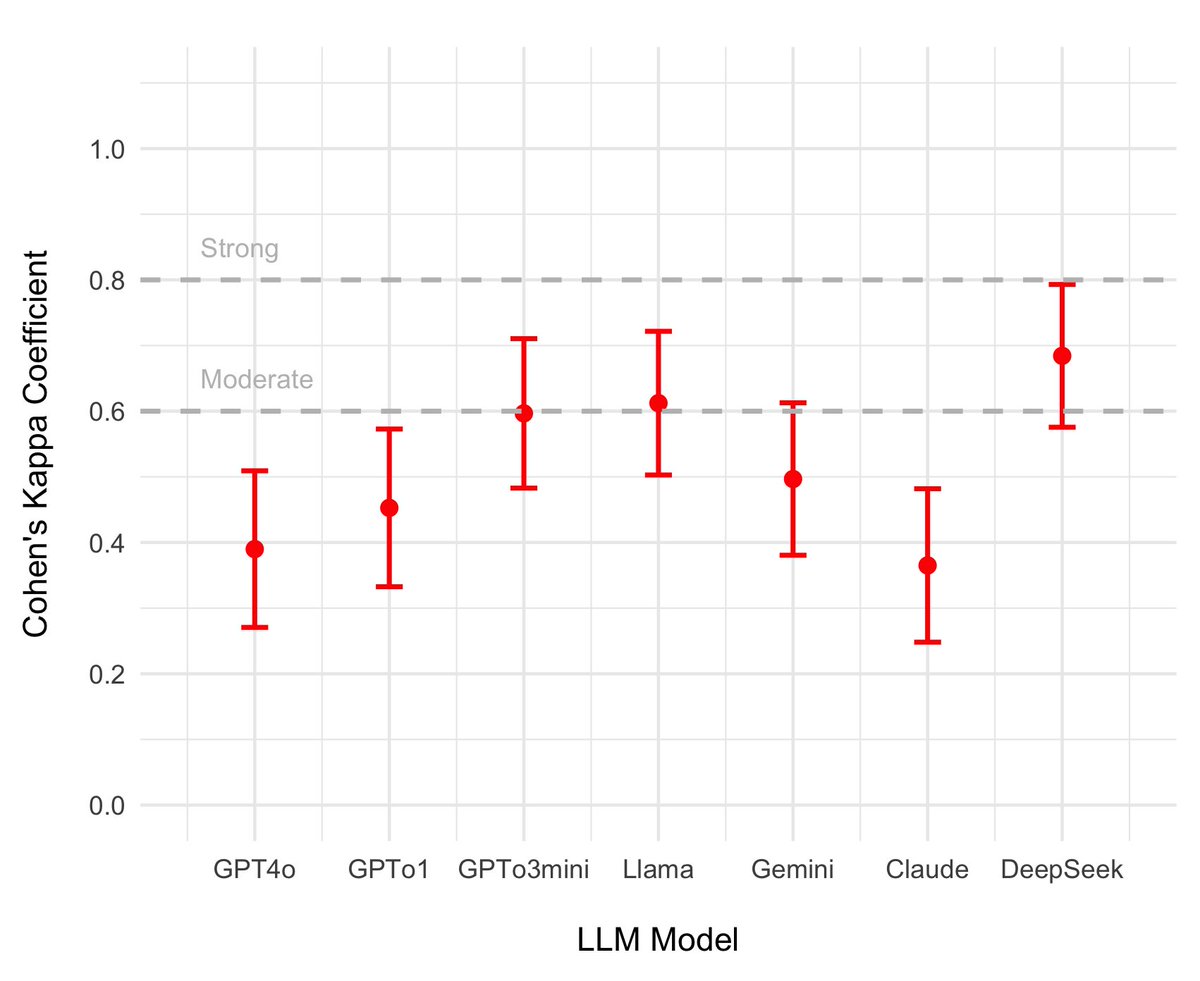
Our paper, "Large language models fall short in classifying learners’ open-ended responses," has just been accepted in Research Methods in Applied Linguistics! 🎉
You can check out the postprint on IRIS: https://t.co/gk9b3zArLA
👇 This figure sums up our key findings.
#SSLA is pleased to share that the winner of the Albert Valdman Award for 2024 is "Replication studies in second language acquisition research: Definitions, issues, resources, and future directions" by Kevin McManus: https://t.co/njzucBo2sa
#linguistics#AAAL2025
"Comparisons with traditional measures … show that u has greater sensitivity to unidimensional structure and less sensitivity to the number of items in a scale."
Revelle & Condon (in press). Unidim: An index of scale homogeneity and unidimensionality https://t.co/TotIBi9nfv
Just out: SSLA special issue on replication, edited by @KMcManus84, which includes an incredibly compelling conceptual piece + 11 outstanding studies. Landmark collection for replication research in AL. Congrats to Kevin + all contributing authors! https://t.co/ra0mybMRy7
Excited to share my open-access paper published in Research Methods in Applied Linguistics (@RMALJournal)! It critically explores the limitations of traditional linear regression models (assuming normal error distribution) for analysing syntactic complexity measures. 1/10
📚Excited to share our recent open-access publication, “Why are some articles highly cited in applied linguistics? A bibliometric study,” in Studies in Second Language Acquisition.
📚Co-authored with my MA student, @ZhangShirley11.
https://t.co/0PDVEppR5G
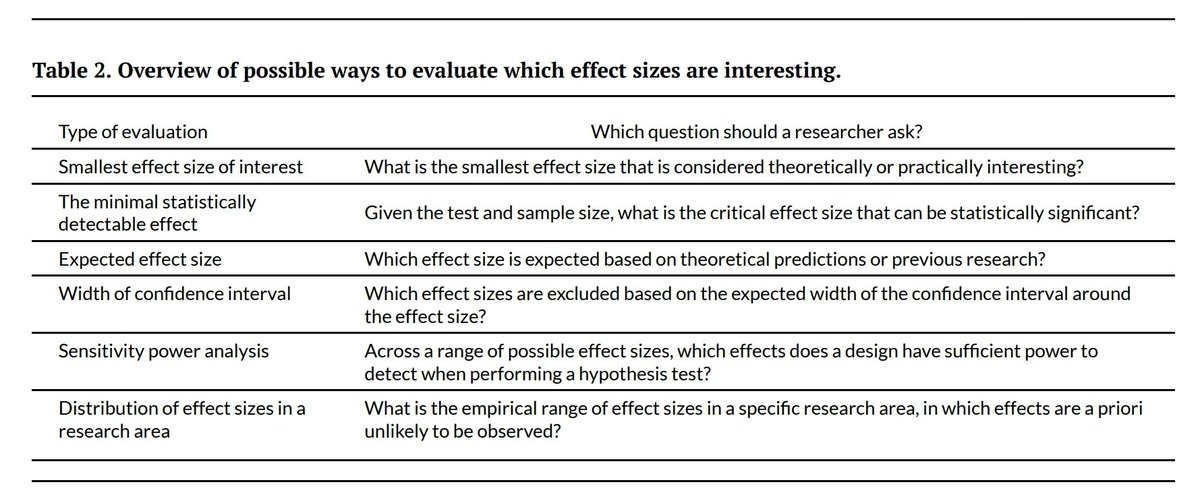
Not every study needs to have a power analysis, but every study needs a sample size justification. I discuss 6 approaches, and 6 ways to think about which effect sizes are of interest in the study you are planning.
https://t.co/MBAqD1RhOe
Why Does ChatGPT "Delve" So Much? Exploring the Sources of Lexical Overrepresentation in Large Language Models
'Scientific English is currently undergoing rapid change, with words like "delve," "intricate," and "underscore" appearing far more frequently than just a few years ago.'
https://t.co/PAqYXsCK42
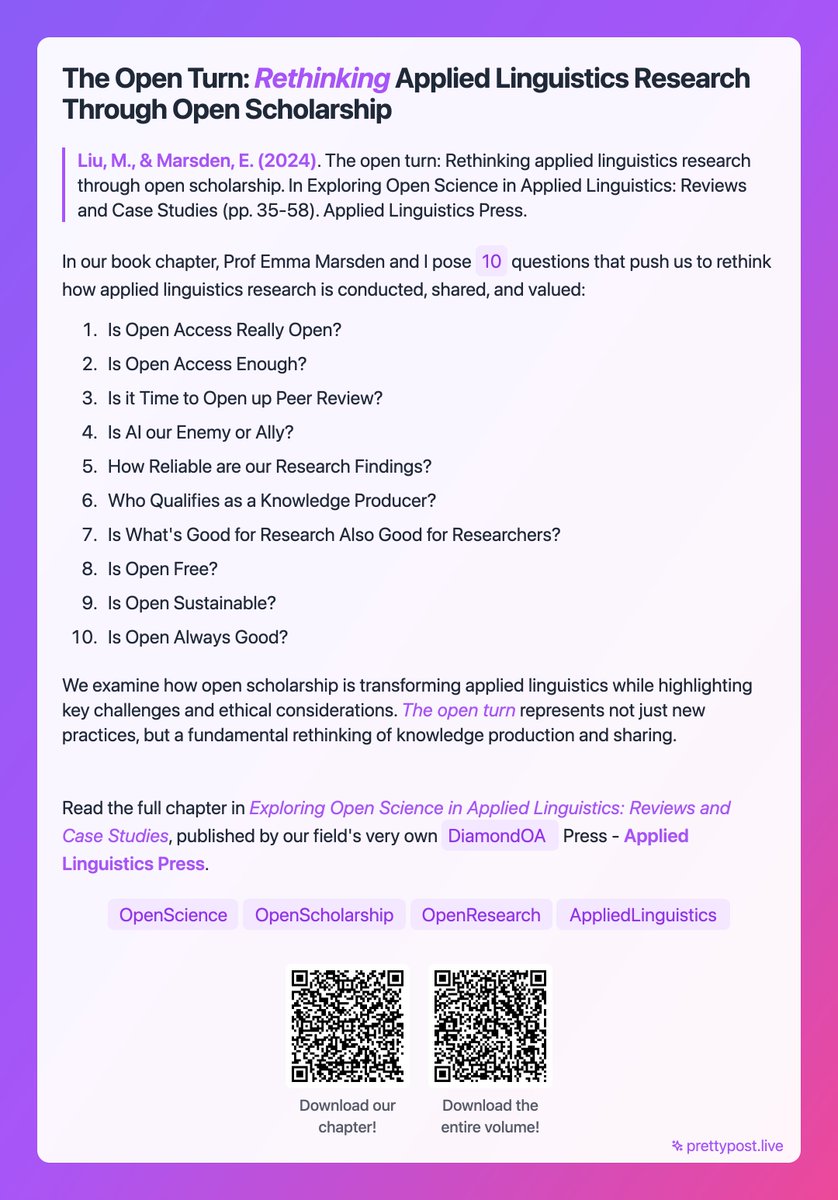
How should we rethink applied linguistics research in an open era?🤔
Prof Emma Marsden and I pose 10 critical questions about open scholarship that challenge our assumptions about knowledge production and sharing.
Check out our latest work published by @AppLingPress!🤩