📢 New preprint! Our latest work enables "alchemy" - ∂[energy]/∂[element] in ML potentials like MACE. We model solid solutions and conduct alchemical free energy simulations. https://t.co/1tyDHq4XRv
@RGBLabMIT#compchem#machinelearning
New work: “GLASS Flows: Transition Sampling for Alignment of Flow and Diffusion Models”. GLASS generates images by sampling stochastic Markov transitions with ODEs - allowing us to boost text-image alignment for large-scale models at inference time!
https://t.co/unsuG3mYer
[1/7]
Microsoft researchers introduce MatterGen, a model that can discover new materials tailored to specific needs—like efficient solar cells or CO2 recycling—advancing progress beyond trial-and-error experiments. https://t.co/z9yOaV7VGo
A General Framework for Inference-time Scaling and
Steering of Diffusion Models
Introduces Feynman-Kac steering, an inference-time steering framework for sampling diffusion models guided by a reward function. It generates multiple samples (particles) like best-of-n (importance sampling) approaches. Particles are evaluated at intermediate steps, where they are scored with functions called potentials. Potentials are defined using intermediate rewards and are selected such that promising particles are resampled and poor samples are terminated.
"FK steering with just k = 4 particles outperforms
fine-tuning on prompt fidelity and aesthetic quality, without making use of reward gradients."
"FK steering smaller diffusion models outperforms larger models, and their fine-tuned versions, using less compute."
I wrote a thing about "RL or control as Bayesian inference", which encompasses
- RLHF and controlled generation in LLMs
- Finetuning or guidance in diffusion models
- Diffusion samplers from general unnormalized densities
- Sequential Monte Carlo sampling for all of the above
In DDPD, planner decides which tokens to denoise, and denoiser decides what to replace it with. Model's knowledge is decomposed to guessing which part is incoherent and how its incoherent.
Left is planner's prediction on 'whats wrong'.
Right is denoising state. You can see its very confident on the noisy part
Amongst many recent discrete diffusion, I found DDPD very interesting. Its unique in a way it naturally decomposes the task into that planner and denoiser
(so I implemented minDDPD for imagenet)
🧵(1/5) Have you ever wanted to combine different pre-trained diffusion models but don't have time or data to retrain a new, bigger model?
🚀 Introducing SuperDiff 🦹♀️ – a principled method for efficiently combining multiple pre-trained diffusion models solely during inference!
We provide a new approach for estimating density without touching the divergence. This gives us the control to easily interpolate concepts (logical AND) or mix densities (logical OR), allowing us to create one-of-a-kind generations! ⚡🌀🤗
This is all due to an amazing team: @martoskreto@lazar_atan@bose_joey@AlexanderTong7
📄Paper: https://t.co/fOvjdT5k9B
💻Code: https://t.co/ElodwDXDzp
🤗HuggingFace: https://t.co/iVmSobsSEq
📢Out now! @HaoTang811269 and colleagues from @mit_dmse and @mit_nse introduce MEHnet, a deep learning method for molecular electronic structures that can predict a host of molecular properties. https://t.co/ObnAz2CVgM
🔓https://t.co/I9LPyIhWHr
📢@draykol, @ekindogus and colleagues from @GoogleDeepMind introduce a computational approach to predict the most likely crystallization products from amorphous precursors, which has the potential to help with the synthesis of new materials. https://t.co/kZZiG0Z7iG
Excited to be at #NeurIPS2024 🚀
I will share prelim results:
Improving long-term rollout of neural operators with flow matching-inspired correction
https://t.co/CatoAsmbAf
Learning PDEs (for frontal polymerization) with differentiable simulations
https://t.co/z9au8sifkZ
1/2
Our paper has been selected as a spotlight at #NeurIPS2024 AI for Materials. We uncover why generative models are well-suited for materials synthesis prediction and propose a diffusion-based approach,
When/Where: Sat 14 Dec 8:15a, West 211-214
https://t.co/p2oa0wIUuT
Zero-shot extrapolation for out-of-distribution (OOD) chemical property prediction is an important step towards high-performance materials discovery. Check out our spotlight at the #NeurIPS AI for Accelerated Materials Design Workshop! https://t.co/wHxezk4zD7
📢New preprint out! We constrain the molecular generation space to follow the "symmetry" of patented molecules that are likely to be synthesizable. Achieved with "symmetry-aware" fragment decomposition, and a constrained Monte Carlo Tree Search generator. https://t.co/NWidW2Wx9y
Super excited to preprint our work on developing a Biomolecular Emulator (BioEmu): Scalable emulation of protein equilibrium ensembles with generative deep learning from @MSFTResearch AI for Science.
#ML#AI#NeuralNetworks#Biology#AI4Science
https://t.co/yzOy6tAoPv
New Paper Alert! "Thermodynamic Interpolation: A generative approach to molecular thermodynamics and kinetics" introduces Thermodynamic Interpolation (TI) for generating and transforming equilibrium statistics with temperature control! 🌡️ led by @SelmaMoqvist and @vollon3
Thrilled to announce Boltz-1, the first open-source and commercially available model to achieve AlphaFold3-level accuracy on biomolecular structure prediction! An exciting collaboration with @jeremyWohlwend, @pas_saro and an amazing team at MIT and Genesis Therapeutics. A thread!
We often think of an "equilibrium" as something standing still, like a scale in perfect balance.
But many equilibria are dynamic, like a flowing river which is never changing—yet never standing still.
These dynamic equilibria are nicely described by so-called "detailed balance"
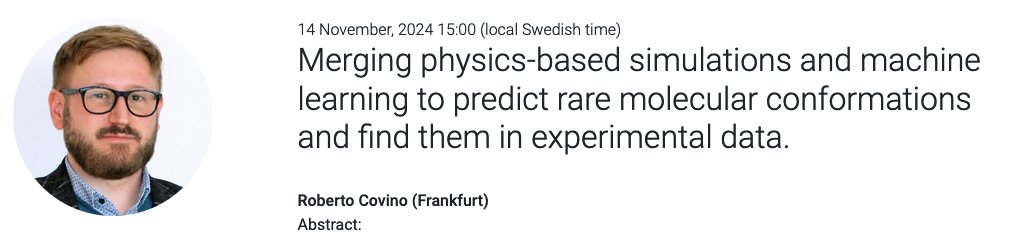
Today we are excited to welcome @CovinoLab to give this months Chalmers AI4Science seminar. Join us in Analysen on the Chalmers Johanneberg Campus this afternoon at 3pm or on zoom. For more details see https://t.co/2TbVpiAixo


![junonam_'s tweet photo. 📢 New preprint! Our latest work enables "alchemy" - ∂[energy]/∂[element] in ML potentials like MACE. We model solid solutions and conduct alchemical free energy simulations. https://t.co/1tyDHq4XRv
@RGBLabMIT #compchem #machinelearning https://t.co/QvqKGIZ9F7](https://pbs.twimg.com/media/GMbmdKebIAAep2_.jpg)