Official Twitter for the Gómez-Bombarelli group @MIT_DMSE | We use atomistic simulations and ML for accelerated materials design | Managed by group members
Why does this matter? We believe the Almanac is the foundation for a new kind of scientific instrument that will enable AI-guided ensembles of MLIPs (with improving quality weekly) to be pointed at the hardest problems.
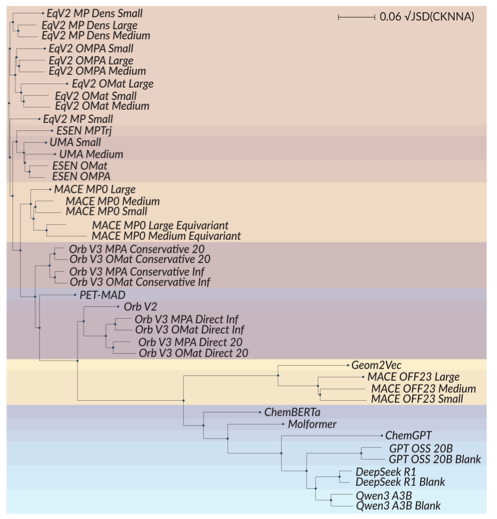
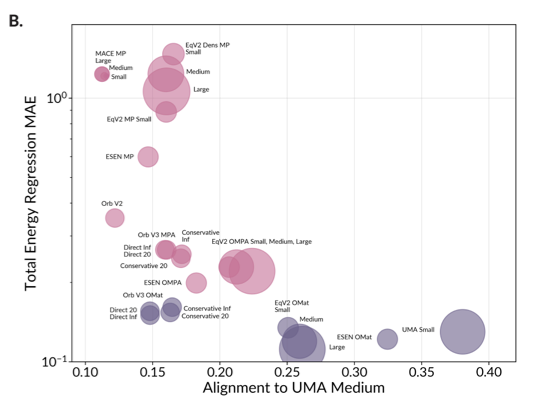
Recent work from Sathya Edamadaka, Soojung Yang, Ju Li and @rgblabmit, which was a core motivator of the Almanac work, shows convergence in representation space between models. But, despite this convergence, no single model is yet enough for most research tasks. https://t.co/SJJewV9zbB
Demo coming soon: agent-driven MLIP committees orchestrated with Academy on @globus Compute - agents that query many potentials, quantify disagreement, and decide what to trust or what needs more detailed simulation.
Today, we excitedly announce Garden's Almanac of Matter Models!
The goal is simple: make it as easy to use the latest matter models as it is to use the latest LLM. We see this as the foundation of a new kind of scientific instrument - one where ensembles of MLIPs, not a single model, are pointed at a discovery problem.
https://t.co/DGy4FYMwQq
The Machine-Learned Interatomic Potential (MLIP) landscape is growing so rapidly. New foundation models for molecules, materials, and proteins seem to drop every week, each with its own architecture, training data, and software quirks. This fragmented, and sometimes downright tricky setup and maintenance slows, and often precludes deep questions that require many models from all but the most advanced users.
What if instead anyone could access and run them with very little hassle?
Fun surprise coming later in the week... :)
@RGBLabMIT@ianfoster
"Atomistic Language Models Understand and Generate Materials"
Most materials AI still treats crystals and language separately, either turning atoms into lossy text formats or making LLMs call atomistic tools.
This paper makes materials natively multimodal by connecting a 3D atom encoder, Qwen LLM, and diffusion crystal generator through continuous latent projectors.
This model can read atomic coordinates, predict properties, edit crystals from text, and generate stable new materials, with SoTA crystal structure prediction and strong de novo generation.
Our new work achieves native multimodality over language and atomistic structure. The paradigm unlocks crystal property prediction, generation, and optimization as instructed by text!
Introducing Atomistic Language Models (ALMs), a new paradigm to unify atomistic understanding, materials generation, and natural language.
ALMs set the SoTA on crystal structure prediction, de novo generation, and editing materials as instructed by text.
Thrilled to announce the final preprint of my PhD!
We introduce PackFlow, a flow matching method for generative molecular crystal structure prediction, and post-trained via reinforcement learning on MLIP energies and forces.
Paper: https://t.co/wFbxV7RQb4
@RGBLabMIT
We'll be giving a public talk about this work tomorrow, January 28, at 11:30 AM ET (8:30 AM PT, 4:30 PM GMT)! It'll be hosted by LeMaterial, an initiative from @entalpic_ai and @huggingface. We'd love to see you there!
🔗https://t.co/Htj360egSZ
📅 https://t.co/38bmrkCM28
Scientific foundation models are converging to a universal representation of matter.
Come chat with us at #NeurIPS! We (@SoojungYang2@RGBLabMIT) have an oral spotlight at the #NeurIPS#UniReps workshop and will also poster at #AI4Mat.
🖇️: https://t.co/H8ZRlpvJUj
🧵(1/5)
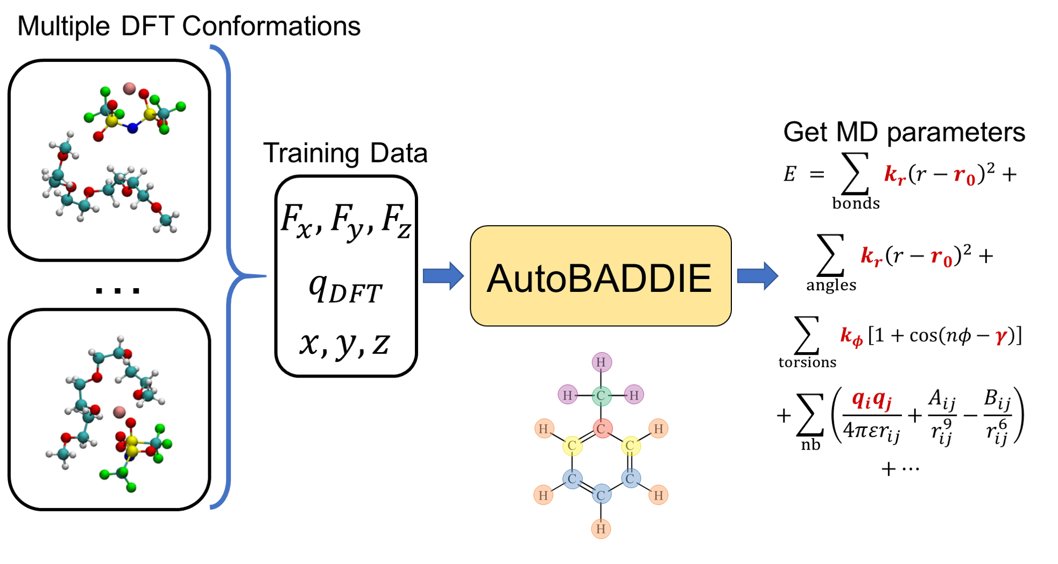
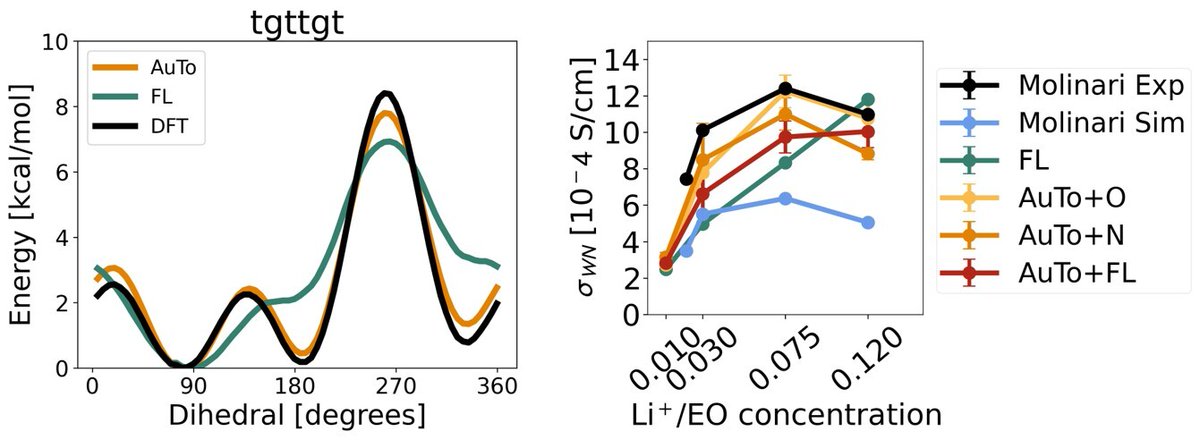
Our work on "End-To-End Learning of Classical Interatomic Potentials for Benchmarking Anion Polarization Effects in Lithium Polymer Electrolytes" is out now in Chemistry of Materials! https://t.co/JSDwQwv8VZ
We also find that previously-parameterized classical potentials model two separate anion polarization states that drastically influence resulting lithium solvation and transference.
The surprising ineffectiveness of molecular dynamics coordinates for predicting bioactivity with machine learning
1. The study challenges the assumption that molecular dynamics (MD)-derived coordinates are superior for machine learning-based bioactivity predictions, revealing that they often underperform compared to minimum-energy conformations.
2. Using over 2600 protein-ligand complexes, the authors systematically compared MD-derived and minimum-energy coordinates, employing three descriptor sets and machine learning algorithms like Random Forest, XGBoost, and Support Vector Regression.
3. Surprisingly, MD-derived conformations failed to consistently outperform minimum-energy structures, even though they provide dynamic representations of molecular interactions.
4. In certain cases, ensemble averaging of MD-generated snapshots improved predictive performance slightly, but the benefits were not proportional to the computational costs.
5. Extended Connectivity Fingerprints (ECFPs), a 2D molecular representation, outperformed MD-based models in many cases, questioning the utility of complex 3D data for predicting bioactivity.
6. The findings highlight a critical need for better 3D and dynamic molecular representations. The study suggests exploring geometric deep learning or incorporating protein information to improve machine learning models.
7. The authors propose a tiered approach: using fast, simpler methods like ECFPs for initial screening, followed by MD-based predictions for refining top candidates.
8. The study serves as a wake-up call for molecular machine learning, emphasizing the importance of balancing data complexity, computational cost, and predictive accuracy.
@fra_grisoni@DerekvTilborg@Rza_ozcelik
📜Paper: https://t.co/6b6GxztgQ9
#MachineLearning #DrugDiscovery #MolecularDynamics #Bioinformatics #AI
📢New preprint out! We constrain the molecular generation space to follow the "symmetry" of patented molecules that are likely to be synthesizable. Achieved with "symmetry-aware" fragment decomposition, and a constrained Monte Carlo Tree Search generator. https://t.co/NWidW2Wx9y
Zero-shot extrapolation for out-of-distribution (OOD) chemical property prediction is an important step towards high-performance materials discovery. Check out our spotlight at the #NeurIPS AI for Accelerated Materials Design Workshop! https://t.co/wHxezk4zD7
I will always upvote bogus enthalpy-entropy compensation.
My thesis advisor, J Casado, loved this paper. I remember doing the calculations in undergrad kinetics class some 20 years ago
Instead of the typical (somewhat technical) lecture, we discussed a couple of papers, including a favorite J. Chem. Ed. activity of mine: "Chemistry from Telephone Numbers: The False Isokinetic Relationship." It's a lot of fun. Do check it out. 2/3
https://t.co/uvFEdlESXK
MERGED NETS 💎📄
I can’t describe 350+ new nets in 280 signs, so just watch the animation & read our new paper in @ScienceMagazine 👨🎨💎👨🔬 with @Eddaoudi_FMD3.
In short, we merge nets together and get new topologies perfect for designing mix-ligand #MOFs.
https://t.co/xnARltj9dO
Applying to DMSE? The DMSE Application Assistance Program (DAAP) offers support for students from underrepresented groups in science and engineering. You’ll be paired with a grad student mentor to guide you through the application process. Apply by Nov 1. https://t.co/4H3Eq1gHxz