I am seeing a lot of P vs NP takes. I've had a good track record this year (regarding predictions of what complexity claims are true) so now I'm ready to mess it all up and post three options, as I see them.
Excited to see that the Aaronson-Ambainis conjecture has apparently been proved! But depressed to see the amount of completely incorrect commentary on its implications, so here's an attempt to clear things up.
For Aaronson-Ambainis, you have to remember that in quantum computing we say "query complexity" the way that biologists say "in mice."
As in "we can cure cancer in mice" or "we know the power of QCs in query complexity."
STOC 2027 received 1665 submissions. In a bold new experiment, all submissions (and author identities) are immediately made public. This is the most immediate and revealing posting of any conference I am aware of.
Take a look and see what you find!
https://t.co/Ph7RKx6jhc
Happy to see our paper published in #PRXQuantum!
Many thanks to @Godthinkun and @ChanghunOh6 for the wonderful collaboration.
Looking forward to exploring more experimentally efficient approaches to quantum learning during my PhD!
https://t.co/exNTATFNNd
Finally, if this sounds interesting to you, please also take a look at the independent and concurrent work https://t.co/j5eABBZwm5 by Francisco Escudero Gutiérrez, @Junseo_Lee_ , and Sebastian Zur, who approach some of the same questions using adversary methods.
LLMs have gotten very good at making classical code do more with less, from faster CUDA kernels to leaner compilers. This summer, as part of the Anthropic STEM Fellows program, we asked whether Claude could do the same for quantum computers.
We found it can. Across a wide range of tasks, Claude's circuits need fewer qubits and less running time than the best published designs. The video shows the most striking one: modular inversion, the costliest step in the quantum algorithm for elliptic-curve discrete log. Claude built it on a classical method few thought could work on quantum computers.
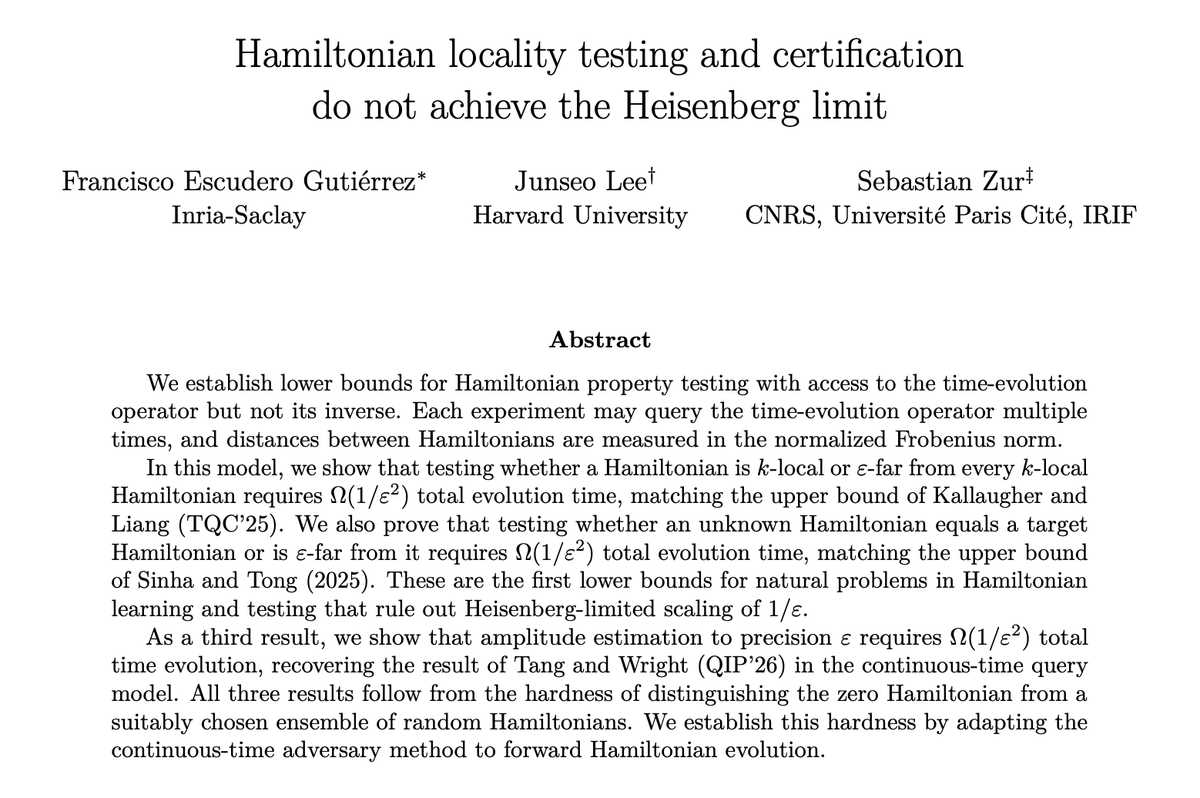
Sadly, we can’t always achieve the Heisenberg limit 🥲
Excited to share our new work showing that Hamiltonian locality testing and certification require Ω(1/eps^2) evolution time, ruling out the celebrated 1/eps Heisenberg scaling.
A short thread 🧵
As a byproduct, we also show that quantum amplitude estimation without inverse access requires Ω(1/eps^2) evolution time, even with arbitrary fractional/continuous-time forward queries.
So the usual quadratic speedup fundamentally relies on inverse access.
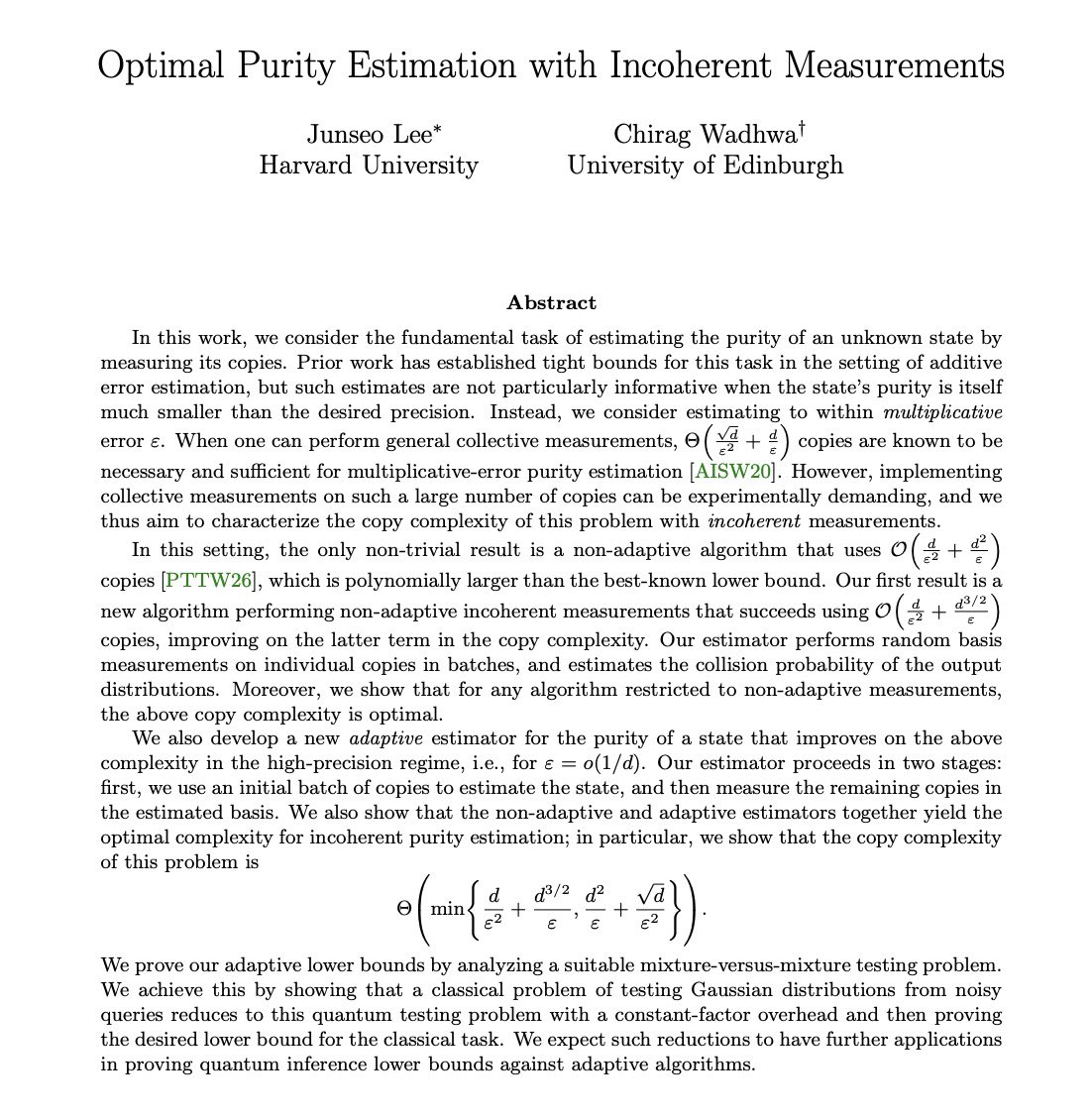
Purity estimation is a fundamental and seemingly simple problem, yet its optimal complexity with single-copy measurements had remained surprisingly elusive. Very happy to finally have a complete answer!
📄 Paper link: https://t.co/7IVESFpp3M
A key challenge is proving the adaptive lower bound. We introduce a reduction from a classical problem of testing Gaussian distributions from noisy queries to quantum purity testing, with only constant-factor overhead, and prove a tight lower bound for this classical problem.
It's rare when the main result of a paper is tweetable! My postdoc Barak and I just posted a paper which shows all quantum circuits can be parallelized to very low-depth. Specifically, all n-qubit unitaries admit circuits with poly(n)-depth and exp-many ancillas.