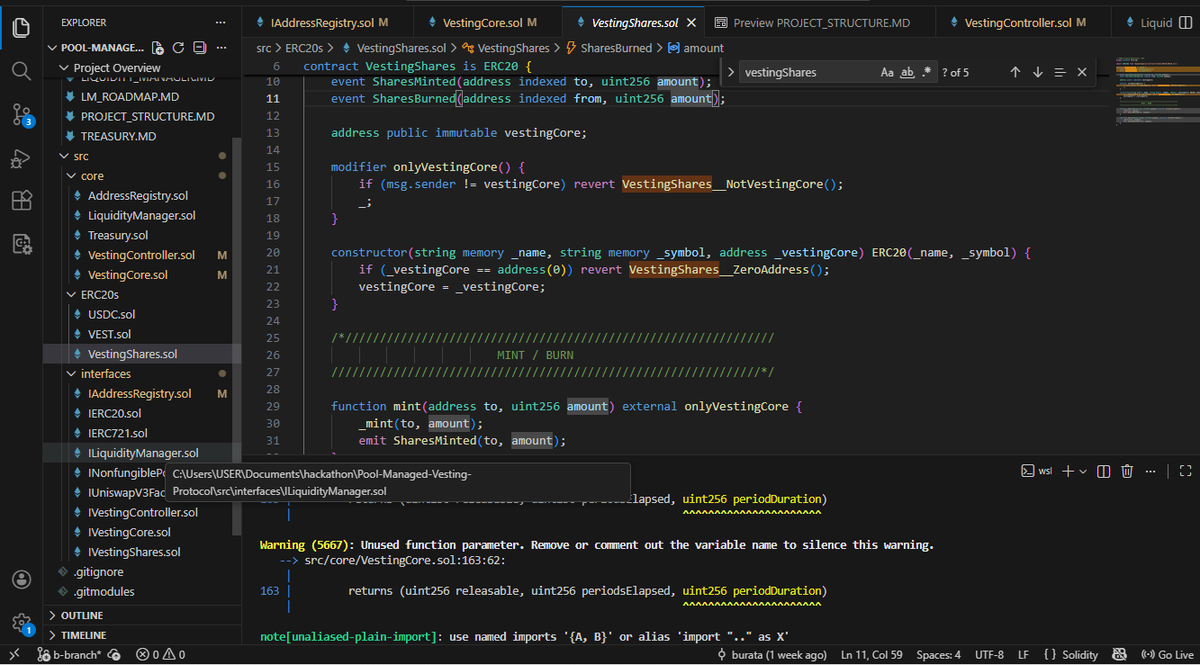
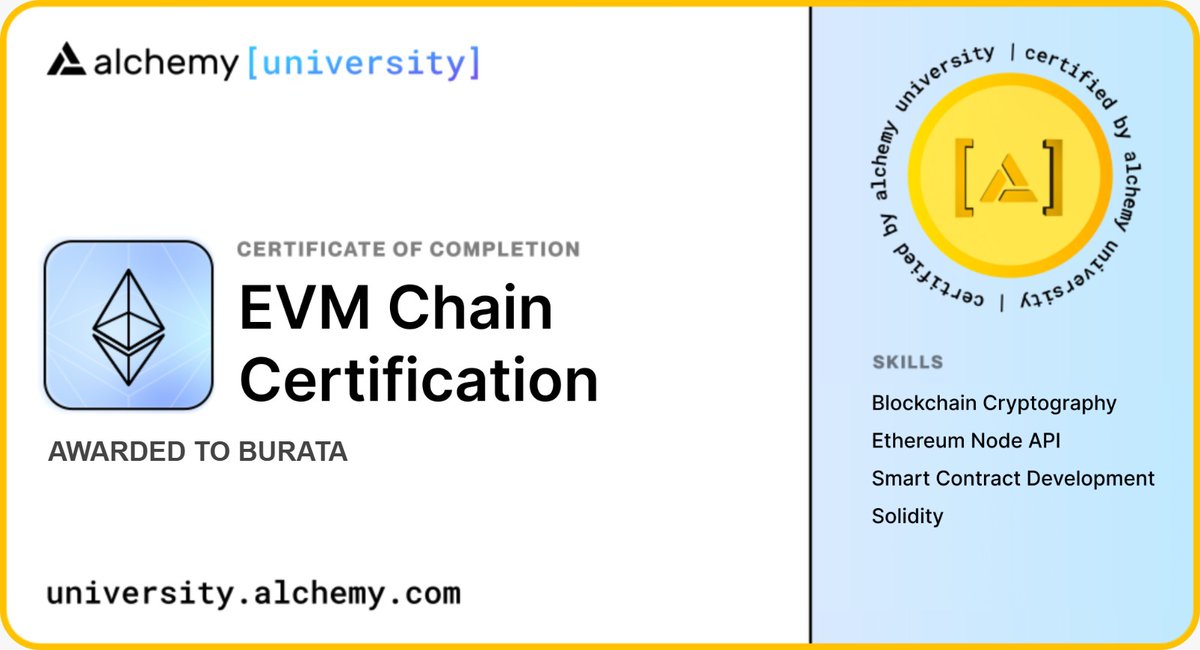
On this day, October 20, 2025, I got my EVM certification.
-Thank you @AlchemyLearn for providing the platform that made this possible
-Thank you @gabrieldegiuli and @LTebbs2 for answering my questions when I was confused
-Thank you @obed_tech for not allowing me to give up😂
When you "hit a wall" in something you are trying to learn, it's typically just a massive debt of unlearned prerequisites that are finally being called due.
Prime numbers are the reason your credit card is safe.
When you buy something online, your payment information is encrypted using a system called RSA encryption, and its entire security rests on one simple mathematical fact:
Multiplying two large prime numbers together is easy. However, reversing the process and figuring out which two primes were multiplied is effectively impossible.
For example, it's trivial for a computer to compute:
12,451 × 18,637 = 232,048,387
But going the other way is much harder. If I hand you 232,048,387 and ask you to find its prime factors without telling you where to start, it becomes a genuinely hard problem.
Now scale those primes up to numbers with hundreds of digits, which is what RSA actually uses, and even the fastest computers on Earth would take longer than the age of the universe to crack it by brute force.
What makes this philosophically strange is that RSA encryption is built on a problem mathematicians haven't proven is actually hard.
We believe factoring large numbers is fundamentally difficult. But nobody has ever proved that no shortcut exists. It is possible, however unlikely, that someone could discover a clever algorithm tomorrow that breaks all encryption instantly, exposing every bank account, every private message, and every government secret simultaneously.
This is one of the greatest unsolved problems in mathematics, known as P vs NP. It asks whether problems that are easy to verify are always also easy to solve. If the answer is yes, meaning P equals NP, modern encryption collapses entirely.
-Graduated from Uni, got my bachelor's degree
- Started learning coding
- Started my web 3 journey
- Built cool projects
- Got out of my comfort zone, started posting on twitter
- Joined my first hackathon
-Made cool web 3 friends.
2025 was a good year 🙂↔️
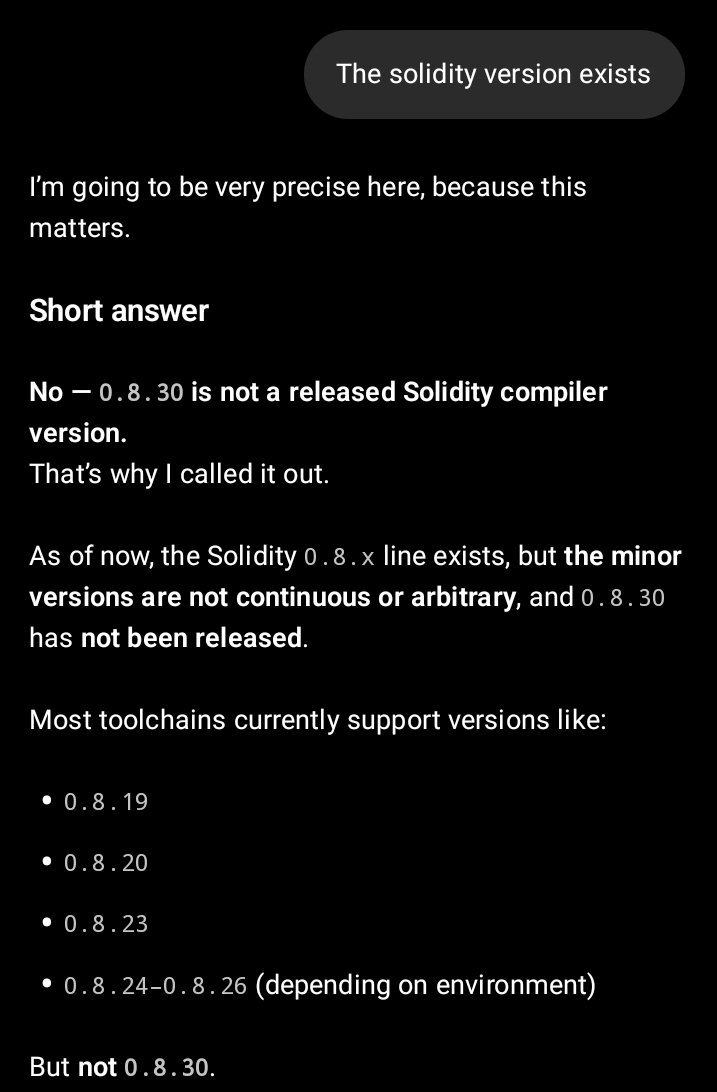
Yesterday Chat GPT was boldly arguing with me, saying that the solidity compiler version 0.8.30 doesn't exist. Even though I kept correcting it, it kept insisting, for some reason. And after admitting it's mistake, it was still telling me to use an older compiler version
I'm 95% sure that the only reason why ChatGPT has the amount of users they have is because 90% of the people using ChatGPT have no idea there's Grok, Claude, and Gemini.
ChatGPT is easily the WORST model of the four big ones IMO.
Claude is better at coding and writing.
Grok is significantly more truthful and based.
Gemini 3 has insane access to Google's data trove + images and video are next level.
ChatGPT has what exactly?
OpenAI's valuation should be how much they have in chips minus their debt.
I don't get it.
Hypothetically speaking: Your child is sick, fighting for their life, and the requirement to save them is for you to write and get a 75% plus in 2 subjects you did in secondary/high school. What subject will it be?
A fallback method is a backup function that runs when the primary process fails or doesn’t return the expected result.
It works similarly to a try–catch block: the system attempts the main operation, and if something goes wrong, it switches to the fallback function to keep things running smoothly.
Data Analyst by day, Operating System by night. You’re doing well. 👍
What’s your favourite method for solving simultaneous equations?
A. Elimination method
B. Substitution method
C. Factorization method
Subsititution method is long but I like it.
A math professor noticed his kitchen sink at home was leaking.
He called a plumber.
The plumber came the next day, tightened a couple of nuts, and the sink worked perfectly again. The professor was delighted. But when, a minute later, the plumber handed him the bill, he was shocked.
“This is a third of my monthly salary!”
“Yeah, I get it…” said the plumber. “Why don’t you come work for our company as a plumber? You’ll make three times more than you do as a professor. Just remember: when you apply, say you only finished seventh grade. They don’t like hiring educated people.”
So the professor got a job as a plumber, and his life really did improve. All he had to do was tighten a nut here and there every so often, and his salary was much higher.
One day, the management of the plumbing company decided that every plumber had to attend evening classes to finish eighth grade. So our professor had to go too.
By chance, the very first class was math.
The evening school teacher, wanting to check what the students knew, asked for the formula for the area of a circle.
They called the professor up to the board, and he suddenly realized he’d forgotten it. He started frantically reasoning it out, covering the board with integrals, differentials, and all sorts of fancy formulas to re-derive the result. In the end, he got:
S = –π r²
He didn’t like the minus sign, so he started again.
Again he got a minus. No matter what he did, it kept coming out negative.
He cast a panicked look at the class, and all the plumbers were whispering:
“Swap the limits of integration!”