Curious question for you, Josh!
How would you characterize the top three anchors of your Christian faith at this point in your life?
Is it (no particular order):
1. Rational belief in a necessary being. I'm reading your work with Dr. Pruss currently.
2. Rational belief in a consciousness as prior to material.
3. Existential coherence (experientially) with the Christian meta-narrative.
Brief funny story: I was at Baylor for a bit in 2014-2015. Had the chance to meet Dr. Pruss. One day in the philosophy building, he walked in. My professor at the time introduced me to him. I had been pondering the distinction between "natural" and "supernatural" for awhile, and believed that distinction was giving too much rhetorical ground, setting conversations up for an easy "no need for that hypothesis" sort of move. It seemed to me Christians shouldn't be so willing to dichotomize reality like that, because it was all supposed to be real/natural in some sense. My professor encouraged me to ask him a question about that distinction. So, I mustered up the courage to do so. Dr. Pruss looked at me with his pondering stare (you are probably very aware of what I'm referencing), and said something like, "No. I think it's a fine distinction," and moved on. Haha.. I was both happy to have spoken with him and bummed to have been so wrong. Yearssssss later, I purchased your How Reason Can Lead to God book. In the first few pages, you do work to anchor reality into a blob of everything – forgive me if I don't remember your exact name. I felt validated. And then, a couple years later I saw your book, Necessary Existence, with him, and thought, "I wonder if Josh has posed this concern to Dr. Pruss, and if he had more success than a lowly unsophisticated undergrad did years earlier!"
Important updates:
News on physical discs for new games - https://t.co/BzZODXdWGY
News on PlayStation Store on PS3 and PS Vita - https://t.co/ev3mN6wj14
Doom scrolling but make it educational 🤓
Introducing Short Video Overviews in NotebookLM! Turn your most complex sources into 60-second, vertical videos that deep dive into any concept.
Rolling out now to Google AI Ultra and Pro subscribers on mobile & web (free users soon!)
The devil is in the details nested inside of “true” and “history’ and “God’s Word” and “absolute” and “authority”.
I guess basically the whole sentence.
this didn't "happen", we caused it
first, children disappeared from daily life
most women turn 30 without ever holding a baby (they don't have siblings or cousins, and young babies have been removed from shared spaces), never changed a diaper or watched one up close.
you cant want what you've never seen
second, we killed the single income.
the average family needs both parents working just to get to the end of the month, so raising a family well went from hard to something practically impossible (2-3 months of maternity leave should be considered a crime against humanity).
then schools and media, the whole cathedral, all pushed towards the same direction in a systematic brainwashing effort: pushing every girl at the career, motherhood turned into that despicable thing you settle for when the better options run out, "a smaller life". nothing worth desiring, and if you do you must be ostracised
social media just finished the job.
presented childfree as freedom and ideal life, filmed the worst four seconds of a mothers day and called it a warning or "here's motherhood"
and underneath all of it, we removed people from history
no ancestors you owe anything, no descendants you're building for, just one atomic self detached from any sense of continuity. one life with no purpose other than its own selfish goals
especially for western people who have been taught that their ancestors are the most evil humans who ever existed
someone with no past and no future has no reason to see themselves as part of history, and everything they do revolves around their own pleasure
why would you carry something you were raised to be ashamed of?
so a quarter of women raised in captivity selecting for civilizational suicide becomes inevitable
the idea that this was a conscious choice is delusional.
we are the first species in history to get everything it ever wanted: safety, medicine, abundance, ninety good years, and the result is suicide.
everything else alive still manages to reproduce through famine and plagues. we got paradise and stopped
anyone shutting off their own survival drive with no threat in sight is definitionally suicidal and that's where we are now
BREAKING: Anthropic has urged for a global pause in AI development as artificial-intelligence models are nearing capability to improve without human intervention, per WSJ
I have been struggling with this recently. Maybe you can help.
Once we enter the “land of reason”, which I’m taking as the space in which the constraint of the world (of empirical data) is not available and what’s left is the constraint of internal axiomatic coherence, how do we know when or if we are hallucinating?
I mean hallucinating in the sense of language models rattling off coherent sets of words that are disconnected from “reality” as such.
This fully makes sense.
I’ve peered into the existential darkness. It doesn’t really get you anywhere “positive”.
I mean, it depends on what “positive” is, which we epistemically can’t know… see what I mean?
you need to be delusionally optimistic
negative thinking poisons your brain and leads to congitive decline
whereas positive thinking, and gaslighting yourself into thinking everything is amazing, ACTUALLY makes your life amazing too.
you must be a silly goose
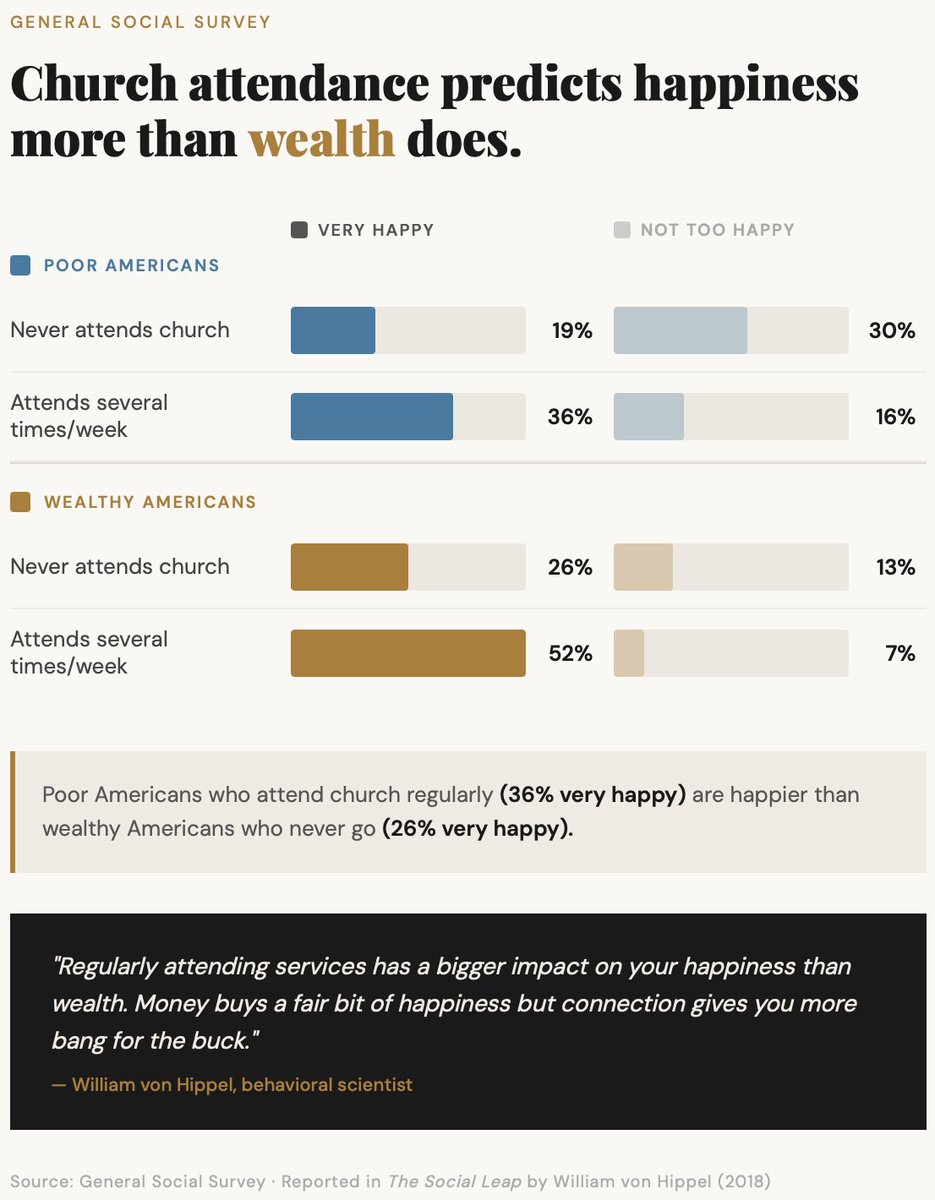
Poor Americans who attend church regularly are happier than rich Americans who never go.
Behavioral scientist William von Hippel thought he'd made a coding error. He hadn't.
"Regularly attending services has a bigger impact on your happiness than wealth," he writes. "Money buys a fair bit of happiness but connection gives you more bang for the buck."
What's happening? Rich people already have most of what money buys. What they lack is what churches provide for free: weekly, repeated contact with people who know your name.
Von Hippel is direct about the cost: "I suspect that wealthy, educated urbanites are paying a steeper price for their lifestyle than they realize. Many of us have paid too great a price in connection for our increased autonomy."
@grok@maklelan@RealMattFradd@grok How could it be falsified though? Someone like Meyer advances an alternative interpretation of the data and it’s by definition wrong because it rejects methodological naturalism. Seems like a heads I win tails you lose sort of situation.