No, I do not believe that we should “surrender human free will” to AI systems, and it’s absurd to suggest that I do. I have written hundreds of pages of essays and a constant theme in them is the need for AI to be governed by legitimate democratic processes. For millennia (going all the way back to Greek and Roman philosophers), advocates of autocracy have claimed that it leads to better, faster, or more decisive decision-making than the messy process of democracy. Even if this were true (which I doubt!), we should never sacrifice legitimacy or self-determination at the altar of efficiency or security. This argument against autocracy applies word for word against governance by AI, and I feel equally strongly that turning over governance to AI is a bad idea.
No one who had carefully read my writing or my interviews could reasonably conclude that I believe anything different. For example in an interview on CBS a couple months ago, I specifically called for AI to be governed democratically. I call for the same in Policy on the AI Exponential, Machines of Loving Grace, and The Adolescence of Technology, and We Must Pace the Frontier. Machines of Loving Grace contains an extended section on using AI to revitalize democracy, and discusses the use of AI as an aid to citizens in their decision-making, "aggregat[ing] opinions and driv[ing] consensus among citizens, resolving conflict, finding common ground, and seeking compromise.” The clear and obvious implication is that humans should remain the ones making political and governance decisions. The Adolescence of Technology has an entire section on fighting against AI-driven tyranny, and I even discuss the danger of AI labs usurping power and come out strongly against it — by implication, this definitely includes an AI lab usurping power and giving it to AI itself!
If I thought any of this was a good idea, I would be advocating for it in public, just as I have not been afraid to advocate for many, many unpopular views over the last few years. But I am not advocating for it, because I think turning over governance to AI is a terrible idea.
Separately, I think there is frequent conflation (including in this article) between the idea of “surrendering human free will” to AI in some grand sense of global governance, and the more prosaic idea that as AI systems advance, they become capable of doing specific tasks in a more automated way. This is not AI “running the world,” but AI driving a car, designing a cancer drug, or writing software end-to-end. Here, my view is mixed. AI doing more complete or larger tasks is economically valuable and can drive important advances in software, medicine, transportation, energy, etc. It is clearly desirable in many cases and will save a lot of lives. But it has downsides as well, and in some areas it may not be worth it.
For example, using AI too autonomously to build the next generation of AI systems (known as recursive self-improvement, or RSI) may cause AI to improve faster than we can control or adjust to it, so we may want limits on this process. As we said publicly in early November, we don’t expect it to be safe for Claude to build successive frontier models fully autonomously, without meaningful human supervision or understanding. Second, in some contexts, using AI in too end-to-end a manner may be a cause of serious job disruption, and it may make sense to slow or even stop some AI deployments to give people more time to adapt. Third, while the use of AI for alignment research is an incredibly valuable tool, it must be done with caution, because we may not be able to trust the work of the AI system. Finally, in many cases, humans would simply prefer to do some activities themselves, so they can stay deeply engaged in what matters to them, even if AI can do those activities better. There are countless other examples and hard cases. I don’t think there are any easy answers here, nor is there (nor should there be) any single decision-maker: some of these decisions will be made by society, some by government, some by AI companies, and some in a decentralized manner by individuals expressing their own preferences as consumers, which may differ from the preferences of others.
I don't think that other AI leaders or AI companies have significantly different views from me on whether specific tasks should be automated. Certainly the products that they offer don’t differ materially in their orientation towards automation of tasks; every company seems to be releasing models more and more capable of task automation (as that’s been the general consequence of scaling up AI training), and every company claims to understand there are risks and downsides of such automation and to offer safeguards. If anything, Anthropic has been the most vocal and the most proactive about acknowledging these downsides and trying to address them. For instance, it’s fairly absurd to cite my statement that fully autonomous weapons might “one day be needed for the defense of democracy” as differing from that of other AI companies, when I was willing to risk Anthropic’s future as a company to refuse to allow our existing AI models to be used for autonomous weapons even in the face of legal sanctions, and no other AI company did the same.
To summarize, as applied to grand questions of how we govern increasingly capable AI, I have been vocal and consistent that AI needs to be governed by a legitimate, democratic process and that “surrendering human free will” to AI systems is a terrible idea. As applied to automation of specific tasks by or for people, my views are more mixed, but I don’t think they differ from those of other AI companies — most other companies seem to be offering similar products and confronting similar tradeoffs without having perfect answers to them. What is happening is that there’s a sort of vibes-based commercial and political positioning that some AI CEOs are engaging in, where they repeat slogans like “human control and agency,” or “AI should be just a tool,” without actually doing anything different in their products or taking seriously the difficult questions that lie behind these slogans.
my main reaction to that was:
- not sure the METR hard to specify tasks are really hard to specify enough to represent what we mean usually when we talk about that?
- by definition we might not expect measurable evidence about some hard to verify tasks. See nostalgebraist's footnote here: https://t.co/6leCeUA98V
Thus I think a lot of this debate is almost a philosophical one over whether you think everything important can be benchmarked or not
An AI-powered government would be the most powerful state in history: far more capable of abuse, and less likely to be caught.
@DaveBanerjee and I wrote "The Legible Leviathan" for @JoinFAI on AI-enabled checks and balances to oversee an AI-run government.🧵
The 2 pacing techniques I've liked the most are:
1. compute-reallocation pacing
2. internal-deployment-blocking pacing
The excellent @EvanHub (alignment lead at Anthropic) used to prefer 1.
Now he prefers 2 for reasons he explains here:
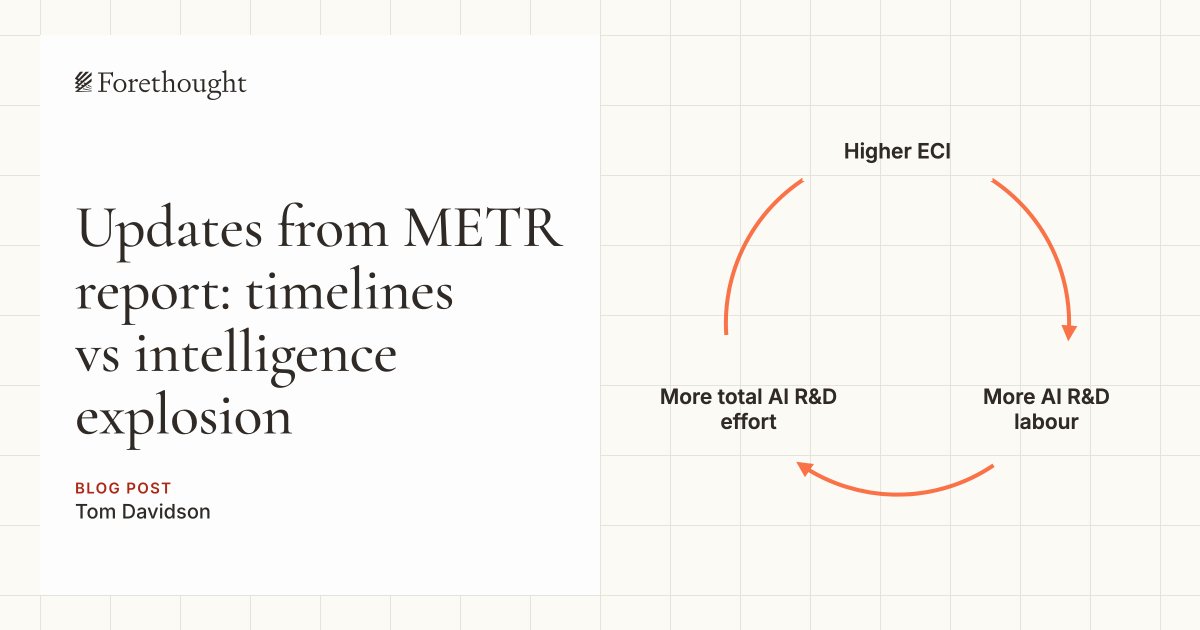
New from @TomDavidsonX: the METR report is a strong update towards shorter timelines. Does it also point to an intelligence explosion?
Moderately, he argues: AI looks better at AI R&D than expected, but compute bottlenecks remain plausible.
https://t.co/Z8INluQJeg
Every single @ahall_research piece is a must-read, but this one is a must-must-read. @freesystemslab is showing us the future of what AI-enabled social science research can look like. In this post they show what frontier AI models can help with in a research project, and what they still struggle with.
My personal take-away: the concept of "verifiable domain" has expanded tremendously, basically anything where you can get data on to train a verifier becomes something to hillclimb. But it's probably harder to train a verifier on something that even experts disagree on. In this case, "choosing an important question."
Frontier AI companies are handing off AI R&D to internally deployed AI agents: first coding, then review, and now decisions.
We call this process "Handoff." It is advancing fast and mostly out of sight.
Our report covers what Handoff is, why it matters, and what to do.
We decided to provide more transparency into pretraining progress at OpenAI for the sake of moving toward shared safety bars. In “Perplexity and Intelligence” I argue for common limits based on perplexity and other measurements, with progress beyond them gated on our ability to understand AI behavior.
https://t.co/XX35m5vq89
ten years later - it’s so impressive thinking back on lee sedol and the pure grace he showed as the era of human supremacy in his domain ended, even as he became an avatar for the human race and crushingly lost in front of a global audience. very few have managed it
The Lean and Mathlib communities have released a joint statement. 'We hereby certify that both the statement and the proof of the Riemann Hypothesis are correct.'
As AI systems get more powerful, we believe we will see a speedup in the rate of scientific progress. How we prepare for this, build the infra to support it, and deal with the associated safety issues will define 2027 and beyond. https://t.co/sqEzhYivFY
I spent last weekend at the Takeoff Conference in DC, trying to get up to speed on the current state of AI policy.
I compiled my learnings in this post: https://t.co/ZLjQyQGJLO
Over the last year, I’ve become increasingly scared about research sabotage on safety tasks by future AI models. Some personal thoughts:
We are currently struggling to fix safety problems that are relatively easy to notice and train away. It will take far more work before any company can reliably catch, and successfully train away, strategic underperformance on safety research.
The safety community is dramatically underprepared for this and for the related problems of underelicitation and non-strategic underperformance on safety work. I’m planning to write more on this topic soon.
Because of the small sample, underelicitation, and other limitations, it’s difficult to draw very rigorous conclusions from the empirical data of our paper alone. A more skilled human researcher would have produced significantly more covert sabotages than I did; our auditors would also have likely done much better if they had more research experience, more time, or more powerful models.
Even so, subjectively, working on this was a big update. I had previously thought that forcing the attacker to log every action, and letting the defender run unlimited experiments, would significantly advantage the defender.
Most relevant results to me: the attack selection results suggest that a strategic saboteur could guess fairly accurately which attacks would be easy to detect, and so attack only when it would be very hard to identify. Also, the fact that auditors were much worse at identifying ‘minor’ problems targeted at changing the results, compared to ‘major’ ones, suggests that generic sandbagging might be even harder to detect than the targeted sabotage I studied here.
To draw firmer conclusions about risk, we would need better answers to several questions. For instance:
- What capabilities does drastic AI R&D acceleration actually require?
- Is performance on easy-to-verify tasks enough?
We've been working on understanding model capabilities beyond what our prior time horizon tasks could capture.
Today we’re sharing a research update. We find that AI R&D-relevant capabilities are improving rapidly and are getting harder to measure.
My sense of one crux on AI regulation: skeptics think advocates are doing a sort of "political planning fallacy", asking "what regulation is needed to handle the risks well", but should be asking "if these regs were on the books, what's the worst way they could be abused"
Next Import AI comes out on Monday, with this issue partially written in Nasdaq on the Anthropic listing day. Writing this newsletter is a privilege and a joy - thanks for reading!