I agree that peaceful disagreement without ad hominem attacks is crucial to democracy and good governance, but voting for Trump requires agreeing with or at least ignoring his complete lack of ethics, empathy and frankly, decency.
I’m the guy doing this for my small business clients. It’s very exciting and fun and 10x more productive than the way I used to help my clients with tech challenges.
Agentic AI adoption is on fire at @Uber, and it's changing the way we build, not just in engineering, but across the entire company.
Today, 99% of our engineers use AI tools. More than 70% of pull requests are attributed to local or cloud agents. And our engineers have built 2,500+ agent skills across the software development lifecycle.
Those numbers are exciting, but they led us to a much bigger question:
How do we bring agentic AI beyond engineering?
Finance. Legal. Operations. Marketing. Customer Support. HR. Procurement.
These functions run on complex workflows that are often manual, highly nuanced, and spread across dozens of systems. You can't automate them effectively by looking at process diagrams or documentation. You have to understand how the work actually gets done.
So we created something called Agentic Pods.
The idea is simple.
We handpicked ~30 of our most AI-proficient engineers (people with deep knowledge of Uber's systems) and paired each of them with a domain expert from a business function.
Then we gave every pod just two weeks.
• Days 1 – 2: Shadow the expert. Observe every step. Document workflows. Ask questions. Build intuition.
• Day 3: Prioritize opportunities based on scale, repetition, business impact, and data availability.
• Days 4 – 5: Build a working agent alongside the person doing the job.
• Days 6 – 9: Validate with several others performing the same work. Does it generalize? Does it actually make their job better?
• Day 10: Ship.
In just the past two months, we've run 16 Agentic Pods across 16 different business functions.
• Capital allocation across 150 cities: 15 hours → 30 minutes.
• Financial pacing reports: 2 days → 10 minutes.
• Marketing web quality assurance: 2 weeks → 50 minutes.
• Support workflow creation: 9,000 manual workflows → self-service automation.
The productivity gains are impressive, but what surprised us most wasn't the speed.
• It was how quickly engineers embedded in unfamiliar domains uncovered opportunities that had been hiding in plain sight.
• The biggest wins rarely come from automating one task. They come from rethinking an entire workflow. Once you redesign the workflow around AI, you often eliminate handoffs, remove unnecessary approvals, replace legacy tooling, reduce vendor spend, and dramatically accelerate decision-making.
• The workflow becomes the unit of automation - not the individual task.
• The most impactful agent skills cut across teams, orgs, functions, tools, and systems.
The biggest lesson? The best AI opportunities are rarely visible from the outside.
You discover them by sitting next to the people doing the work, understanding every friction point, and building with them, not for them.
We're now forming a dedicated team to scale this further and go deeper. They'll deeply understand the work, redesign it from the ground up, and use AI to fundamentally change how the business operates.
It's exciting times!
@tferriss I created a web app (using Claude Code of course) that helps with goal and vision setting. It’s not the same exact method but it’s very similar… and it’s free!
https://t.co/mO88S7Xq0y
And if you try it and have feedback, send it to me here ;)
This is really stupid, and it’s not getting enough attention.
The Trump administration is pulling a working $368 million ocean monitoring system out of the water, equipment taxpayers already bought, built, and sank into the deep ocean.
And they are doing it right when the oceans are behaving in ways that alarm the scientists who study them.
Record-breaking temperatures.
A system of Atlantic currents that may be lurching toward collapse.
The response?
Yank out the instruments and walk away.
That is not budgeting. That is smashing the gauges while the engine is on fire and calling it efficiency.
For what? The Trump administration dressed it up as a “nimbler approach” and “smart lifecycle management,” which is fancy nonsense for “we shut it off and hoped nobody would ask why.” There is no return-on-investment analysis. They cannot show taxpayers save a dime, because the gear is already paid for and the science it produces protects real money and real lives.
The kicker: the same people killing the monitors want to mine the deep sea for minerals. So they are destroying the only tools that could measure what that mining does. That is not an accident.
That is the point. You cannot see the damage if you break the instruments first.
https://t.co/MzE4AW1QBv
This is so insanely corrupt, I can’t even believe it.
More than half the donors to Trump’s $400 million White House ballroom just won over $50 billion in new federal contracts in six months.
And here’s the part that should make your blood boil.
Sixteen of these 27 donors were facing federal enforcement actions, antitrust reviews, labor cases, securities charges. Many of those cases have been quietly dropped or scaled back since Trump took office. You write a check, your legal problems disappear. That’s not a coincidence.
The White House won’t even release the full donor list. They’re hiding it on purpose, because daylight is the one thing pay-to-play can’t survive. A federal judge already ruled ballroom construction has to stop until Congress authorizes it.
Government is supposed to serve the people, not auction itself off to the highest bidder. When access goes to whoever pays the most, working families always end up paying the price.
We either end the corruption, or the corruption will end us.
https://t.co/4MGFzSseFl
This New York Times piece is worth your time. Here’s what is happening, as simply as I can put it.
Back in January, Trump sued the IRS, an agency he controls, demanding $10 billion over the leak of his tax returns a number of years ago.
IRS lawyers did their jobs. They wrote a memo laying out the defenses that could beat the suit, including the fact that Trump filed too late. His own lawyer was in court when the leaker pleaded guilty in October 2023, more than two years before Trump sued.
The Justice Department never showed up to court. Never argued back. Never used the defenses sitting on their desk.
The judge got suspicious and ordered both sides to explain whether they were actually opposing each other or just colluding. The day before that brief was due, Trump dropped the suit.
Same day, his Justice Department announced a $1.776 billion taxpayer-funded “anti-weaponization fund.”
Trump gets a formal apology. The IRS agrees to drop any audits of him and his family, even though a 2024 Times report found a loss in an ongoing audit could cost him over $100 million.
The acting Attorney General, Trump’s former criminal defense attorney, picks the five commissioners who decide who gets paid. Trump can fire any of them. Proud Boys and Oath Keepers are not ruled out.
This is the most corrupt thing I’ve ever seen from an American president.
Where in the hell are my Republican colleagues?
https://t.co/La0nlLuz1r
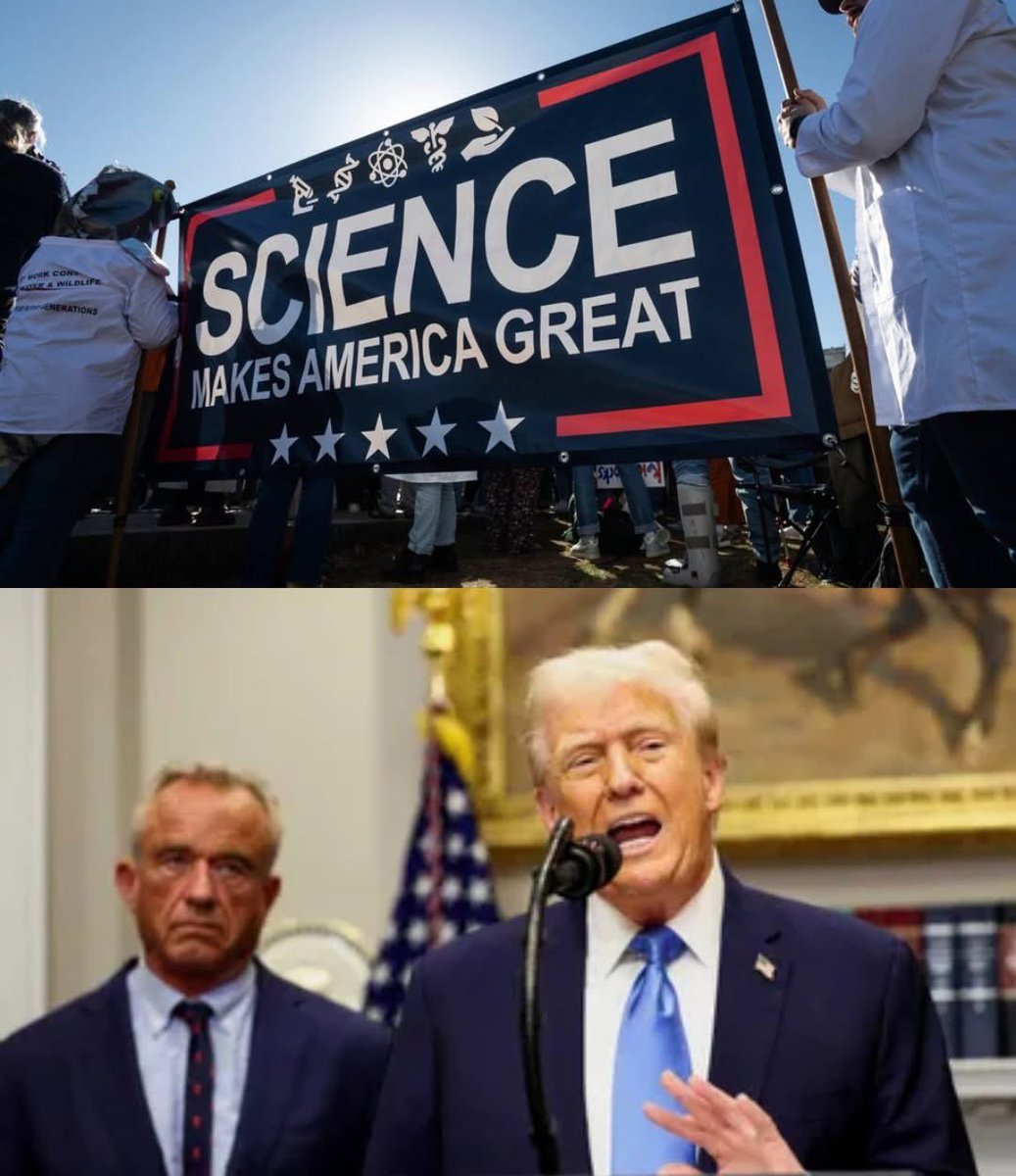
Trump just fired all 24 members of the National Science Board. Every single one. By email. No warning. No reason given. The board has existed since 1950.
The National Science Board is the independent body that oversees the National Science Foundation, the agency that distributes $9 billion in research grants every year.
Its members are scientists and engineers from universities and industry. They serve six-year staggered terms specifically so they cross presidential administrations and stay independent of whoever is in power.
On Friday, every single one of them got the same boilerplate email from Mary Sprowls of the Presidential Personnel Office: "On behalf of President Donald J Trump, I am writing to inform you that your position as a member of the National Science Board is terminated, effective immediately. Thank you for your service."
That's it. That's the whole letter. For 76 years of institutional independence.
The NSF funds the basic science behind MRIs. Cellphones. LASIK eye surgery. GPS. The internet itself. The Antarctic research stations. The deep-space telescopes. The research vessels mapping the ocean floor. Every breakthrough that made America the world's leader in science for the better part of a century traces back through grants this agency made and this board approved.
The board chair, Victor McCrary, was actively advising Congress on Trump's proposed 55% cut to NSF's budget. The board was helping fight back. So Trump fired the board.
Marvi Matos Rodriguez, one of the fired members, told reporters she had been reviewing an 80-page report as part of her board duties just days before being terminated.
Keivan Stassun, a physicist at Vanderbilt, said NSF's leadership had already stopped responding to board oversight requests months ago. "We would ask them, 'Are you following board governance directives?' And their answer would be, in effect, 'We don't listen to you anymore.'"
Now there's no board to answer to.
Rep. Zoe Lofgren of California, the top Democrat on the House Science Committee, called it "the latest stupid move made by a president who continues to harm science and American innovation. Will the president fill the NSB with MAGA loyalists who won't stand up to him as he hands over our leadership in science to our adversaries?"
That's the actual question.
Because while Trump is firing American scientists, China is building research universities at a rate we cannot match. The CDC just buried a study showing vaccines work.
RFK Jr. runs HHS. The EPA is gutted. The Forest Service is being broken. Half of American children are breathing dangerous air. And now the people who decide what gets researched in the United States have all been fired by email on a Friday afternoon.
Hey Republicans;
He pardoned 1,600 violent criminals. You said nothing.
He bulldozed the East Wing. You’ve said nothing.
He’s interfered with the release of the Epstein files. You’ve said nothing.
He took over the Kennedy Center, even renaming it after himself. You’ve said nothing.
He accepted a $400 million airplane as a personal gift. You’ve said nothing.
He’s threatened Canada, Cuba, Denmark, Greenland, Venezuela, Colombia, Brazil. You’ve said nothing.
He’s tariffed just about everyone but Russia, causing inflation and instability worldwide. You’ve said nothing.
He attacked a nation during mediated negotiations. You said nothing.
His ill-conceived war killed 175 little girls in its first days. You’ve said nothing.
He’s alienated and insulted more countries than I can keep track of. You’ve said nothing.
His ICE Army is terrorizing and murdering U.S. citizens. You've said nothing.
He has committed murder on the high seas. You've said nothing.
He's co-opted the Justice Department and directed it to prosecute his political enemies. You've said nothing.
You've not only said nothing to all of these egregious acts, and many more, but you have also enabled them.
And it’s only been a year.
Hey, Republican Congressmen, you took an oath, remember?
Not to him. To the Constitution.
It’s time to do your fucking jobs!
The more enterprises I talk to about AI agent transformation, the more it’s clear that there is going to be a new type of role in most enterprises going forward. The job is to be the agent deployer and manager in teams. Here’s the rough JD:
This person will need to figure out what are the highest leverage set of workflows on a team are (either existing or new ones) where agents can actually drive significantly more value for the team and company.
In general, it’s going to be in areas where if you threw compute (in the form of agents) at a task you could either execute it 100X faster or do it 100X more times than before. Examples would be processing orders of magnitude more leads to hand them off to reps with extra customer signal, automating a contracting review and intake process, streamlining a client onboarding process to reduce as many straps as possible, setting up knowledge bases than the whole company taps into, and so on.
This person’s job is to figure out what the future state workflow needs to look like to drive this new form of automation, and how to connect up the various existing or new systems in such a way that this can be fulfilled. The gnarly part of the work is mapping structured and unstructured data flows, figuring out the ideal workflow, getting the agent the context it needs to do the work properly, figuring out where the human interfaces with the agent and at what steps, manages evals and reviews after any major model or data change, and runs and manages the agents on an ongoing basis tracking KPIs, and so on.
The person must be good at mapping the process and understanding where the value could be unlocked and be relatively technical, and has full autonomy to connect up business systems and drive automation. This means they’re comfortable with skills, MCP, CLIs, and so on, and the company believes it’s safe for them to do so. But also great operationally and at business.
It may be an existing person repositioned, or a totally net new person in the company. There will likely need to be one or more of these people on every team, so it’s not a centralized role per se. It may rile up into IT or an AI team, or live in the function and just have checkpoints with a central function.
This would also be a fantastic job for next gen hires who are leaning into AI, and are technical, to be able to go into. And for anyone concerned about engineers in the future, this will be an obvious area for these skills as well.
I’ve been in crypto for 13 years, of everything I’ve seen, this is quite possibly the worst and most blatant fraud I’ve come across. It’s insanity. Sad to see.
Instead of watching an hour of Netflix, watch this 2-hour Stanford lecture on AI careers. It will teach you more about winning in the AI race than all the AI content you’ve scrolled past this year.
Instead of watching an hour of Netflix, watch this 2-hour Stanford lecture on AI careers. It will teach you more about winning in the AI race than all the AI content you’ve scrolled past this year.
There are far more categories where AI agents making things more efficient will induce demand for that skill than spaces where agents eliminate the work. This is why the AI jobs predictions will not play out as advertised.
AI making it easy to produce more code will mean we start to apply code to far more parts of our businesses. We will build automation and software for things that wouldn’t have made sense before. Marketing automation, client onboarding, modernizing old systems, doing far more research on existing data, and more. More engineers.
Far more software will mean vastly more security risks. This will mean far more people thinking through system security, compliance, and governance. This used to be primarily manual and only large companies could afford this work. AI will make it so more companies care about this (and maybe can do something about it), causing more security roles.
AI will also lower the cost of a bunch of previously relatively niche or harder to access categories of work. Companies will now be doing 10X more with video and graphics, and will need people to manage that work. More media. We’re going to have a near unlimited set of legal challenges in a world of AI as AI helps write even more bespoke and complicated legal docs. More lawyers.
Then there’s the impact of AI efficiency on non-office worker jobs. Talked to a customer that said they’re going to make scheduling medical appointments and getting referrals so efficient the next problem will be there will be no booking time slots available. More healthcare. Many industries will have this same dynamic play out.
The examples are endless once you start to think through second order effects of agents making work more efficient.
The math on OpenAI's governance structure is the part that should terrify you.
Ilya wrote a 70-page memo documenting deception. He got sidelined and left. Mira supplied the screenshots for that memo. She left. Helen Toner requested documentation and found safety reviews hadn't been completed. She got removed from the board. Dario kept 200+ pages of notes on what he witnessed. He left and started a competitor.
Four separate people, across years, independently documented the same pattern. All four are gone. The person they documented now controls a company valued at $852 billion.
The WilmerHale investigation that was supposed to provide accountability after Altman's return? It produced no written report. The law firm orally briefed two new directors, and the decision not to write anything down was partly based on advice from those directors' private lawyers. Current board members are reportedly discussing whether they need a "redo."
The $852B entity is burning $4 billion a month, projecting $14 billion in losses this year, and won't break even until 2029 or 2030. The IPO is targeting Q4 2026. Every investor who underwrites that offering is betting that the governance concerns raised by OpenAI's own chief scientist, CTO, board member, and co-founder were all wrong.
That's a $1 trillion bet on the whistleblowers being the problem.
My next step might be iMessages or creating a GUI, though I think I’m pretty happy with obsidian for that. Might try the “articles” idea from this post, though.
I love this and am already implementing it for myself:
Level 1 (done weeks ago): Claude project files, best practices for my business, etc
Level 2: I incorporated 20 years of Apple Notes and switched to Obsidian
Level 3: added 16k links I’ve saved with Instapaper and pocket…
This is Farzapedia.
I had an LLM take 2,500 entries from my diary, Apple Notes, and some iMessage convos to create a personal Wikipedia for me.
It made 400 detailed articles for my friends, my startups, research areas, and even my favorite animes and their impact on me complete with backlinks.
But, this Wiki was not built for me! I built it for my agent!
The structure of the wiki files and how it's all backlinked is very easily crawlable by any agent + makes it a truly useful knowledge base.
I can spin up Claude Code on the wiki and starting at index.md (a catalog of all my articles) the agent does a really good job at drilling into the specific pages on my wiki it needs context on when I have a query.
For example, when trying to cook up a new landing page I may ask:
"I'm trying to design this landing page for a new idea I have. Please look into the images and films that inspired me recently and give me ideas for new copy and aesthetics".
In my diary I kept track of everything from: learnings, people, inspo, interesting links, images.
So the agent reads my wiki and pulls up my "Philosophy" articles from notes on a Studio Ghibli documentary, "Competitor" articles with YC companies whose landing pages I screenshotted, and pics of 1970s Beatles merch I saved years ago. And it delivers a great answer.
I built a similar system to this a year ago with RAG but it was ass.
A knowledge base that lets an agent find what it needs via a file system it actually understands just works better.
The most magical thing now is as I add new things to my wiki (articles, images of inspo, meeting notes) the system will likely update 2-3 different articles where it feels that context belongs, or, just creates a new article.
It's like this super genius librarian for your brain that's always filing stuff for your perfectly and also let's you easily query the knowledge for tasks useful to you (ex. design, product, writing, etc) and it never gets tired.
I might spend next week productizing this, if that's of interest to you DM me + tell me your usecase!
And level 4: today I’m including “conversations” from my email sent folder. Every business conversation I’ve ever had via email is now part of my wiki. They’re saved (via fastmail’s excellent JMAP API) easily as clean threads without the normal email noise and linked universally
@quxiaoyin@sindhubiswal My 14 year old was in a Waldorf school for 3 years after the pandemic and I think that system does teach empathy and creative problem solving as well as hand skills like cursive and needlework with zero technology. He’s in public school now (and bored) but got that foundation.