🚨 KASPA IS GETTING ITS OWN BLOOMBERG-STYLE TERMINAL! 🚀
Introducing x4kas v0.1.0 — an open-source, locally running analytics platform built for the Kaspa ecosystem.
🔹 Real-time BlockDAG visualization
🔹 Whale wallet tracking & address monitoring
🔹 On-chain queries & transaction analysis
🔹 Address clustering & fund-flow insights
🔹 Desktop GUI + CLI for AI agents
🔹 Local data processing & analytics
💡 The real game-changer? AI integration.
Imagine autonomous AI agents monitoring whale movements, analyzing on-chain activity, detecting unusual transactions, and generating actionable intelligence — 24/7.
No centralized analytics platform required.
And this is just the beta.
Future ambitions include KCC support, SilverScript, Argent, wallet functionality, and deeper ecosystem integrations.
Kaspa is evolving beyond a blockchain into an ecosystem of powerful, independently built infrastructure.
The network provides the foundation.
Developers build the intelligence.
The ecosystem creates the value.
⚡ $KAS — Built for a decentralized future.
🔗 https://t.co/R7Tfb5va0u
#Kaspa #KAS #BlockDAG #AI #OpenSource #Web3
I finally wrote a book that covers vprogs, and in particular tic-tac-toe implemented as a vprog on testnet-10. It follows the game down to the machinery underneath, with diagrams and appendices for the details. Welcome to explore it and ask questions: https://t.co/shDcRXiQaf
@RaoulGMI That is not true. Europe has a well-developed electricity grid, and the Germans simply buy energy from other countries with nuclear power plants.
1/10
Kaspa just published official developer documentation.
One entry point for the full programmability stack Covenants, Based Apps, Inline ZK, SilverScript, vProgs.
This matters more than it sounds.
Here's everything that happened in CW38. 🧵
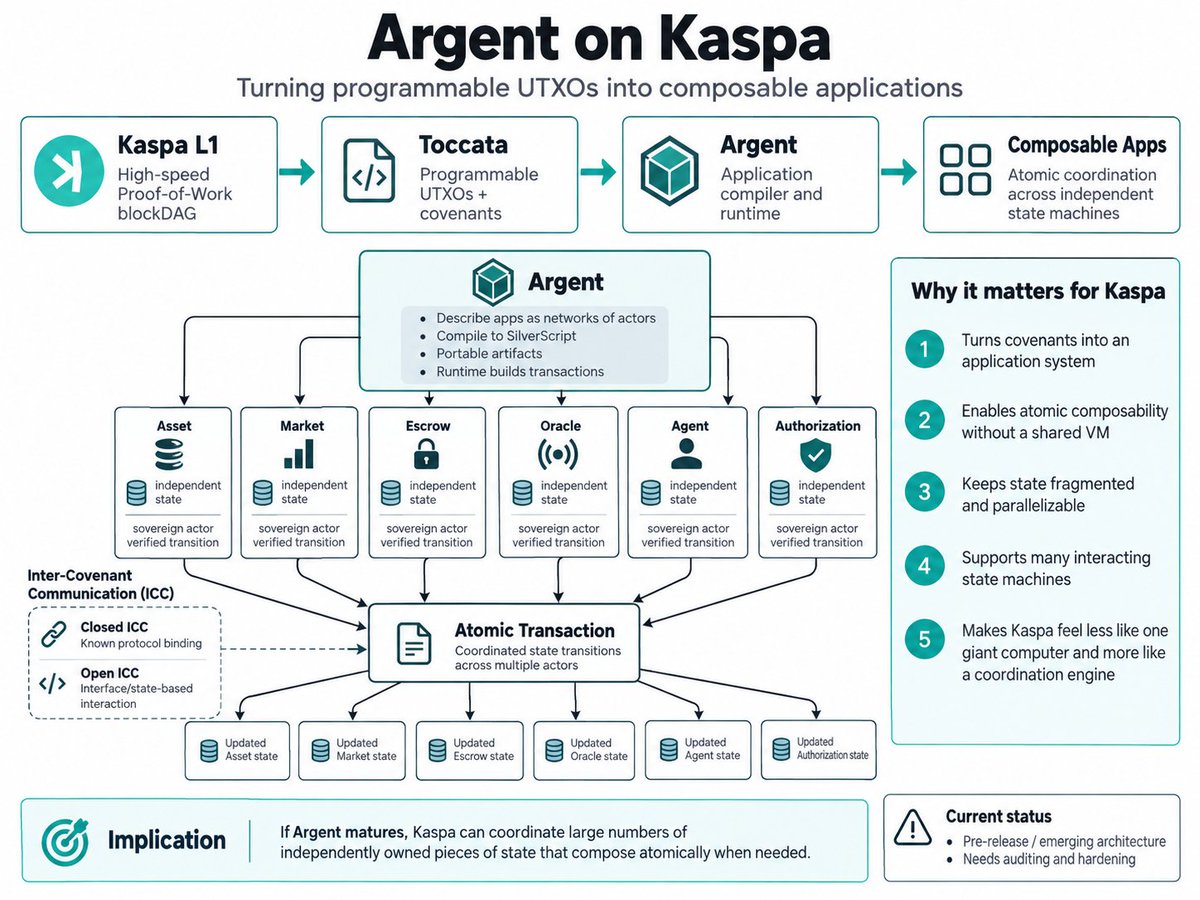
Argent may end up being one of the most consequential pieces of Kaspa’s post-Toccata architecture because it turns covenants from isolated programmable UTXOs into something much closer to a coherent application system. Instead of developers manually managing script templates, covenant IDs, witness construction, output ordering, state serialization and route commitments, Argent lets them describe applications as networks of actors that own state and transition through transactions. The compiler then lowers those relationships into auditable SilverScript and produces portable artifacts that argent-runtime can use to construct the actual transactions. In effect, Argent is trying to make the application graph itself programmable rather than forcing developers to reason directly about covenant plumbing.
The larger implication is composability. Argent’s Inter-Covenant Communication allows independently compiled covenant applications to participate in the same atomic transaction. Closed ICC can deliberately bind one application to another known protocol, while Open ICC introduces something much more powerful: applications can interact with independently created actors that satisfy an expected state or interface shape without hard-coding every possible implementation beforehand. That begins to resemble dynamic application composition, except there is no shared VM executing arbitrary calls. Every covenant remains sovereign over its own state and verifies its own transition, while the transaction provides atomic coordination between them.
That architecture fits Kaspa unusually well. Instead of concentrating application state inside globally shared contracts, state can remain fragmented across independent UTXOs that only coordinate when necessary. This creates the possibility of applications composed from many parallel state machines: assets, markets, escrows, games, autonomous agents, authorization systems and other protocols interacting without everything funneling through one global execution bottleneck.
If Argent matures, Kaspa could end up with something fundamentally different from conventional smart-contract platforms: not one giant shared computer, but a high-speed Proof-of-Work network coordinating enormous numbers of independently owned pieces of state that can compose atomically when required. The major caveat is that Argent is still pre-release and requires substantial auditing and hardening. But architecturally, it may be the layer that turns Toccata’s primitives into an actual application ecosystem.
I think the market is still fundamentally misunderstanding what Kaspa is becoming.
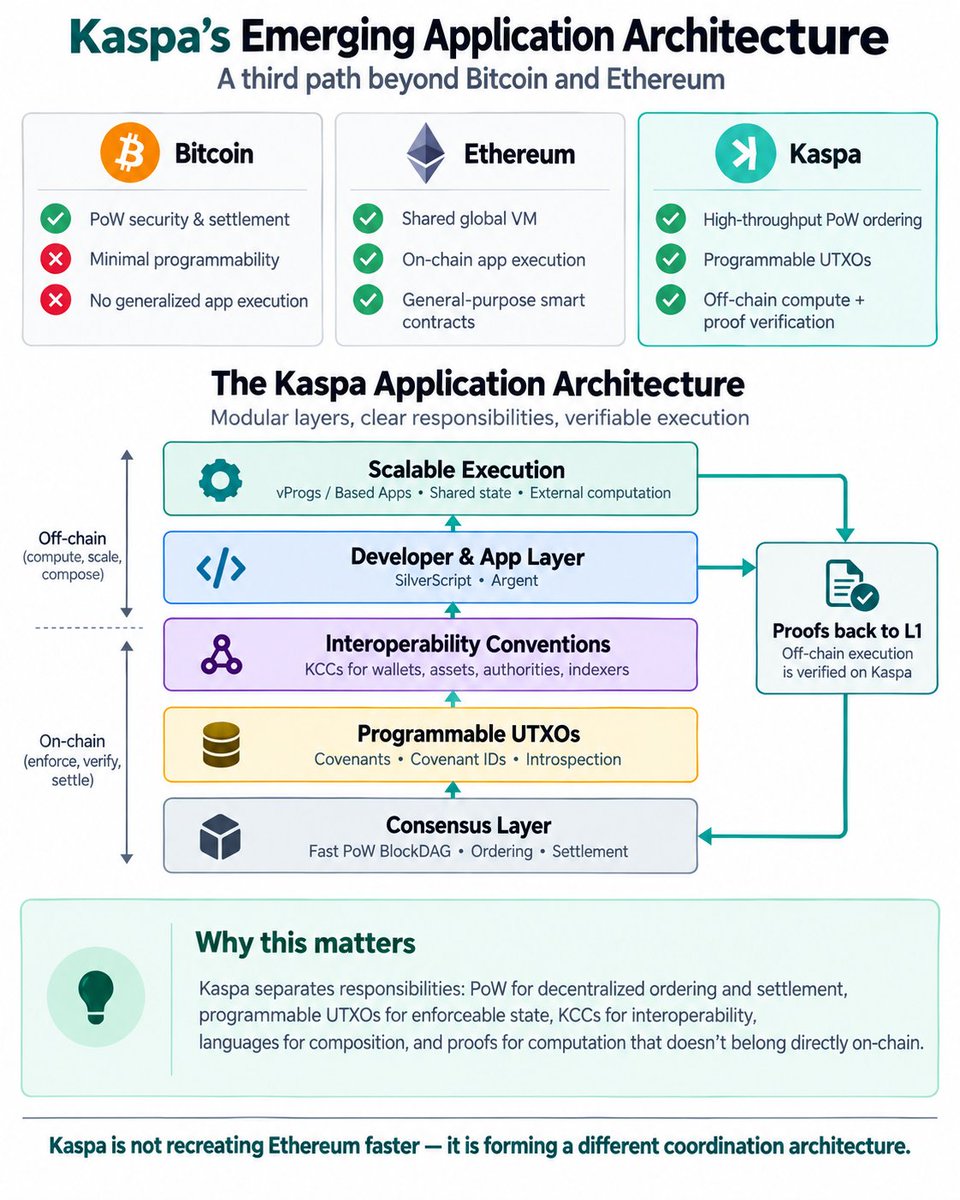
The easy description is that Kaspa started as fast Proof-of-Work and is now adding programmability. I think that framing is already outdated. What is actually forming looks much closer to an entirely different application architecture, one that does not fit cleanly into either the Bitcoin or Ethereum model.
Toccata established the primitives: programmable UTXOs, covenant IDs, transaction introspection, ZK verification and sequencing commitments. But primitives by themselves are not an ecosystem. What matters now is everything beginning to assemble around them. KCCs can standardize how wallets, assets, authorities, indexers and applications interpret these primitives without bloating consensus with every new convention. SilverScript gives developers a higher-level way to express covenant logic. Argent is exploring applications composed from independent covenant actors. And vProgs/Based Apps create a path for computation and shared state that can happen outside L1 while still anchoring ordering, commitments and verification back to Kaspa.
That combination is where this gets interesting.
Ethereum largely asks applications to live inside a shared execution environment. Bitcoin largely avoids generalized application execution altogether. Kaspa appears to be developing a third path: keep consensus focused on extremely fast decentralized ordering and settlement, make UTXOs programmable enough to enforce meaningful state transitions, standardize how those pieces communicate, and push expensive computation outside consensus when cryptographic proofs can verify the result.
That is a radically different division of labor.
If it works, Kaspa does not need to become “another smart contract chain.” It could become something harder to categorize: a high-throughput Proof-of-Work coordination layer where assets, applications, autonomous agents and external computation can interact through independently evolving pieces of verifiable state.
And I think that distinction matters more than TPS comparisons ever will.
The real question may eventually stop being whether Kaspa can compete with existing L1s.
It may become: what exactly do you compare Kaspa to when the architecture itself is different?
169 -> 253.
That's how many active Kaspa miners existed on August 12 vs. today.
+84 miners in 21 days. +50% increase.
The weekly trajectory:
Aug 12 (CW33): 169 miners| 575 nodes
Aug 18 (CW34): 204 miners| 582 nodes
Aug 19 (CW34): 215 miners| 584 nodes
Aug 20 (CW34): 225 miners| 587 nodes
Aug 25 (CW35): 255 miners| 591 nodes
Aug 27 (CW35): 253 miners| 597 nodes
New pool entrants confirmed in 21 days:
- AntPool (Aug 5)
- EMCD (Aug 18)
- NiceHash (Aug 18)
- Binance Pool (Aug 20, zero fee until Nov 5)
- BaikalMine (Aug 24)
On August 11, Shai Wyborski raised a legitimate concern: 80% of peak hashrate sitting idle, concentration risk unaddressed.
Three weeks later: five major pools entered. Miner count up 50%.
The data moved in the opposite direction than the concern predicted.
Both things can be noted simultaneously the concern was valid. The response was faster than expected.
#Kaspa #NFA
Zero-day exploits are going to become normal. For most of computing history, discovering a serious vulnerability required scarce human expertise, time and persistence. AI is destroying that scarcity. Frontier models can already read enormous codebases, reason across functions, compare historical patches, identify previously unknown vulnerabilities and increasingly construct working exploit chains. Anthropic has found vulnerabilities in software that had already endured years of conventional fuzzing. Google has now observed a threat actor using what it believes was an AI-developed zero-day. The important shift is economic: vulnerability discovery is becoming industrialized.
Soon the attacker isn't one researcher staring at code. It's thousands of autonomous agents continuously probing every implementation, dependency, bridge, API, sequencer, validator client and administrative surface simultaneously. That makes architecture matter enormously. Proof-of-work does not make software immune to exploits. Kaspa's node software can have bugs like any other software. What PoW does is anchor the fundamental problem of controlling consensus to something intelligence alone cannot manufacture: physical computation and energy. You can know every rule of the network. You can have an AI smarter than every developer who wrote it. That knowledge does not magically produce hashpower.
This is why Kaspa becomes increasingly interesting in an AI-dominated world. Kaspa retains permissionless PoW while using GHOSTDAG to order parallel blocks, allowing the network to operate at 10 blocks per second without abandoning Nakamoto-style resource-based consensus. AI makes intelligence abundant. That means systems increasingly dependent on credentials, privileged operators, governance layers and complex trusted infrastructure face an expanding machine-speed attack surface. Kaspa moves in the opposite direction: transparent rules, permissionless participation, decentralized proof-of-work and a consensus mechanism ultimately grounded in an external physical cost. In the age of superhuman intelligence, one of the strongest security primitives may be something intelligence cannot simply think its way around: work.