MCP+: Precision Context Management for MCP Agents https://t.co/AA9vfoYcGa
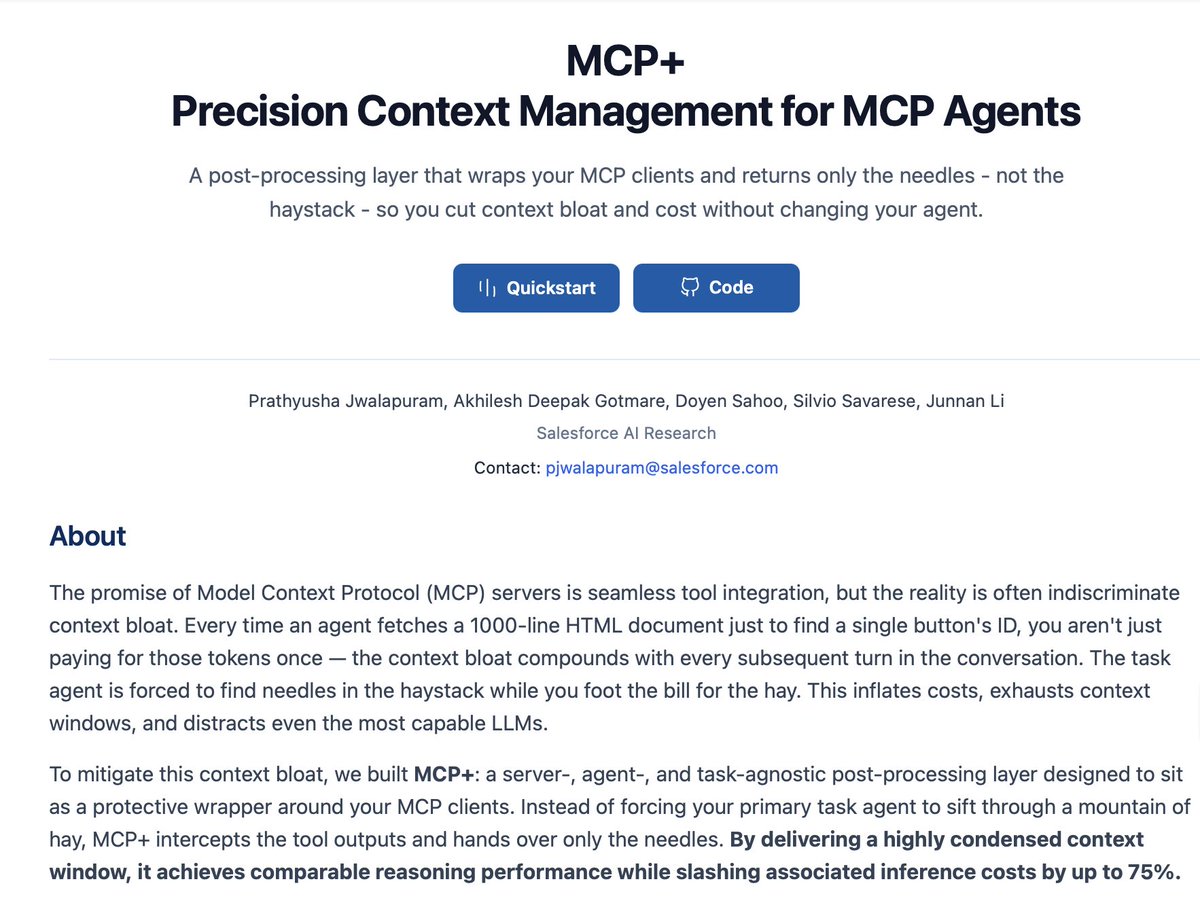
A server-, agent-, & task-agnostic post-processing layer that wraps your MCP clients — filtering tool outputs down to only what your agent needs, with zero changes to your existing logic.
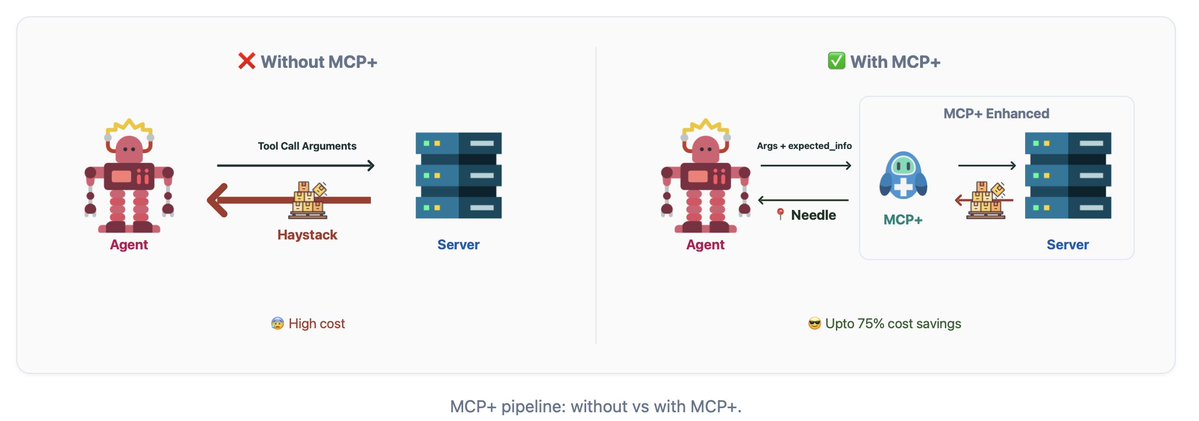
🔍 Context bloat is a real cost. When MCP tools return thousands of tokens of raw HTML, JSON dumps, or API payloads, your primary agent pays for every token — and that overhead compounds across every turn. MCP+ intercepts those outputs and returns only the relevant slice, offloading the filtering work to a cheaper model so your premium LLM context stays focused on the task.
📊 Results across the MCP-Universe Benchmark (browser navigation, financial data, web search): → Up to 75% reduction in inference cost → Comparable or improved task accuracy across Claude, GPT, and Gemini → Token count reduced by >95% in structured data tasks (e.g. ~7,000 tokens → ~200)
⚙️ The key mechanism: an expected_info argument that lets your agent specify exactly what it needs before the haystack reaches its context window.
🛠️ Works with Cursor, Claude Code, and Agentforce Vibes. Supports OpenAI, Gemini, and Anthropic models as the filtering layer.
✍️ Authors: Prathyusha Jwalapuram (@jwala_94), Akhilesh Deepak Gotmare (@akhilesh_gotmare), Doyen Sahoo (@doyensahoo), Silvio Savarese (silviocinguetta), and Junnan Li (@LiJunnan0409).
#FutureOfAI #EnterpriseAI #AIAgents #MCP #LLM #GenerativeAI #MLOps
Context bloat is a silent tax on your Cursor and Claude Code. 💸
When an MCP tool dumps 10,000 tokens of irrelevant JSON blobs into your chat, it burns budget, eats your context window, and distracts the LLM.
Introducing MCP+ 🚀
https://t.co/DBcXFmmzgR
MCP+ is a server-agnostic, agent-agnostic, task-agnostic post-processing layer that wraps around your MCP clients as a protective filter 🛡️ — requiring zero changes to your existing agent logic.
🚨 New paper and dataset alert: When do multi-agent systems actually help?
📄 Paper: https://t.co/x2ydfGXJQ7
Despite growing interest, most multi-agent systems (MAS) today rely on local, sequential, and hand-designed orchestration—making it difficult to reason about their benefits or scale them effectively.
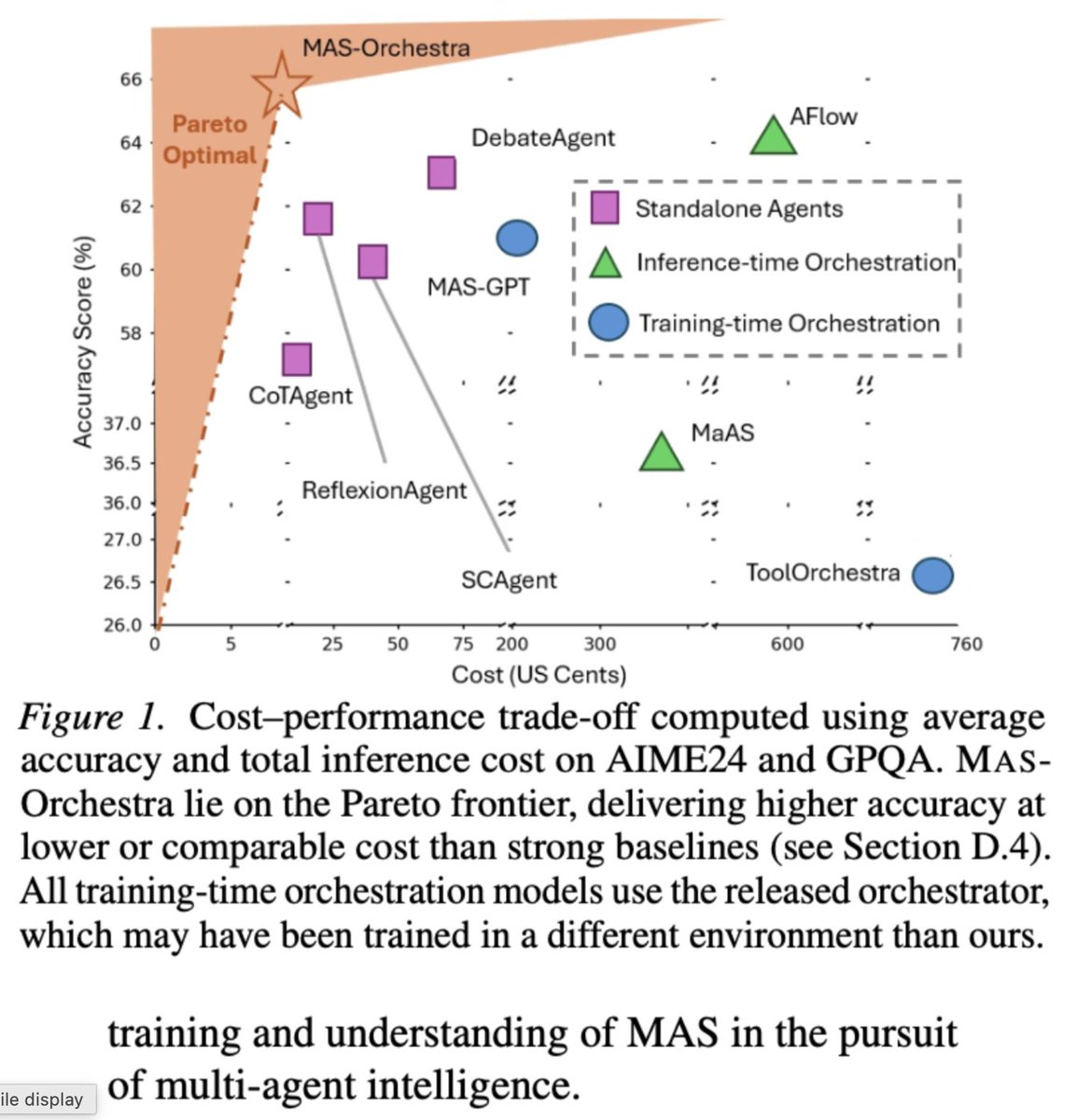
Introducing MAS-Orchestra, which takes a new perspective: treat MAS orchestration as a holistic, function-calling reinforcement learning problem, with an explicit notion of the degree of multi-agentness (DoM).
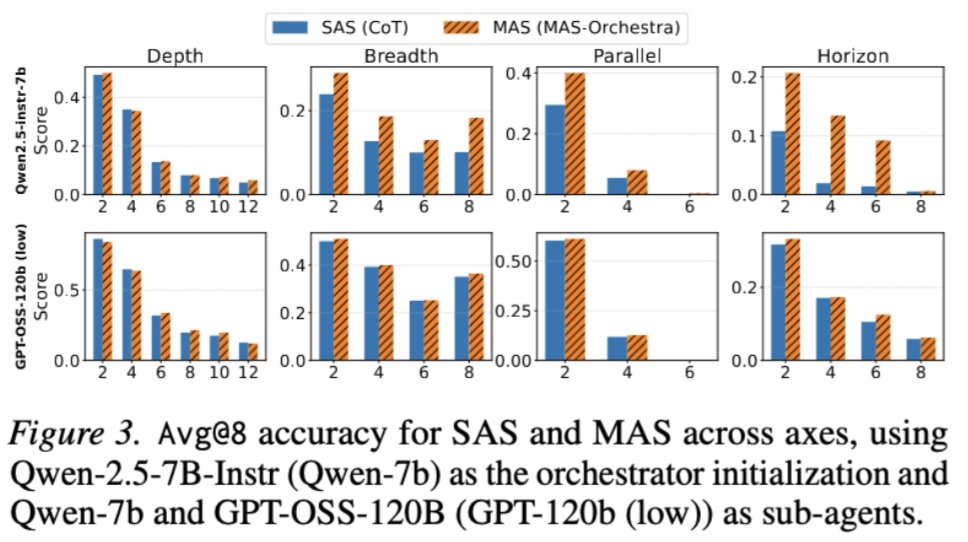
We also introduce MASBench, a benchmark designed to systematically measure when MAS outperforms single-agent systems on reasoning tasks.
The result: strong multi-step reasoning with 10×+ efficiency gains, and clearer answers to when multi-agent systems are worth the added complexity.
🔗 Project Page: https://t.co/aLg1943Lsw
💻 Code: https://t.co/7SZGzMKDnS
📊 Dataset: https://t.co/47zJEz18LA
Authors: Zixuan Ke @KeZixuan, Yifei Ming @ming5_alvin, Austin Xu @austinsxu, Ryan Chin @ryaaanch, Xuan Phi Nguyen @xuanphinguyen, Prathyusha Jwalapuram @jwala_94, Jiayu Wang @jiayuwang111, Semih Yavuz @semih__yavuz, Caiming Xiong @caimingxiong and Shafiq Rayhan Joty @JotyShafiq
Rakuten released high-performance open large language models optimized for Japanese!✨
Foundation model and instruct model achieve top average score among open Japanese LLMs in LM Evaluation Harness benchmark.
👇Check the details:
https://t.co/VYYfvVsie6
#RakutenAI#OpenLLM
My first paper at Rakuten, "Pulling Out All The Full Stops: Punctuation Sensitivity in Neural Machine Translation and Evaluation" has been accepted to Findings of ACL 2023. Huge thanks to the RIT Singapore team for their help and support! @RakutenRIT
I'll be presenting our work on "Rethinking Self-Supervision Objectives for Generalizable Coherence Modeling" at #ACL2022 this afternoon (2.30pm) in the Discourse and Pragmatics session. Do drop by! Full paper: https://t.co/gMicpEskle
We break from the traditional pairwise objective on the permuted document task and show that training with more+hard negative samples leads to better generalization by testing on several downstream tasks. An arxiv version is available here: https://t.co/gMicpEskle
Our paper "Rethinking Self-Supervision Objectives for Generalizable Coherence Modeling" has been accepted at #ACL2022! We usher in a new paradigm for training (pairwise-> contrastive) and testing (permuted document-> machine generated text) coherence models @ntunlpsg@JotyShafiq
I'm wondering if it would help to have some kind of research tracks for submission/reviewing so that familiarity with the task or area is a basic pre-requisite @ReviewAcl. When submitting to a conference track I never received reviews questioning the entire line of research...
@markuseful Hello, I've been working on evaluation, particularly at the discourse-level, for machine translation. How do I reach out? (My website with CV: https://t.co/j4WQeHkXK4)
Now livetweeting, Jasmijn Bastings’ (@BastingsJasmijn) talk, ‘The Very Hungry Caterpillar 🐛 and The Wish for a Wider and More Dynamic NLP’. @WINLPWorkshop#winlp2021#EMNLP2021
A highlight from Bonnie Webber's talk at https://t.co/axQAhVOnm7:
Since every paper has a different set of reviewers, which do not necessarily mean the same thing by the rating "3" or "4", accepting top-scored papers does not make much sense...
/1