Our first $11.1 B quarter - we have always loved the 1-1-1 model. It’s a sign? $6.7B operating cash flow, raised revenue guidance $45.9-$46.2B, 34.3% operating margin, & processed 28.6 trillion tokens — up 152% QOQ — & converted them into 3.8 billion Agentic Work Units for our customers, up 111% QOQ. Another 1-1-1, just sayin. Mahalo to the entire Ohana! ❤️ @PledgeOne
The arc of enterprise infrastructure has always bent toward the invisible. Train stations became airports. Departure boards became apps. The next shift dissolves the app itself. Ambient intelligence is how #EnterpriseAI finally recedes into the work. My latest perspective: https://t.co/WNsCMtLd1o
#SystemLevelAI
Enterprise automation has long forced a trade-off: flexibility or reliability. GPA, from my team at @SFResearch, delivers both. One recorded demo. Deterministic replay. Fully local. #EnterpriseAI#AgenticAI https://t.co/jjBJN8NZXn
Introducing 🔥GPA🔥: GUI Process Automation from Salesforce AI Research
Project page: https://t.co/b3LGmmmaRp
Demo: https://t.co/fUHrqkf2w2
Submitting receipts, logging customer meeting notes, navigating clunky enterprise UIs… all on autopilot.
GPA learns directly from you by watching how you do a task once — mouse clicks, keyboard inputs, everything.
No brittle scripts. No manual setup. GPA is the next-gen RPA.
Pleased to collaborate with Sabastian Niles on this byline in @FortuneMagazine. One of the most important questions emerging around agent-to-agent interactions is: when AI agents negotiate on behalf of competing interests—with no human in the loop—what ensures they remain honest? Interestingly, a London banking house from 1832 points the way. https://t.co/NFVO8z9eeM #AgenticAI #TrustedAI @salesforce
This week, Silvio Savarese @silviocinguetta visited our Singapore team to mark the team's 7th anniversary and kick off FY27.
From time series forecasting and enterprise insights to coding agents and computer use agents — the team presented technically rigorous work with broad product reach across @Salesforce.
A testament to what seven years of focused research builds. 🌏
#AIResearch #EnterpriseAI
Marc Benioff just exposed the biggest hypocrisy in the AI boom.
The companies building the AI that’s supposed to kill software are some of Salesforce’s largest customers.
Benioff: “The AI companies love our products and they can’t buy enough of them. They’re some of our largest customers now: Anthropic, OpenAI, Google, Amazon, you name it.”
Let that land.
The most advanced AI labs on earth. The companies with more engineering talent and compute than anyone. The ones building the technology that analysts say will make traditional software obsolete.
Still buying traditional software. At scale.
Benioff: “No one has a company that’s running entirely on a large language model because it’s not real.”
Not because they haven’t tried.
Because an LLM is not a foundation. It’s a feature.
Benioff: “Yeah, Minority Report, I watched the movie. Great guys, fantastic. But I’m in the present-moment reality right now. We’re living in this world. This is 2026.”
The analysts writing reports about fully autonomous AI companies have never had to run one.
Benioff is running one of the largest enterprise software companies on earth.
The gap between those two perspectives is where billions of dollars are being misallocated.
Benioff: “How are we doing our financials, our HR, our customer information? How are we doing all of these aspects of our business?”
A neural network that hallucinates cannot execute a financial transaction that has to be right every single time.
Cannot secure customer data with zero tolerance for error.
Cannot provide the determinism that every real business runs on.
Benioff: “We need the determinism, and the programmability, and the security, and the sharing.”
AI doesn’t replace those requirements. It sits on top of them.
Benioff: “I think the software industry is going to be bigger and broader and do more this year than ever before.”
The future isn’t AI replacing software. It’s AI making software exponentially more powerful.
The smartest people building the future already know this.
They’re the ones still buying the software.
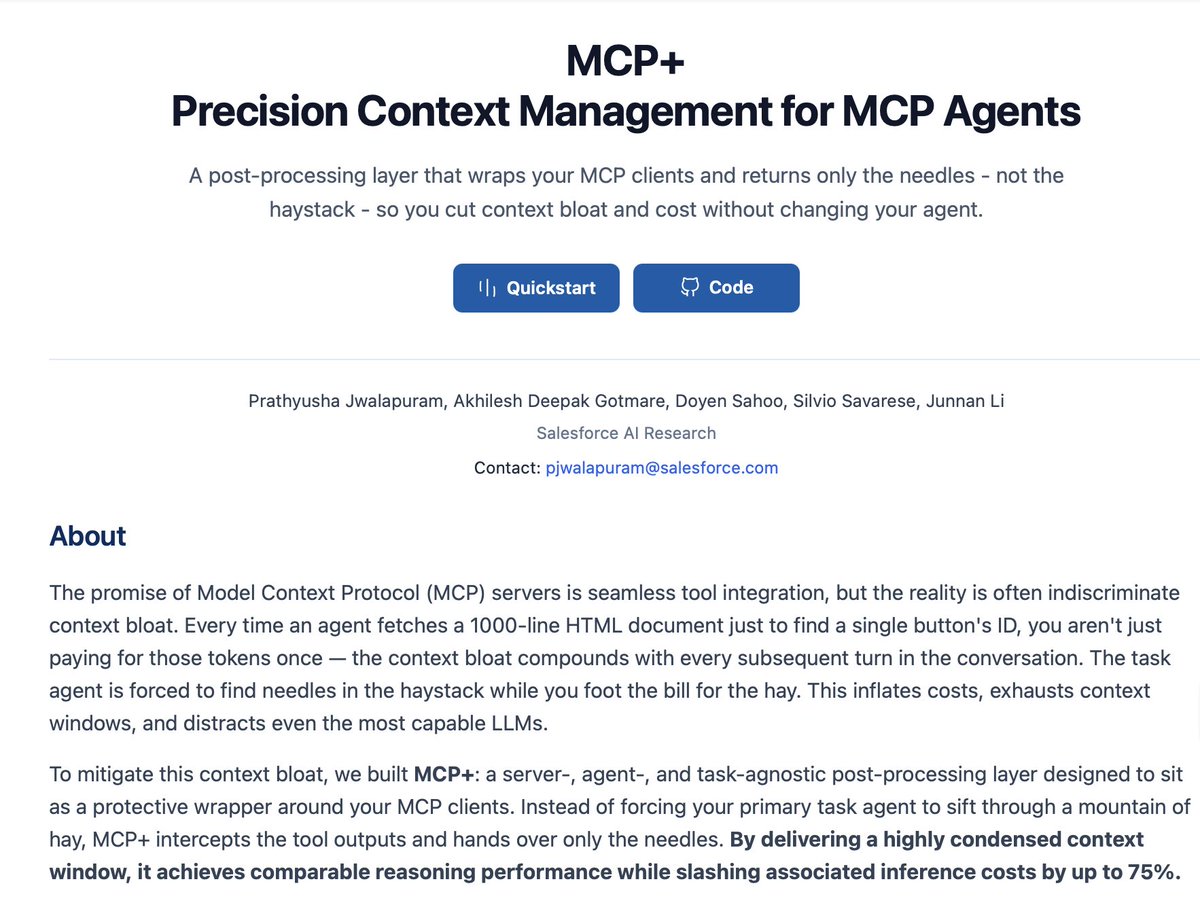
MCP+: Precision Context Management for MCP Agents https://t.co/AA9vfoYcGa
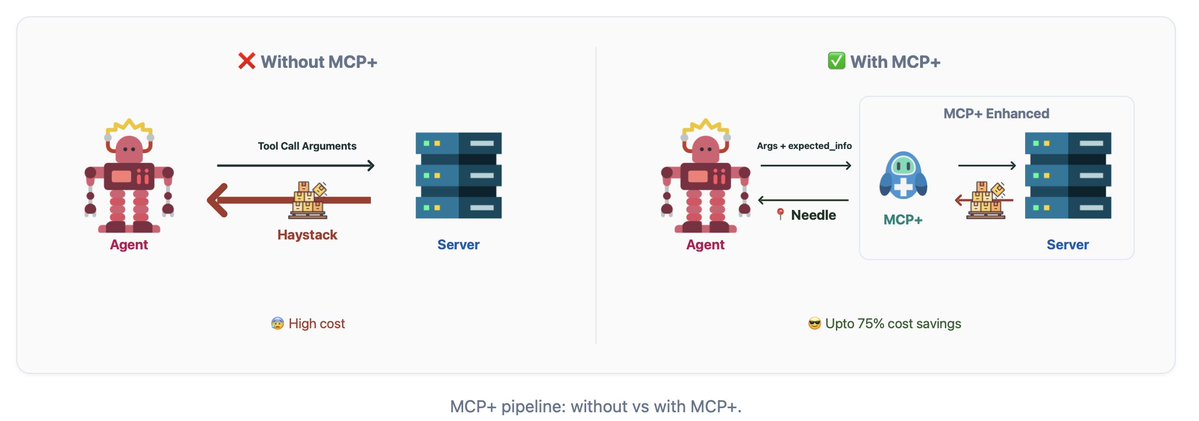
A server-, agent-, & task-agnostic post-processing layer that wraps your MCP clients — filtering tool outputs down to only what your agent needs, with zero changes to your existing logic.
🔍 Context bloat is a real cost. When MCP tools return thousands of tokens of raw HTML, JSON dumps, or API payloads, your primary agent pays for every token — and that overhead compounds across every turn. MCP+ intercepts those outputs and returns only the relevant slice, offloading the filtering work to a cheaper model so your premium LLM context stays focused on the task.
📊 Results across the MCP-Universe Benchmark (browser navigation, financial data, web search): → Up to 75% reduction in inference cost → Comparable or improved task accuracy across Claude, GPT, and Gemini → Token count reduced by >95% in structured data tasks (e.g. ~7,000 tokens → ~200)
⚙️ The key mechanism: an expected_info argument that lets your agent specify exactly what it needs before the haystack reaches its context window.
🛠️ Works with Cursor, Claude Code, and Agentforce Vibes. Supports OpenAI, Gemini, and Anthropic models as the filtering layer.
✍️ Authors: Prathyusha Jwalapuram (@jwala_94), Akhilesh Deepak Gotmare (@akhilesh_gotmare), Doyen Sahoo (@doyensahoo), Silvio Savarese (silviocinguetta), and Junnan Li (@LiJunnan0409).
#FutureOfAI #EnterpriseAI #AIAgents #MCP #LLM #GenerativeAI #MLOps
Context bloat is a silent tax on your Cursor and Claude Code. 💸
When an MCP tool dumps 10,000 tokens of irrelevant JSON blobs into your chat, it burns budget, eats your context window, and distracts the LLM.
Introducing MCP+ 🚀
https://t.co/DBcXFmmzgR
MCP+ is a server-agnostic, agent-agnostic, task-agnostic post-processing layer that wraps around your MCP clients as a protective filter 🛡️ — requiring zero changes to your existing agent logic.
🚀 We’re Hiring – Salesforce AI Research (at Singapore)
We are hiring Research Scientists and Research Engineers (all levels) to work at the frontier of AI × Enterprise applications.
If you’re excited about advancing agents that powers real-world enterprise products — Apply here:
https://t.co/TEZ7ZgOrpz
Deep research agents typically scale depth—more sequential steps. But what about scaling width? 🤔
📄 Paper: https://t.co/TLP3YBEHUZ
We introduce Wide & Deep (W&D) research agents: a framework exploring parallel tool calling to boost performance while reducing costs and latency.
Key results on BrowseComp, HLE, and GAIA:
📊 Parallel tool calling improves accuracy across GPT-5, Gemini, and Claude 💰 36% reduction in API costs, 41% reduction in wall-clock time 🎯 W&D with GPT-5-Medium achieves 62.2% on BrowseComp—beating GPT-5-High's 54.9%
Why it works:
🔍 Enhanced source credibility through diverse information gathering
✅ Tool result verification catches unreliable outputs
🧩 Query decomposition improves retrieval effectiveness
We also tested tool call schedulers. A "descending" strategy—explore early, exploit later—added another ~6% gain. 📈
Unlike complex multi-agent orchestration, W&D uses intrinsic parallel tool calling within a single reasoning step, making it easy to integrate into existing agent frameworks.
🌐 Website / Code: https://t.co/FajxSDV5XY
Authors: Xiaoqiang Lin @xiaoqiang_98, Jun Hao Liew @jhliew91, Silvio Savarese @silviocinguetta, and Junnan Li @LiJunnan0409 at @Salesforce AI Research.
#FutureOfAI #EnterpriseAI #AIAgents
We introduce 🔍Wide & Deep (W&D) research agents: scale width by making more parallel tool calls per turn.
Scaling width boosts accuracy on BrowseComp, HLE, and GAIA — while cutting turns, API cost, and wall-clock time.
A simple descending scheduler (explore early → exploit later) adds another ~6% gain.
Our W&D agent with GPT-5-medium hits 62.2% on BrowseComp, beating GPT-5-high deep research (54.9%).
📄 Paper: https://t.co/swJNgBrELO
🌐 Website: https://t.co/oveD9ycBIM
💻 Code: https://t.co/Lsux9PqDqK
Great work led by @xiaoqiang_98 and @jhliew91 at @SFResearch!
Excited to welcome @salesforce as our latest enterprise customer! Already massive contributions (180 public models like Blip) and can't wait for what they'll do next! https://t.co/D3uKZ7bwDw
Fine-Tuning Time-Series Foundation Models on Business Data ⏰
Fine-tuned Moirai on 1.3B+ CloudOps time steps to build a @Salesforce-specific forecasting engine.
📚 Read the Blog: https://t.co/KkxagFlkoA
More accurate forecasts, better uncertainty estimates, more stable performance across shifting workloads. At scale, 0.5% accuracy gains = millions in operational impact.
Foundation models are incredible generalists, but enterprise systems need specialization. Cloud infrastructure has its own rhythms: release cycles, region launches, customer migrations, cost curves, seasonal patterns that don't exist in public datasets.
📈 The pattern: pre-training gives you intelligence; your data gives you competitive advantage.
Authors: Kyle Gilson @kygils, Piyush Lakhawat, Quang Pham, Doyen Sahoo @doyensahoo, Junnan Li @LiJunnan0409
#FutureOfAI #EnterpriseAI
We’ve released the technical report for Moirai2: When Less Is More for Time-Series Forecasting.
Time-series intelligence has hit its GPT-3 moment, with early evidence of scaling-law behavior as datasets grow. Plenty of exciting work lies ahead!
Paper: https://t.co/hgYklmGc8L
@SFResearch@doyensahoo@silviocinguetta@CaimingXiong
My team is hiring Research Scientists!
If you’re curious about life in Singapore — amazing food, great vibes, and top-tier research (or so we keep telling ourselves) — come join us!
The air-conditioning here is so cold you might just forget we live on the equator.