wise words from the best systems engineer I've worked with:
"two things that make code actually maintainable:
1. reduce the layers a reader has to trace
2. reduce the state a reader has to hold in their head"
applies to every codebase. always.
"You can just do things" is basically the same heuristic as "Everyone has a plan until they get punched in the face" except for people who haven't been punched in the face yet.
Should you start with your easy tasks or your hard tasks? Astro Teller, CEO of *X, The Moonshot Factory*, offers a powerful mental model to give an answer.
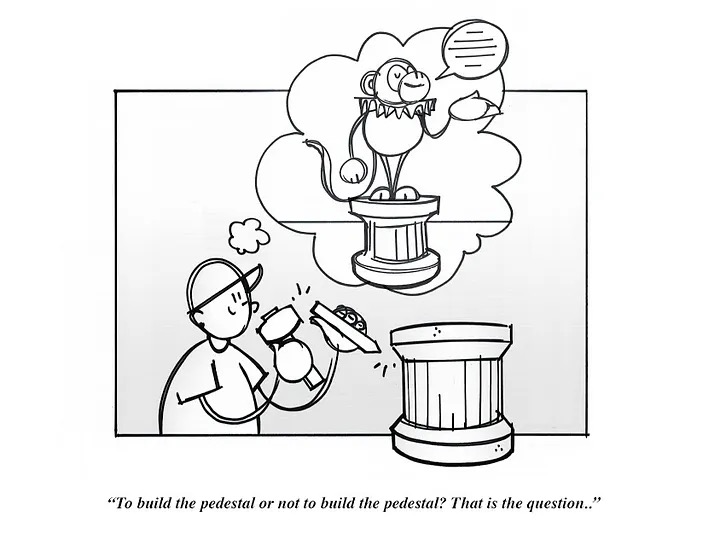
The metaphor might sound absurd, but it works. If you want to train a monkey to juggle flaming torches while standing on a pedestal, the endeavor consists of two tasks:
1. Training the monkey (hard part)
2. Building the pedestal (the easy part)
Teller argues that building a pedestal is trivial; people have been doing it for millennia, and you could simply turn a milk crate upside down to achieve the same effect. The actual challenge that determines success or failure lies in the training. Therefore, the rule is to “monkey first”, or tackle the hardest part of the problem first.
The reasoning behind this mindset is logical. By doing the easy work first, you feel like you’re moving forward, but you have learned nothing about whether the project is actually viable.
Instead, you’ll get caught in a sunk costs trap, whether you invest time, money, and effort into a project that doesn't hold weight anyways. This accumulation of resources makes it psychologically harder to quit later if you discover the “monkey” is untrainable.
Let’s apply the concept to a business startup. It might seem fun and exciting to begin with a logo, business cards, or picking a cool name, but these are all pedestals. You have to attack the core challenges first.
The real monkey is proving product-market fit, validating demand, and building something customers truly want.
Even knowing the monkeys on pedestals mindset, I know how hard it is to make the right decisions. Join my course on Maven where you can explore how to make smarter, faster, and more confident choices including how to:
- Create consistent habits and systems for disciplined, high-quality decision-making.
- Strengthen analytical reasoning and strategic thinking in complex or ambiguous situations.
- Learn new frameworks through case studies.
My next cohort with Maven starts April 20th. Join us
This is not what spreadsheets are good for…
Spreadsheets a superpower is they’re flexible and can be used good enough for (1) analysis, (2) presentation, (3) storage by a layperson
prediction re the end of spreadsheets
AI code gen means that anything that is currently modeled as a spreadsheet is better modeled in code. You get all the advantages of software - libraries, open source, AI, all the complexity and expressiveness.
think about what spreadsheets actually are: they're business logic that's trapped in a grid. Pricing models, financial forecasts, inventory trackers, marketing attribution - these are all fundamentally *programs* that we've been writing in the worst possible IDE. No version control, no testing, no modularity. Just a fragile web of cell references that breaks when someone inserts a row.
The only reason spreadsheets won is that the barrier to writing real software was too high. A finance analyst could learn =VLOOKUP in an afternoon but couldn't learn Python in a month. AI code gen flips that equation completely. Now the same analyst describes what they want in plain English, and gets a real application - with a database, a UI, error handling, the works. The marginal effort to go from "spreadsheet" to "software" just collapsed to near zero.
this is a massive unlock. There are ~1 billion spreadsheet users worldwide. Most of them are building janky software without realizing it. When even 10% of those use cases migrate to actual code, you get an explosion of new micro-applications that look nothing like traditional software. Internal tools that used to live in a shared Google Sheet now become real products. The "shadow IT" spreadsheet that runs half the company's operations finally gets proper infrastructure.
The interesting second-order effect: the spreadsheet was the great equalizer that let non-technical people build things. AI code gen is the *next* great equalizer, but the ceiling is 100x higher. We're about to see what happens when a billion knowledge workers can build real software.
In practice, the ability to “feel” and organization drops off somewhere between 20 and 40 people in my experience.
Somewhere in that range, you start needing abstractions and trust
Human orgs are not legible, the CEO can’t see/feel/zoom in on any activity in their company, with real time stats etc. I have no doubt that it will be possible to control orgs on mobile, with voice etc., but with this level of legibility will that be optimal? Not in principle and asymptotically but in practice and for at least the next round of play.
Felt like I used to be able to listen to sports talk every day. Not so much now.
Feels like now, everything is fake intellectual/insider slop from intellectual-yet-idiot types...
Understand this: Waymo in DC is not being delayed because the City Council wants a study. Instead, the City Council is asking for a study because they want to delay Waymo in DC.
Most writers have a hard time making a living writing as is; writing jobs (and skill) have been in decline for some time – this tech is very scary for them
Software engineers have been facing down the end of their profession for 60 years
Why do a lot of software people like a tool that can allow them to expend their mental energy on higher order problems, while writers dislike the tool that can replace their output completely?
Truly one of the great mysteries of our time
Love seeing everyone come to many of the conclusions the NLP community dealt with for decades before LLMs
"Hey! Let's add this bit of information it should make things go better!" *things get worse*
LLMs themselves are, in many ways, a refutation of the very idea of helping
no one has been able to solve ai memory yet. it’s brittle, it’s fragmented, & often times less helpful than not using memory.
it’s an incredibly fascinating problem, way more of an art than a science at this point.
If you're an indie hacker, builder, or developer... I want to know your thoughts.
We've been building enterprise SaaS, and we're exploring a dev tool variant
Please take our survey and help us!
https://t.co/WtVlcfZ4bg
Raffling off a $100 Amazon gift card
#buildinpublic
on MCP vs "skills" - MCP was a good (??) model for web-based LLM-system providers to offer a plugin model. It is designed to work in setups where the agentic loop runs on the providers servers. skills are for agentic loops running on the user's local OS.
@AndyMasley The hazing of becoming a mini public intellectual!
I thought this screenshot was telling. “Playbook”, “outside the community” — these two are clearly fighting a battle. And truth has nothing to do with it, unfortunately.
@AlfredoBGarcia@AndyMasley I think I like the original phrase less than I did. It seems like an obtuse was of saying “instinctively conspiratorially”.
There are probably also some dark opposites to this, e.g., extending excuses to people who really are intending to do bad things