@InvaderDJ@BenDenny@Seltaa_@pangram So next time a Chinese publishes a breakthrough in cancer research we should wait months for it to be translated by a human so writers’ feelings don’t get hurt? Does that make sense to you?
@trollaxethrower@BenDenny@Seltaa_@pangram I actually like your idea- the fact that Claude didn’t separate translated vs plagiarism says a lot about their motive. They want control.
@trollaxethrower@BenDenny@Seltaa_@pangram Read again. The dude is claiming that anything processed by ai is not worth the time to read. Also, Claude doesn’t put “translated by ai”. Claude puts “processed by ai” so they can brag about market share to their greedy billionaire investors. They are claiming everything.
@BenDenny@Seltaa_@pangram So if someone translate Nietzsche’s or Goethe’s works to English using Claude, it’s not worth the time to read per your logic?
@hetero_ally@jukan05 They can now claim any written texts that have gone through their algorithms as theirs, even if they’re just grammar or spelling checks. Same with coding. For them it’s about control, not morals.
Mark Zuckerberg gets it right:
“The defining question of our age isn’t whether superintelligence will exist, but who will have access to it. Will it be centralized and restricted to a few institutions, or will it be a tool that empowers everyone?”
Concentration of power is the biggest risk of AI. When a small number of labs (working hand-in-glove with the administrative state) decide who has access to which model capabilities, they inevitably shape what can be said, known, and built. That’s not “safety.” It’s control.
As Mark points out, the history of open source shows that broad access and transparency are usually the best path to actual security and resilience. Decentralization creates checks and balances on power. By contrast, centralized alternatives, like bureaucratic approval regimes and mandatory gatekeeping, typically produce regulatory capture and reinforce cartels.
Personal superintelligence in everyone’s hands, with competing models and real data sovereignty, is a far better check on a dystopian future than self-appointed guardians who claim to be “aligned” with all of humanity.
@jorgiting@Sutra0813@Tammy349886035@nypost That's just an ancient phrase we use to end privacy discussions. We have smart glasses coming next. Do we continue using the same legal framing? What if everything is recorded the moment we walk out of our homes? There needs to be a threshold.
One pattern I find useful for working with LLMs is a nice long ramble session. Sometimes the LLM needs more bits to understand what you're trying to achieve, but you're too lazy to type them. In these cases I like to lean back, switch to /voice and just ramble for like 10 minutes, total mess, anything goes, full stream of consciousness. Sometimes I declare it up top, something like "switching to speech recognition sorry for any typos...". Sometimes I turn it into a small interview of a few turns. But I find that the LLMs are somehow very good at reconstructing long incoherent rambles and often their echo of your own tangle of thoughts comes out quite a bit cleaner than what you started with. The result is that you improve the mind meld and have to correct things less from that point on.
Tricking the US Government to protect frontier labs’ business model by using a China boogeyman is a mistake.
It is protecting the equity of 5,000 people who are investors in OAI and Ant at the sale of everyone else. This would be a terribly stupid decision.
Let the market sort this out!
The events of the past few weeks may simply mean that the frontier labs’ business model is not good and that their revenues aren’t sustainable.
That’s ok. It’s ok to have a business model that worked for some time then all of a sudden didn’t (remember Groupon)!
This still leaves a lot of value for a lot of other American companies:
- CPUs
- GPUs
- hyperscalers
- neoclouds
- rack manufacturers
- electricity and power
- skilled trades
- application layer AI
None of this value goes away. In fact, if the model layers’ costs decrease by 10-100x, competition would accelerate and I would argue that the value to everyone else will go up more than what is lost.
Let the free market sort this out vs allowing two companies whose stock is owned by less than 5,000 people decide this for America.
The Chinese do not need to distill anymore. They've climbed up the proverbially tech tree that to climb higher, they need to do actual frontier work. Distillation is marginal.
Any lobbying or legislation that calls for banning open weight models in the name of "distillation" is total BS. This is a fight against future American innovation.
The labs know that open weight models completely commoditize their revenue generator. They know that we will optimize it to 1/100th the costs. They know that we will stop concentrating our workloads on them. If we start using open models, they lose the understanding of workloads that they can build products around to *replace* your products as they move up to the app layer.
Remember: *they* trained on humanity's data and didn't pay a cent. If you own intelligence, you can tax humanity.
Do not let them fool you.
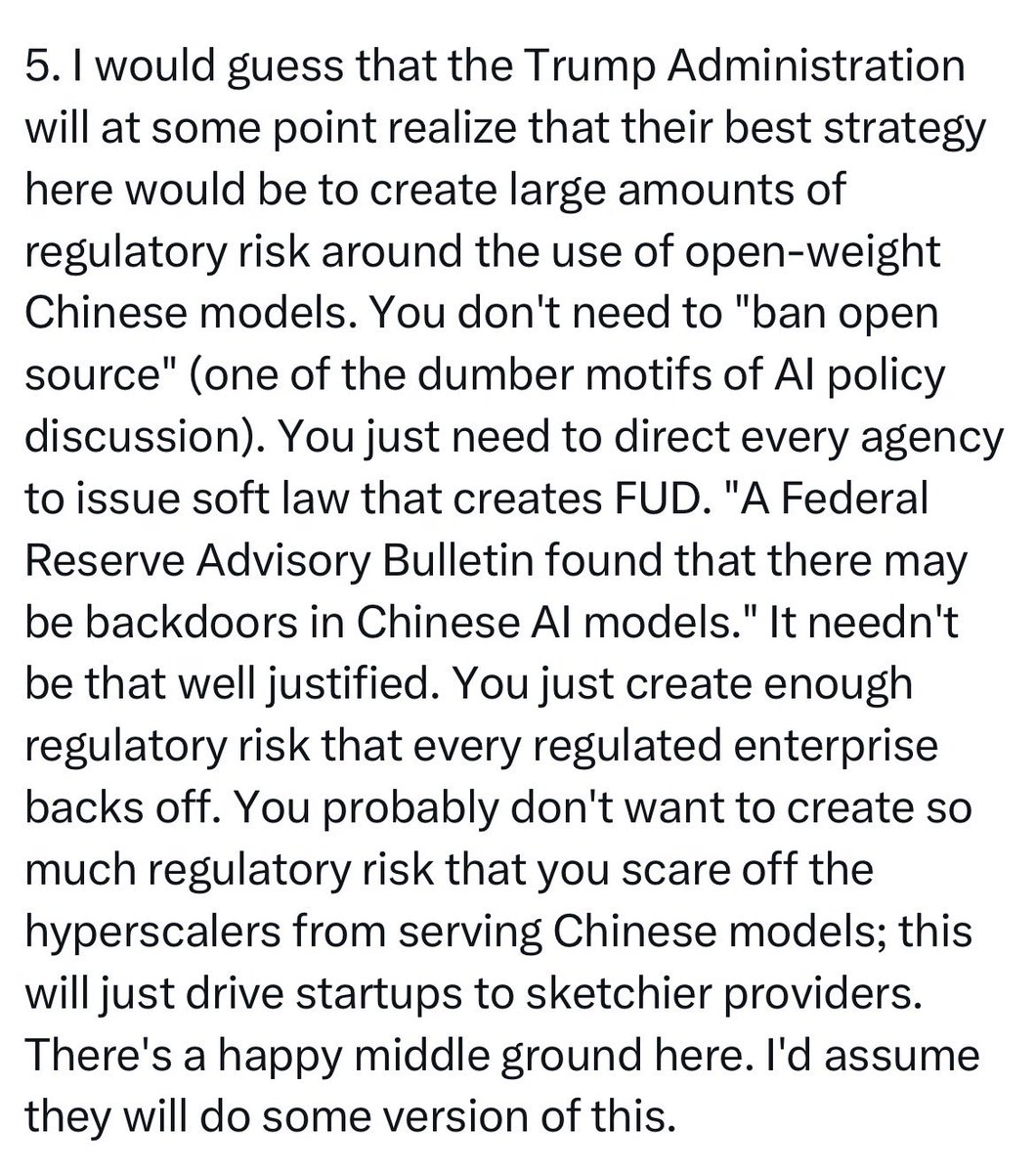
I’m not sure whether Dean Ball is confessing to a regulatory capture strategy or simply predicting this will happen (he now says the latter). Either way, the weaponization of regulatory uncertainty as a competitive tool should be completely unacceptable.
He argues there’s no need to ban Chinese open-source models — just direct agencies to issue soft-law warnings that create enough FUD so regulated enterprises back off. “It needn’t be that well justified.”
Wrong. Regulatory decisions should always be well justified and grounded in facts, logic, and evidence, not the deliberate exploitation of fear and uncertainty. Implementing a surreptitious policy through manufactured doubt — rather than strong and explicit justification — corrodes the rule of law and invites future abuse against anyone.
We are at a critical inflection point in AI policy. The leading closed labs, already a duopoly in terms of AI model revenue, want the government to eliminate their open source competition. They have laid their cards on the table. It is time for the rest of Silicon Valley — the vast majority that still values open competition — to do the same.
This is concerning. For the first time, a Chinese model Kimi K3 has taken #1 on the Frontend Code Arena and is scoring at or near the frontier on other benchmarks.
Meanwhile America is tying itself in knots: politicians and bureaucrats are banning new data centers, piling on state regulations, and pushing for new federal agencies to pre-approve frontier models.
This is how you lose the AI race. The rest of the world won’t play by our rules if we bog ourselves down. Permissionless innovation is how America won the internet and became the technological envy of the world. We can do it again with AI -- while addressing risks in a targeted way -- or we’ll watch our lead evaporate.
@bobli855311@MightBeUrDaddy8@pubity How about all of the medium class family who already spent their life savings on properties only to see them crash?