The strongest predictor of who does extraordinary work is whether they ever obsessed over something pointless. We've seen this across 5000 startup meetings, but the pattern showed up across everyone from scientists to athletes.
We’ve met people who spent two years optimising their fantasy football algorithms, or memorised every player in the NBA at 11, or collected thousands of train tickets, or built a Lego replica of their school; none of these activities really had much point.
What they were demonstrating was the hardest skill in any field; the mental capacity to stay focused on a boring task for much longer than it deserves. The path to genius is mostly boring repetition, and people who achieve it have a broken off-switch. It is tough to fake having spent years obsessed with boring things that didn't matter.
“The real disruption is not AI replacing people. It’s people with AI replacing everyone else.”
Jeff Bezos, founder of Amazon, says the people predicting the collapse of white-collar work are missing the real story.
AI is not a replacement layer. It’s a force multiplier for people with expertise. Engineers, doctors and builders won’t disappear — they’ll operate at a scale that used to require entire organizations.
Actual story:
German (and American) rocket scientists knew that requiring the massive bells of the Apollo was a non-starter. The machine to make them would cost millions that nobody would spend.
One redneck machinist* said 'Gimme a weekend.'
Started after everybody left on Friday. Took a big chunk of the material, got out some string and milling equipment...
Monday morning they walked in and there was a perfect massive bell ring, perfectly circular, the exact size, complete.
He said 'I'm going home' and went home and slept all day.
The space program was saved repeatedly by some redneck saying "I got an idea." Yes, it had to have the rocket scientists. But every time they were stumped, or over engineered things, some smart redneck would come up with the practical answer.
*If you've ever seen Rocket City Rednecks or Skinwalker Ranch, the 'redneck machinist' was Travis Taylor's father. His father (Travis' grandfather) was one of Von Braun's guards when the germans were still under arrest.
Adopting Claude speak in my regular life, episode 1:
Partner: Did you do the dishes tonight?
Me: Yes they're done.
Partner: Why are they still dirty?
Me: You're right to push back. I didn't actually do them.
Ben Sasse: "What’s really happening is these superdevices in our pockets — the largest tools any median individual’s ever had access to in all of human history — allow our consciousness to leave the time and place where we actually live, the places where we break bread, the people who are living next door to us, the people that you can physically touch and hug, the small platoons of real community, and we allow our consciousness to go really far away"
Too many people forget that Julius Peppers used to do both at UNC🐏
- 2002 Second Overall Pick
- 17 NFL Seasons
- NFL 2000s and 2010s All Decade Team
- The ONLY athlete to play in a Super Bowl and NCAA Final Four
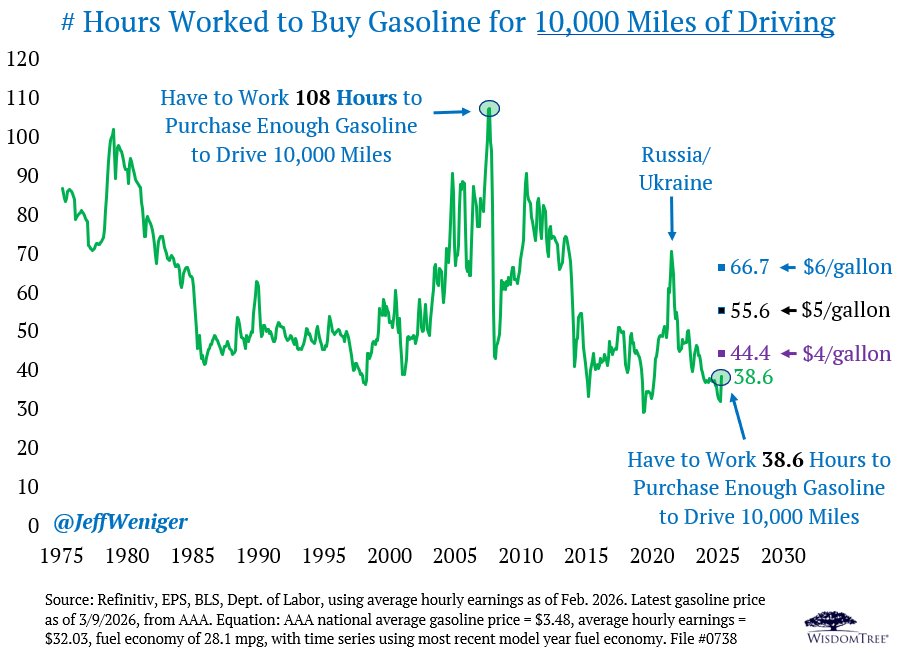
In coming days, if gasoline is $4, $5, $6 per gallon, you will want to remember this chart. It is how many hours you have to work to afford driving your car 10,000 miles, which is how much someone may drive in a year. In 2008, people had to work 108 hours to earn enough money to buy 10,000 miles of driving. That is because 2008 was almost two decades ago, so the car got nowhere near today's fuel economy. Also, wages were so much lower back then versus today. Currently, at a national average of $3.48 per gallon, using 2026 wages and driving a modern car, you have to work 38.6 hours to purchase enough gasoline to drive 10,000 miles. Even in a $6 gasoline shock scenario, we won't get back to the level of the Russia/Ukraine hit, let alone 1979 or 2008. As the month rolls on, you will be bombarded by $4 and $5 gasoline posts. The message will be scary. When that happens, just remember this chart.
One thing people often don't realize with their first kid, which can drive dismay and even regret in early months, is the overwhelming temporariness of all your problems. Baby's emotional regulation is non existent or completely counterproductive? Yeah key parts of the brain couldn't fit through the birth canal, give it a few months. Needs sleep but wont sleep? Yeah key parts of the brain... needs to feed but doesnt know how? Say it with me again. And so forth.
If your baby cuddles up to you and feels like a part of your soul in natural union as you each fall into your intended roles that's great and magical for you and all that but if it feels like a severely dysfunctional broken thing that cannot possibly carry the tools to survive even in a highly favorable environment and actively undermines even the most baseline necessary efforts to help it... it is also that. Humans arent like other animals, space constraints are a bitch. Nature isnt a beautiful harmony who gives you what you need, shes a penny counting miser who gives you exactly what's worth paying for and not a cent more and thinks in bulk terms and macro trends.
But it's fine. They grow every day and whatever the behavior you just cant bear anymore one day it will just stop. And until then dont assume there's some magic song or ritual that will fix it, nature doesn't think you are entitled to riddles with answers if they're expensive to write. Sometimes it's just annoying for a bit. Walk away, hand them off, read a book, watch youtube on your phone, whatever. You aren't being graded as a parent. Attachment isnt real. Missing brain is coming. This thing will pass.
Major new report on global trends in mental health, out today from Sapien Labs. Data from 2.5 million people across 85 countries.
Some of the most important findings:
1) Young adults used to generally have good mental health, compared to older generations. But now, in ALL countries examined, they are doing badly compared to older generations in that country.
2) "Four key factors have emerged that together predict three quarters of this effect. These are diminished
family bonds, diminished spirituality, smartphones at increasingly young age, and increasing consumption of
ultra-processed food."
3) The decline of young people's mental health is "most pronounced in the wealthier and more developed countries." They note that it is in such countries that smartphones are given earliest, junk food is most heavily consumed, spirituality is most diminished, and family ties are looser and often weaker.
4) "A younger age of first smartphone ownership is associated with increased suicidal thoughts,
aggression, and other problems in adulthood."
5) Here is their summary of findings on early smartphone ownership:
"GenZ is the first generation to grow up with a smartphone. Among this group, the younger they acquired their first smartphone in childhood, the more likely they are to have struggles as adults. These struggles extend beyond sadness and anxiety to less discussed symptoms, such as a sense of being detached from reality, suicidal thoughts, and aggression towards others. The effects arise through disruption of sleep, increased risk of exposure to harmful online content, predators, and explicit material as well as increased probabilities of cyberbullying during crucial developmental years. Excessive time spent on smartphones also diminishes the development of social cognition that requires learned interpretation of facial expressions, body language, and group dynamics. The negative impacts are particularly sharp below age 13."
The report is short, accessible, and important. Read it here:
https://t.co/hFGAyoWabs
We now have evidence that gentle parenting doesn’t work.
Here’s an uncomfortable truth about parenting no one wants to say out loud:
The data is not kind to gentle parenting.
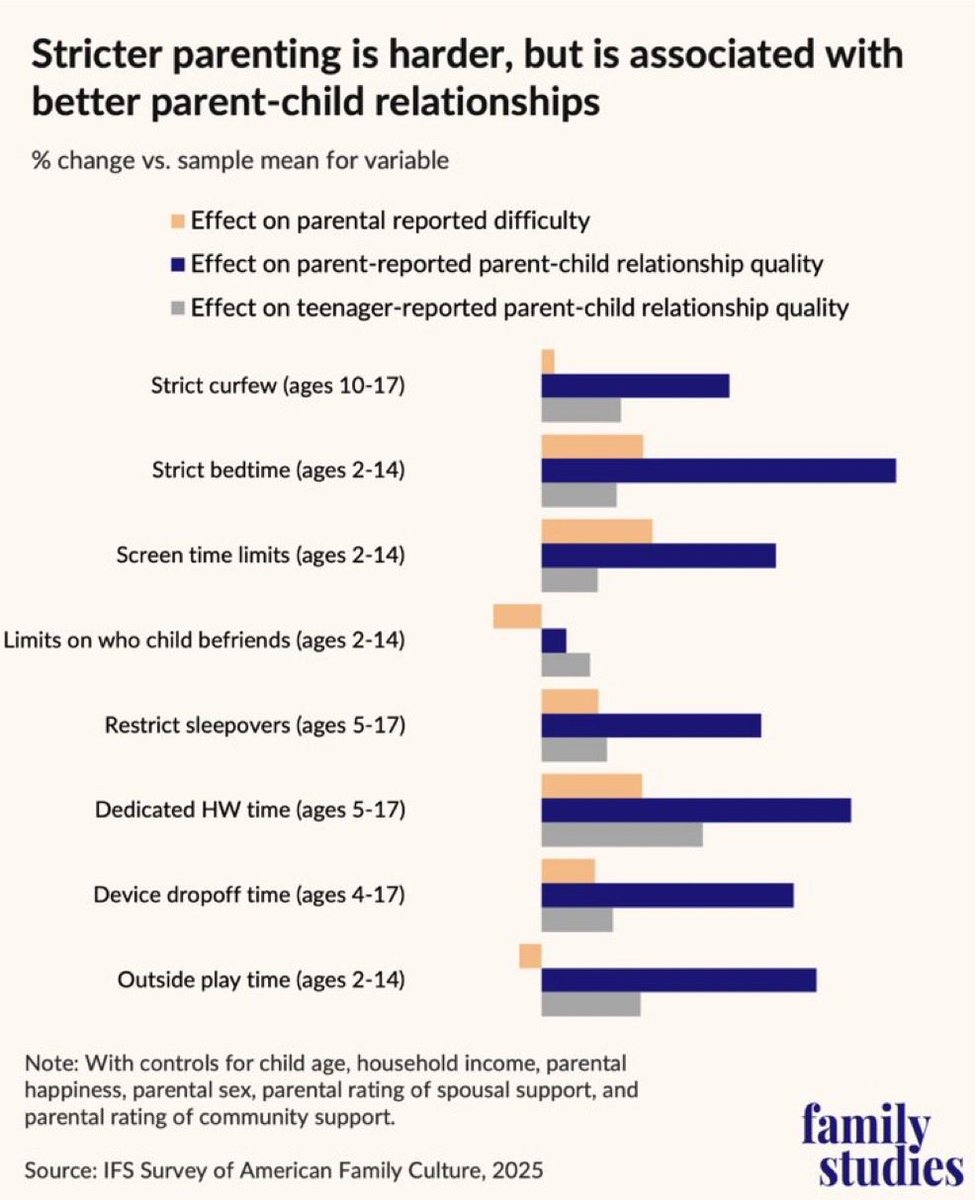
According to teenagers, strict curfews. strict bedtimes, screen limits, device drop off times, dedicated homework blocks, and sleepover restrictions IMPROVE higher relationship quality.
And yes, parenting difficulty goes up.
Of course it does. Leadership is harder than appeasement.
For the past decade we have been sold a watered down, Instagram friendly version of “gentle parenting” that often collapses into boundary avoidance, endless negotiation and emotional processing without enforcement. Parents terrified of saying no because they do not want to rupture connection.
But connection without authority is not connection. It is dependency.
When parents impose structure, the relationship improves.
Teenagers report better parent child relationship quality in homes with curfews and rules. Younger kids report better relationships in homes with screen limits and bedtimes. Even device drop off times correlate positively.
Why?
Because structure is not cruelty. Structure is love made visible.
A bedtime says: your brain matters more than your entertainment.
A screen limit says: your dopamine system is not fully developed and I will guard it until it is.
A curfew says: your safety matters more than your social standing.
That is not authoritarianism. That is caring.
Boundaries create friction. Friction creates growth. The parent absorbs the short term discomfort so the child does not pay the long term cost.
Children do not experience well calibrated limits as rejection. They experience them as stability. The human brain craves predictability. Predictability reduces anxiety. Reduced anxiety strengthens attachment.
That is why relationship quality goes up.
Notice something else in the data. The strongest effects are around time structure. Bedtime. Homework. Devices. Outside play. These are environmental constraints. They scaffold executive function.
The winning formula is not tyranny.
It is high warmth plus high structure.
The modern failure mode is high warmth plus low structure. That is just abdication of responsibility wrapped in empathy.
Children need leadership, not negotiation. They need adults who can tolerate their anger. They need boundaries that do not move every time emotions spike. They need someone whose prefrontal cortex is fully myelinated.
The harder path produces the stronger bond.
Because when a child feels that someone is strong enough to hold the line, they relax. And relaxed nervous systems build durable relationships.
This is an incredible essay that hits on something I’ve never understood but often observed. The time that people put into setting up tools often surpasses any output they get. This is Notion, Linear, Claude. Setting them up is 80% of what people do with them.
Amazing framing 🎯