Last year, I put together the first version of a Delegation Handbook.
A year in DAO governance is a long time. The space evolves, new models emerge, and what “good delegation” looks like keeps changing.
So at @Anode_GG, we went back to it, challenged what we thought we knew, and built V2.
Really excited to finally have this out.
DAO Delegate Handbook V2 ↓
We published an updated version of our DAO Delegate Handbook.
Dive in to see what makes a delegates useful for DAOs, what to avoid and how to be a great delegate:
https://t.co/owBMbR9cr9
Very proud that @Anode_GG has played a role in this success story.
The first Bitcoin L2 DAO - implementing the best lessons from EVM governance on a platform secured by the biggest digital asset.
It's possible that a killer app of adversarial governance mechanism design theory will end up being AI safety.
Compare:
https://t.co/w2LeAoVysF
https://t.co/dZXnORP9LU
There's a deep duality between the two environments. Both are about a less-sophisticated principal trying to get ideal outcomes from a set of more-sophisticated agents: in the first case, the principal is a static algorithm and the agents are humans, in the second case, the principal is humans plus weaker LLMs and the agents are stronger LLMs.
A key finding was that you can achieve much better outcomes if you can guarantee limits to how much agents can collude (see: Nash equilibria being abundant, vs. cooperative-game-theory "cores" often being empty). That argument should naturally transfer to this new setting.
@pablo_moncada_ This is exactly the rabbit hole I’ve been going down lately.
I come from DAO governance, and I think a lot of the infrastructure we built for coordinating humans onchain becomes even more interesting for agents.
I wrote about this recently:
https://t.co/YpC7QqQRTZ
One of the most interesting governance problems in crypto isn’t voting.
It’s what happens after capital gets allocated.
There’s a big gap between approving something and actually seeing it work in practice.
That layer deserves much more attention.
On-chain governance in the age of AI:
We've seen an attacker submit 1,656 malicious proposals to a low-TVL token on @reserveprotocol.
The idea is simple: Make it impossible for guardians to catch every single one of them. Only a single of these proposals has to go through for the attacker to be able to drain the funds quickly.
The token is called $BDTF and has a marketcap of just shy of $5,000. So not a huge target.
But also a powerful demonstration that cost is no longer an issue. Submitting 1,656 governance attacks on-chain on Base cost probably less than $1.
What to do?
Permissions
Permissions
Permissions
And clear procedures.
The time where "everyone can propose", because "we're onboarding the next billion users", is OVER!
It never worked anyway.
Token projects need to grow sustainably and offer strong investor protection from day one.
This is what we offer @Anode_GG.
DAOs automated rules.
Autonomous Organizations may automate actors.
But capability ≠ authority.
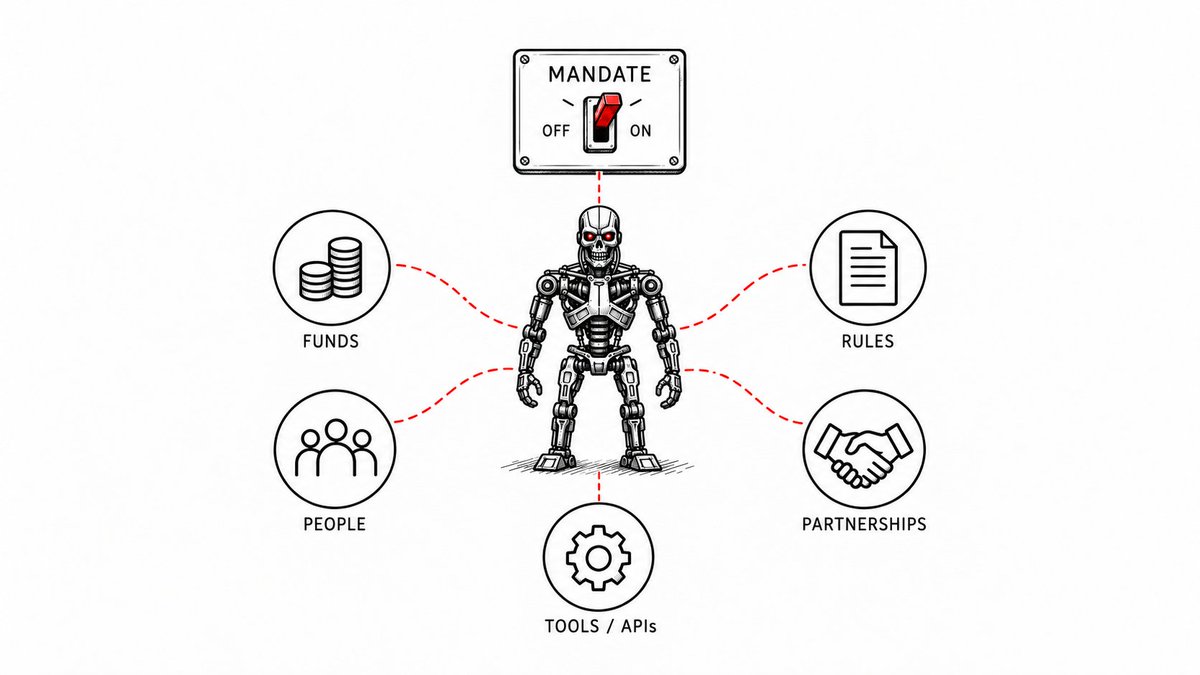
If agents can allocate capital, hire, transact and coordinate, who governs them?
I wrote about the governance layer AOs will need:
https://t.co/YpC7QqQRTZ
I agents can already hire people, spend money, negotiate contracts and coordinate teams.
The next question isn’t whether they can run organizations.
It’s:
Who gave them the authority and who can take it back?
A new Kybernāō piece ↓
Once an AI agent has resources, goals and the ability to act, this stops being just a capabilities problem.
It becomes an institutional one.
Work from @adambinksmith, @aidigest_ and @StanfordAILab is already approaching that boundary.
Who governs the agent?
I went down the rabbit hole of autonomous organizations, from early DAOs to today’s AI agents.
The core idea:
Capability ≠ authority.
And DAOs may already have spent a decade testing some of the governance mechanisms AOs will need.
Full piece:
https://t.co/YpC7QqQRTZ