1/ $SPX is in an unusual spot right now.
The market is sitting in negative gamma (-142M GEX), but volatility remains extremely low at 15.1%.
Historically, that combination doesn't tend to last long. 🧵👇
AVOIDING CRITICISM HARMS YOU & THEM
Early on in my work with SMB Capital, there was a trainee that was not meeting the standards of the firm. As a result, during a meeting, Bella chewed out this trainee regarding the quality of his work. Feeling bad for the trainee, I softened the blow by telling him it would be okay and that he's working hard and all these other platitudes at the end of the call.
After the meeting, Bella told me to never do that again because I was softening his message to the trader and ultimately hurting the trader's and the firm's long-term prospects, because if he does not learn that lesson, he will not be at the job in another few months.
As most humans do, I initially got defensive, but then the more I thought about it, I realized how right he was. If this message was not hammered into the trainee, he actually would be gone and his dreams would be broken. The trainee still had the possibility for change, but only if the emotional drive was strong enough to create new behavior.
So often in life, we avoid giving feedback because we don't want to hurt the other person's feelings. Yes, there absolutely is a productive and an unproductive way to give feedback. One of the most important skills in life is being able to give feedback in the most productive manner possible. Too soft and they don't listen. Too harsh and they get defensive and unresponsive.
Similarly, in life, it is just as important to be able to learn to receive feedback. We all get defensive. It is our ego and human nature, but with time we learn to tone that response down and objectively listen to the feedback to find out whether it is true and whether it is actionable. There is tons of feedback that isn't true and can be dismissed, and there's tons of feedback that isn't actionable and ultimately we can't change. The feedback that comes from a position of caring to help us be better is the feedback we must take.
Almost comically, what inspired me to write this post is that a local small business bagel shop opened up by me. Many in the area love to see small local businesses thrive. The truth is, though, that the bagels were not good and barely edible because of how crispy and chewy they were.
Despite this, many of the reviews gush about how important it is to have small local businesses but avoid giving the hard feedback that is necessary for this business to thrive in the long run.
If you do not give the necessary feedback, counterintuitively, the business will actually fail, and your actions are counterproductive to what your goals are. Sometimes in life, the nicest thing you can ever do for someone or something is to give the hard feedback to help them be better.
Additionally, avoiding feedback also hurts you. Not only are you suppressing your own thoughts and feelings, but if you care about something or you care about an outcome, good feedback helps you make sure your needs are met and the outcome you hope for occurs.
If you care about the prospects of a trainee or a business or a person, you end up harming yourself AND them by not giving them the feedback to succeed and grow. You’re avoiding short-term discomfort at the cost of long-term success.
Quick read on what the SPX vol surface has been doing.
We finally saw fixed strike vols drift lower as the SPX rally priced in a some kind of deal with Iran, and the bid for upside started to calm down.
This suggests the dealer community is not scrambling to cover upside anymore. And that increases the likelihood of low realised vol going forward.
Having said all that, there could still be nasty headlines that spook markets. But the market does appear to be quite immune to most of them, and would probably require a major escalation to see any meaningful pullback.
For now, theta trades are a go.
When fixed strike vols drift lower, dealers have stopped chasing protection and are likely bleeding THETA. That tends to mean the regime is grinding higher with low realised vol.
At least until the next exogenous shock.
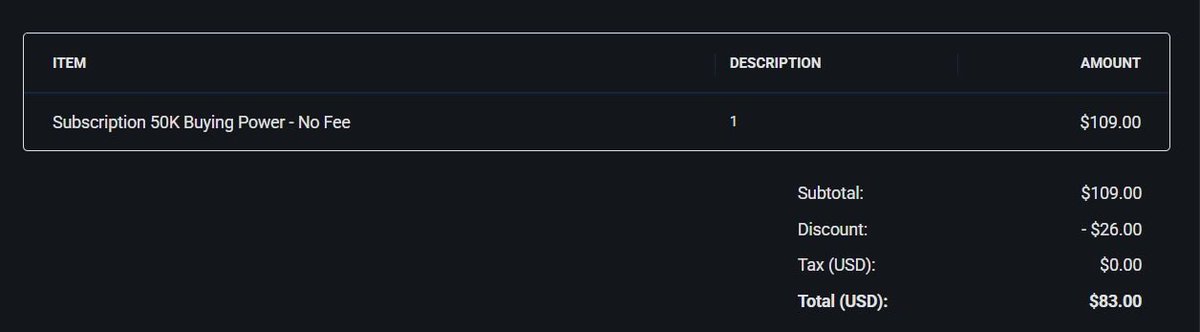
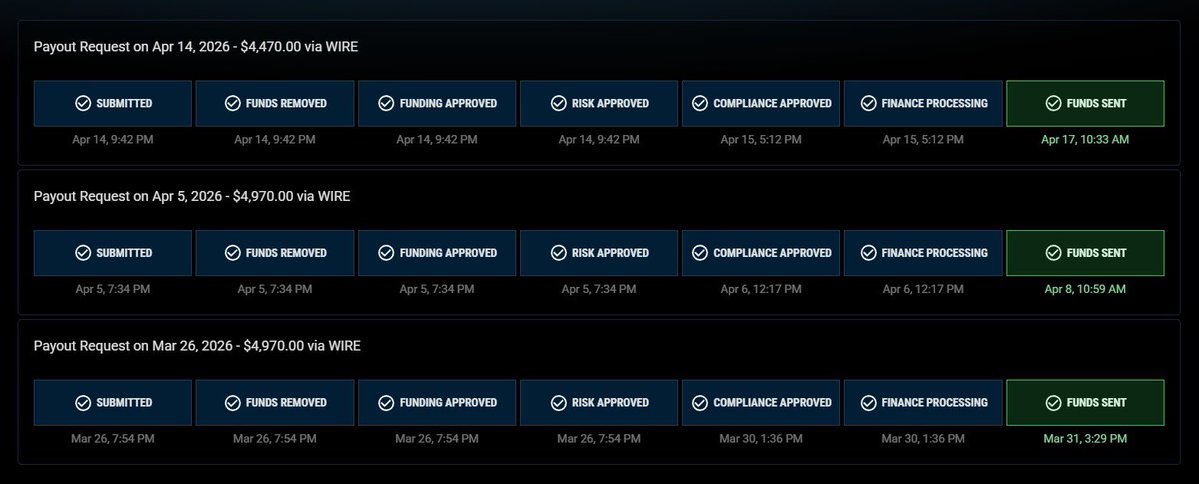
i turned $83 to $19,000 in 4 weeks
- traded with @Topstep
- had one bullet in my gun
- $4k debt on myself
- passed account in two days
- under 20 trading days made $32k just from $2k total drawdown
- 30 calendar days i had $19k in my bank account
Became debt free , started grinding more on charts , finally prioritising the health .
All of this came from one single account.
If i can do it , you can do it as well , never give up.
🚨 LEOPOLD ASCHENBRENNER IS OFFICIALLY BETTING BILLIONS THAT THE AI HARDWARE BOOM HAS PEAKED.
The exOpenAI researcher who was fired for warning that China could steal their AI models then turned $225 million into $5.5 billion in 12 months just filed his Q1 2026 13F with the SEC.
One quarter ago he had $5.5 billion in disclosed equity exposure. As of March 31, 2026 that number is $13.67 billion. The portfolio nearly tripled in a single quarter across 42 positions.
He initiated $7.46 billion in put options against every major semiconductor company between January 1 and March 31, 2026.
None of these positions existed in his Q4 2025 filing.
- SMH VanEck Semiconductor ETF PUT: $2.04 billion
- Nvidia PUT: $1.57 billion
- Oracle PUT: $1.07 billion
- Broadcom PUT: $1.01 billion
- AMD PUT: $969 million
- Micron PUT: $583 million
- Taiwan Semiconductor PUT: $535 million
- ASML PUT: $494 million
- Intel PUT: $159 million
For the past 18 months Aschenbrenner was betting only on electricity, memory, compute, and physical data center infrastructure. That made him one of the best performing fund managers in the world. And his long stock book still reflects that exact same thesis.
- Bloom Energy: $878 million
- SanDisk: $724 million
- CoreWeave: $556 million
- IREN: $401 million
- Core Scientific: $389 million
- Applied Digital: $320 million
- Riot Platforms: $142 million
- CleanSpark: $104 million
- Solaris Energy: $62 million
- T1 Energy: $43 million
- Bitfarms: $38 million
- Bitdeer: $29 million
- Power Solutions: $26 million
- WhiteFiber: $20 million
- Babcock and Wilcox: $19 million
- SharonAI: $18 million
- ProPetro: $13 million
- Hive Digital: $6 million
He is also running call options on specific names at the same time as his puts, which means he is not simply betting against semiconductors everywhere.
- Micron CALL: $422 million
- SanDisk CALL: $388 million
- Taiwan Semiconductor CALL: $354 million
- CoreWeave CALL: $140 million
- Bloom Energy CALL: $55 million
This means he believes the companies supplying power, storage, and compute to the AI industry still have years of growth ahead of them.
But the chip companies that Wall Street has been buying for the past two years at record valuations have already priced in everything good that is going to happen to them.
The man who has been right about every major AI trade for the past 18 months is now betting that the biggest names in semiconductors are about to fall.
If his track record means anything, the chip stocks Wall Street has been buying for the past two years may be in serious trouble.
If you go to https://t.co/Xf3UtEIKBU (must be logged into google) you can see literally all of your activities online since 2009 that google has stored on you. They are holding an enormous amount of information about you. Use alternatives other than Google, Chrome, and Gmail.
"All of finance is the probability of discounted cash flows. You can print that on a t-shirt."
@tcoste110 explains:
"A market is a barometer. A tool for processing information in the wider world."
"The bottom 40% don't think about alpha as the thing left over after you hedge away everything else. They don't think about capital preservation. Most don't even think about risk management."
"They treat the markets like a casino. They want a lottery ticket, or a trick that's right all the time — like selling options premium. Looks right until it isn't."
"In the top tier, that's all anybody thinks about. There's a future cash flow, or a probability of one, discounted to today."
"Calculate fair value. If price is above it, sell. If below it, buy. That's it."
"The top 20% [of hedge funds] do it over different time horizons with various efficiencies. That's the breadth of performance."
Let me tell you why put condors crush outright shorts on overextended trends...
You think the move is overcooked. You want short exposure. You're tempted to buy a put or short the underlying.
Both will probably bleed you out before the move comes.
Here's why the put condor wins on extended trends.
Buying an outright put: you buy VEGA on a name where vol is already elevated after the explosive rally. Every day the trend continues, the THETA bleeds and even if you're directionally right the vol may reset back down.
Shorting the stock: defined cost in margin, undefined cost in stress. Every higher print costs you. You'll cover at the worst possible time.
The put condor: you buy a put closer to spot, sell two puts at your target zone, buy a wing below to define risk. The structure is relatively cheap because you're selling the higher downside vol. Your max loss is the small debit. Your max gain shows up if the stock pulls back into your target zone, which is exactly where you thought it would go.
You're not betting on the ultimate top. You're betting on a retracement to a support zone.
You're buying time for your thesis to work.
The risk is that it works too soon and you have to wait to earn THETA in the zone.
There is always a trade of in options, you just need to decide which one suits you best.
My guest today is Paul Tudor Jones (@ptj_official), one of the greatest macro traders of all time.
He correctly predicted the 1987 stock market crash and shorted the Japanese bubble in 1990. For over 40 years, his flagship fund has had a negative correlation to the S&P 500. 100% of his returns are alpha.
He says today's market has so many similarities to 2000, "the easiest bear market I've ever seen in my whole life."
He makes the case for going long dollar-yen, why Bitcoin beats gold as an inflation hedge, and why he was wrong about Warren Buffett.
But what I'll remember most from this conversation is Paul's zest for life. He's 71 and still wakes at 2:30 every morning to trade the London open. He works out for two hours a day. He walks with his wife every evening. He travels the country chasing peak spring and peak fall. He's so excited about the songs picked for his funeral that he wishes he could be there to hear them.
Paul has lived five lifetimes in one. He's one of the most entertaining and interesting people I've met, and the conversation will leave you searching to be as passionate about what you do as he is about what he does.
Enjoy!
Timestamps:
0:00 Intro
1:00 The Kindest Thing
13:19 Trading vs. Investing
17:33 Lessons from Warren Buffet
22:24 The Existential Risks of AI
29:54 The Nature of Trading
31:46 Bitcoin
35:55 Bubbles
42:08 A Day in the Life of PTJ
46:00 Information Overload
47:07 Passion for Markets
50:49 The Robin Hood Foundation
54:18 The Workless World
56:03 Journalism
1:00:00 Principal Components of a Great Life
1:05:06 Kill Them With Kindness
This 1 hour Yale lecture by Nobel Prize winner Robert Shiller will teach you more about the exact Wealth Building Framework & Portfolio Diversification than 20 years inside Goldman Sachs or Citadel.
Bookmark this. Skip one movie today & watch it. You’ll surely thank yourself.
Here’s what you need to know.
First, the term "dark web" refers to .onion sites on the Tor network. Tor sends your traffic through three relays (Guard, Middle, and Exit), encrypting it at each step. No single relay knows both your identity and what you’re accessing.
For most people, Tor Browser is enough. Download it only from torproject[.]org and verify the cryptographic signature. Supply chain attacks can happen.
Your threat model is more important than the tools you use:
• For casual privacy, just use Tor Browser.
• To avoid ISP surveillance, use a reputabe VPN .e.g Mullvad .e.t.c. before connecting to Tor. (but VPN provider knows you used Tor)
• If you face a serious adversary, use Tails OS.
• For nation-state threats or high-value targets, use Qubes OS with Whonix.
Tails OS is an amnesic operating system. It runs from a USB drive, leaves no trace, and routes all traffic through Tor at the system level. It’s great for temporary use. Even if someone takes your computer, nothing is left to find.
Qubes OS works very differently from Tails.
It uses the Xen hypervisor to separate tasks. Each one runs in its own isolated virtual machine, called a "qube."
Your banking qube can't talk to your dark web qube. Malware in one VM cannot escape to another. This is security by isolation at the OS level.
Edward Snowden uses Qubes, which says a lot about its security.
Using Qubes with Whonix is considered the gold standard.
Whonix is a privacy-focused operating system designed to run inside Qubes as two virtual machines:
- Whonix-Gateway: manages all Tor routing
- Whonix-Workstation: your main working environment, which never connects to the internet directly
Even if the Workstation is compromised, it cannot reveal your real IP address because only the Gateway VM has network access.
Tails vs Qubes: what’s the difference?
- Tails: best for temporary, mobile sessions where you want to leave no trace (plug in, use, unplug)
- Qubes: best for a permanent workstation that offers strong compartmentalization
Each solves different problems. Advanced users often use both, depending on the situation.
Some OPSEC rules:
🚫 Never log in to your real accounts over Tor.
🚫 Never enable JavaScript on untrusted .onion sites. JavaScript has been used to deanonymize users in FBI operations.
🚫 Never open downloaded files while you’re online. These files could reveal your real IP address.
✅ Spoof your MAC address before connecting.
✅ Disable WebRTC, since it can leak your real IP address even if you use a VPN.
✅ Remove metadata from files, such as EXIF data or document properties, before sharing them.
Deanonymization risks people often overlook:
- Browser fingerprinting, such as fonts, screen size, and timezone
- Behavioral patterns, like your writing style and posting times (stylometry is real)
- Buying cryptocurrency on a KYC exchange and then using it on-chain
- Reusing usernames on both the clearnet and darknet
For payments, Monero (XMR) is better than Bitcoin.
Monero uses ring signatures and stealth addresses, making transactions unlinkable by default.
TL;DR
Casual: use Tor Browser
Serious: use Tails OS with Tor
Advanced: use Qubes OS, Whonix, Monero, and strict OPSEC
Extreme: Use a dedicated air-gapped device along with all of the above
1/ What are Gamma Levels?
They are price zones where options dealers face heavy hedging pressure.
They're mechanical anchor points that often create technical price action independent of fundamentals.
Think of them as a map of where dealer positioning concentrates. 👇🧵
If your average loss is -1R and average win 3R, you only need to be right more than 25% of the time to make money.
By using @jfsrev's staggered stops strategy, scaling out at three 33% intervals before the full stop is reached, your average loss falls to -0.67R, and you now only need to be right more than 18.5% of the time to make money.
Combine that with a rigorous selection - of environment, themes/sectors, and stocks - and it becomes difficult NOT to make money over time.
And if you can design exit rules that lift your average R, well… you’ve built yourself a money-printing machine
This 1 hour MIT lecture by Jim Simons (Quant King) will teach you more about quantitative trading than most people learn in their entire career at Wall Street.
Bookmark this & watch, no matter what. It’s the most productive start you can give your week. Then read article below.