When you Westerners visit Iran, the Islamic regime say: “Our country, our rules.” Wear the hijab. Cover your hair. No handshakes.
But when they come to the West, somehow it’s still their rules. Cover the nude statues. Hide the wine. Tone down your traditions. Don’t offend Islam.
Watch my conversation with @jaketapper to see why the regime is now asking America to respect Islamic values on American soil.
The Trump administration’s second big gamble on Iran echoes his first-term strategy with Kim Jong Un: offering economic reintegration in exchange for denuclearization. Revolutionary dictatorships rarely take that bribe. My latest in @TheAtlantic https://t.co/3k8HJXXiFp
Do you know why women in Iran receive lashes for singing?
The logic behind Islamic laws is simple: men might get aroused by a woman’s voice.
So I decided to test that logic and asked all men one question. Just listen.
If you are a man, your answer will make you understand this injustice in a completely different way.
@aspenideas
Hard to disagree with, hard to read,
1. The conflict exposed profound failures in strategic competence within the US-Israeli alliance [esp. in US planning]
2. The central strategic reality became impossible to ignore: the U.S.could not tolerate sustained economic disruption, and the Iranian regime has a strong stomach for suffering. The overwhelming military superiority of the U.S. and Israel effectively ceased to matter.
3. This outcome may be most devastating for the Iranian people themselves
4. This strategic shipwreck bears no resemblance to the sweeping regional transformation that supporters of the war —myself included — initially envisioned. I assumed, partly because of the first days’ successes, that Trump and Netanyahu had a plan. This is not a mistake serious people are likely to make again.
My only disagreement is that the article accuses Israel and US equally for strategic incompetence but this is imbalanced but I see what he means. Israel was/is more competent, but its intelligence should have known US had no plan, and Netanyahu maybe misjudged Trump’s commitment to avoiding more expansive war.
The Iran war ended terribly for the US, and even worse for Israel https://t.co/jQGbnbKtO0
The Memorandum of Misunderstanding between the US and Iran:
The US believes Iran will restore the Strait of Hormuz as a secure international waterway, make significant nuclear concessions, and potentially abandon its revolutionary ideology--including its opposition to the US and Israel and support for regional proxies--in exchange for major investment from the same Gulf countries that have just been on the receiving end of thousands of Iranian missiles and drones.
The Islamic Republic of Iran believes it will continue to control the Strait of Hormuz, receive tens of billions of dollars in upfront sanctions relief and unfrozen assets, make no concessions on missiles, drones, or proxies, while potentially offering to suspend uranium enrichment for the period of time they need to reconstitute their bombed nuclear facilities.
Today, women in Afghanistan are being shot in the streets simply for anting an education, wanting a job. Wanting to work and wanting to walk outside without a man's permission.
Taliban security forces killed one person and several wounded. Dozens arrested including women and girls.
It started last Friday, when Taliban imams announced from mosque loudspeakers that women were forbidden from leaving their homes without full hijab, including face cover.
Morality police flooded Herat's streets, markets, and shopping centers, batons in hand, arresting women for their clothing.
Just one day after some men in the West rolled out the red carpet for the Taliban, normalizing them, legitimizing them, shaking their hands, you can see how savagely women being shot and beaten up in the streets.
Masih @AlinejadMasih is right to call out the body language. This is not mere diplomatic courtesy. It reflects a craven orientalism, blind to the social context of Iran’s gender battle and to the symbolic meaning of such gestures before a regime that polices women’s bodies.
I saw this often with some European diplomats in Iran. As I once told the president of a major US foundation, fresh from his JCPOA victory lap (after my release from nearly seven years as a hostage in Iran): fine, engage them. But you don’t have to hug them.
Remembering the brilliant Marjane Satrapi, the extraordinary artist and filmmaker behind Persepolis.
Through this deeply personal and powerful film, she gave audiences a story of identity, freedom, exile and resistance that continues to resonate across the world.
“While this murderous plot was directed from Iran, the would-be assassins were American citizens who agreed to kill Ms. Alinejad for money—out of greed,” said U.S. Attorney Jay Clayton. “Today’s sentence sends a clear message to those who contemplate violence on behalf of a foreign government: don’t do it. If you do, you will be caught and prosecuted.” @DOJNatSec@FBI@NewYorkFBI
https://t.co/q7qlhDuHh9
The Collapse of Deterrence Against Iran?
Paradoxically, one of the most serious consequences of this campaign may be the erosion of deterrence vis-à-vis Iran, specifically, the loss of the implicit sword hanging over Tehran as it considers whether to move toward nuclear weapons capability.
For years, one of the main factors restraining the Iranian leadership under Khamenei from openly advancing toward a bomb was the fear that doing so could trigger a large-scale military campaign aimed not merely at damaging Iran’s capabilities, but at threatening the regime itself.
From Tehran’s perspective, however, Iran has now endured precisely such a confrontation and survived it.
More importantly, the conflict exposed the significant limitations facing both Israel and the United States in any future campaign against Iran: the reluctance to commit ground forces, constraints on available munitions, and Israel’s deep operational and strategic dependence on the United States.
At the same time, Iran may have concluded that its ability to threaten or disrupt the Strait of Hormuz, thereby inflicting severe damage on the global economy, gives it a level of coercive leverage that the West is ultimately unwilling to challenge decisively.
It is important to acknowledge that Iran withstood an unprecedented military assault in terms of the scale of firepower directed against it, yet the regime remained intact and did not capitulate. That reality may lead Tehran to conclude that the deterrent credibility of both Israel and the United States has been fundamentally weakened.
This perception could become even stronger after the U.S. elections and under future American administrations, many of which may be even less willing to enter into direct confrontation with Iran. From Tehran’s perspective, Iran’s resilience during the conflict may have shattered the aura of overwhelming Israeli-American deterrence.
Paradoxically, deterrence may have been more effective when it remained ambiguous and untested. Once military power was actually employed, it may have demonstrated the limits, rather than the strength, of Western coercive capacity against Iran.
This is a deeply consequential development. One indication is that Iran reportedly adopted tougher positions in post-war negotiations than it held before the conflict began. The loss of the deterrence card could ultimately convince the Iranian leadership that this is precisely the moment to move toward nuclear weapons capability, believing that neither Israel nor the United States possesses either the will or the ability to stop it.
The core problem is that neither Israel nor the United States was prepared, or perhaps even capable, of going all the way in a confrontation with Iran. Instead, they appeared to rely on external variables, whether Kurdish unrest, internal regime instability, or hopes for political fragmentation inside Iran by supporting Ahmadinejad, as substitute mechanisms that could spare them the enormous manpower requirements and the prospect of a campaign stretching over months or even years.
Once those assumptions collapsed, what remained was essentially an air campaign. While tactically impressive, its achievements may ultimately pale in comparison to the strategic damage caused by exposing the actual limits of Israeli and American power in Iranian eyes.
From Tehran’s perspective, the war may have revealed not overwhelming Western dominance, but rather the boundaries of what Israel and the United States are truly willing and able to do militarily against Iran.
That, in itself, may become one of the most damaging long-term consequences of the entire campaign. This should force both Israel and the United States back to the drawing board. They will need to reassess how deterrence against Iran can be rebuilt under the current circumstances.
That will not be easy. Restoring deterrence after it has been tested , and, in Tehran’s eyes, exposed as limited, is far more difficult than maintaining an ambiguous threat that has never been put to the test. Most importantly, the conflict likely helped Iran better understand its adversaries through direct friction and real-world confrontatio.
#IranWar
#iran
Batshit crazy idea. From the department of What Were They Thinking!
Early War Goal Was to Install Hard Line Former President as Iran’s Leader https://t.co/wEnMfztMIf via @NYTimes
Iran state media called me out by name today and threatened to confiscate my "property" in Iran, while confirming exactly the analysis re approaching oil storage crisis and extraction damage.
As far as the "property" I left behind: memories of waking up before sunrise in elementary and middle school, standing in line for hours for a subsidized bottle of milk. Getting my face slapped in elementary school for having a "western" haircut, or for not remembering the words to anti-American, pro-Khomeini revolutionary songs. No assets. Just pain and suffering. The regime is welcome to confiscate it.
As for the analysis, yes, their own state media now confirms it: the problem isn't tankers leaving, it's empty tankers getting back in to load. Block the empties → storage fills → pressure on wells → costly shut-ins. That's the squeeze. And they know it.
یکی از مهمترین چیزهایی که در اینجا،
در آلمان، یاد گرفتم این است که زندگی در یک کشور دموکراتیک به آدمی میآموزد مطالبهگر باشد، نه مطیع.
ما سالها در ایران زیر فشار و زورگویی یک رژیم دیکتاتوری زندگی کردیم؛ جایی که حتی پرسیدن یک سؤال ساده هم میتوانست جرم باشد. در آن فضا، از ما انتظار اطاعت بود، نه آگاهی و مطالبه.
وای بر ما اگر در دل دموکراسی زندگی کنیم، اما هنوز جرأت پرسیدن و مطالبهکردن را نداشته باشیم.
#زن_زندگی_آزادی
#مرگ_بر_جمهوری_اسلامی
Islamic Republic denied pre-Islamic civilization, killed many many thousands more than US ever did, diverted our money to support terror groups, engaged in proxy wars that wrecked the region, jailed thinkers, writers and…, shot, beat up, raped women who challenged it… give it a rest
Trump banned Iranians from entering the US, imposed crippling sanctions, started an illegal war in cahoots with a genocidaire, bombed civilian infrastructure, and threatened Iranian civilization itself.
Isn’t it clear that Trump doesn’t care at all about the Iranian people?
It's been more than 45 days since Iran's internet went dark. And the Iranian regime is burning through MILLIONS per day to keep 92 million people offline.
Why spend so much to silence your own country? Because when you control the internet, you control the story. When a government won't let its OWN PEOPLE speak, question the narrative the outside world is hearing.
“Speed up the executions and confiscation of property.”
This is the order issued by Gholam-Hossein Mohseni-Eje’i. It is nothing less than a death sentence for the children of Iran and a green light to plunder the property of its people.
After its humiliating setbacks against the United States and Israel, the Islamic Republic of Iran has once again turned its blade inward, sharpening repression against its own citizens and accelerating executions to compensate for its failures.
We are in a full-scale war!
#Iran
#DigitalBlackOutIran
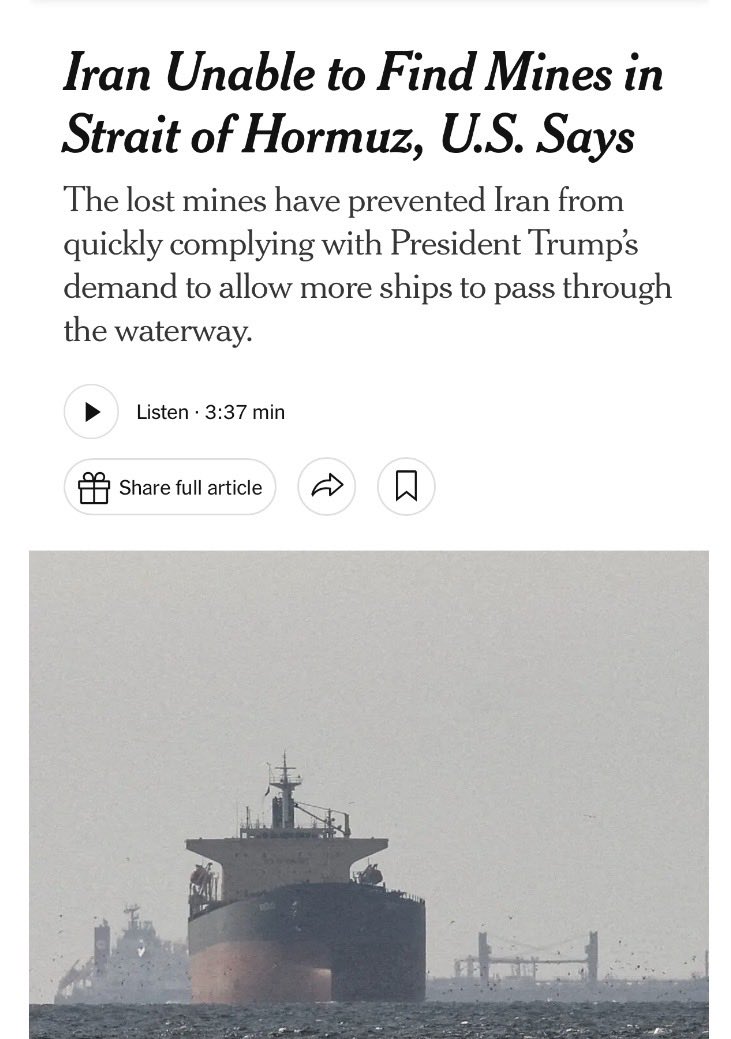
(NYT) - Iran has been unable to open the Strait of Hormuz to more shipping traffic because it cannot locate all of the mines it laid in the waterway and lacks the capability to remove them, according to U.S. officials.
@nytimes
https://t.co/p5Vsdg7Soa