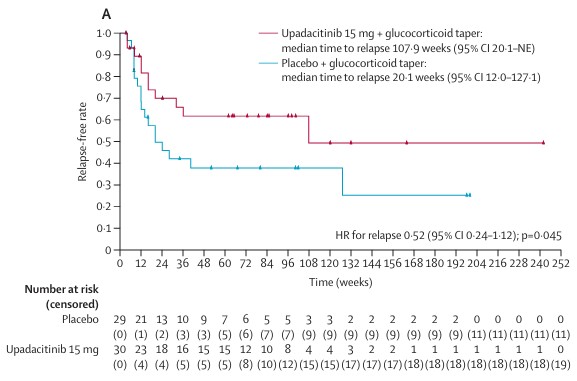
The REMAP-CAP group has used Bayesian statistics to find a 76% likelihood of *mortality* benefit from a study involving *36* patients.
I'm begging everyone to wake up from this Bayesian delusion.
A Fisher Exact test yields p=0.7 for this trial and it was incredibly underpowered. Trying to spin this as anything positive is misleading. It's not even close to positive.
The pre-test probably is WAY too high if you're getting a posterior probability of 76% from this milquetoast data.
The likelihood of any intervention improving mortality is incredibly low, so your pretest probability should be TINY (not some sort of "non-informative prior" which is largely neutral).
This study is obviously nonsense, but these Bayesian methodologies are frankly misleading and eventually they're really going to cause harm (or, at the least, degrade the reliability of the medical literature).
This report is not based on "government data"-it is based on manipulated numbers from the anti-health public health care lobby group called Second Street, backed by the US based Atlas Foundation. The numbers are distorted and include people who have been on a wait list for a day..
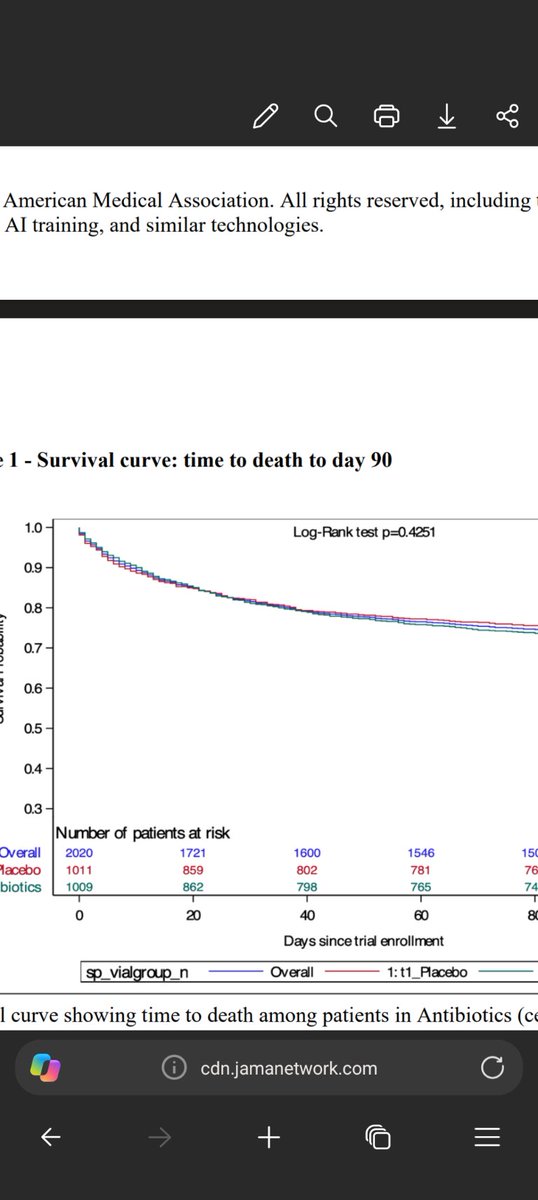
@PulmCrit@JAMA_current It's more than that. If you're going to argue that a one hour delay costs lives in time to antibiotics, how can you reconcile that this was almost 4 hours delay between the two arms with Stone Cold negative survival curve
When Surviving Sepsis 2026 came out recommending pre-hospital antibiotics, I posted that it was looney tunes (see below 👇).
Now I have RCT data supporting me.
The Surviving Sepsis guidelines continue to be an embarrassment to the field of critical care medicine.
Our patients deserve better.
We need to stop normalizing/celebrating this. @HatanMortada, at age 28, third year into his residency, celebrating 100 publications! This is NOT achievable in an honest way. Hatan publishes non-stop AI generated shitty review papers! This is #papermill#fraud!
muito da insatisfação com médicos diminuiria se as pessoas entendessem que UM MONTE DE COISA que se sente não é doença, é variação de estar vivo, é chatice de não morrer, tédio de possuir etc. E digo isso não pra julgar, chamar de maluco, diminuir a dor.
Congratulations to Deepinder Goyal for publishing a hypothetical paper on the gravitational theory of aging in a high impact journal. Only, there is nothing in it on gravitational theory of aging as indicated in the title.
This is the textbook example of of exploiting "science" and "scientists" towards initiating a scam. This is long, but you will really learn a thing or two.
I read this BS so that you dont have to. Here are my comments on this paper which showcases the lowest level of evidence in medical science and proves nothing, nor can claim to prove anything it states in the future.
But before I start, let me get this out of the way:
Neither author Satchidananda Panda nor first author Laura van Rosmalen are brain hemodynamics specialists; their established academic domain is circadian biology, photoperiodism, and metabolism (and the paper awkwardly weaves circadian blood-flow rhythms into the narrative to bridge their background). Panda's corresponding contact on the paper is listed as a personal Gmail address rather than his official Salk Institute email. Combining a billionaire founder (Goyal), his hardware engineer (Kumar), a paid scientific consultant from an adjacent field (Panda), and that consultant's student (Rosmalen) - while omitting the paid consultancy from the journal's disclosure - strongly indicates commercially driven authorship (to drive Temple wearable sales) rather than independent academic consensus.
[1] The paper admits there is no evidence proving that everyday standing causes harmful blood-flow drops in major part of the brain. yes, repeatedly.
[2] The authors have confused cause with effect and admit that lower brain blood flow in older adults does not automatically mean the brain is being starved - an aging, shrinking brain often simply needs less blood. Despite this admission, the rest of the paper still treats lower blood flow as a root driver of aging rather than a symptom of it.
[3] The theory blames Earth's gravity for aging the brain, yet the paper admits that removing gravity in space causes rapid muscle loss, bone loss, heart deconditioning, and enlarged brain ventricles - a hallmark of brain aging. When both normal gravity and zero gravity cause similar structural brain changes, gravity cannot cleanly explain brain aging.
[4] If upright posture and vertical distance between the heart and brain drove aging, horizontal animals like mice and dogs would dramatically outlive upright humans, and tall giraffes would age far faster than short mammals, yet humans are among the longest-lived terrestrial mammals. Moreover, the paper notes that cellular aging occurs across all species down to single cells, which have nothing to do with upright posture or brain circulation at all.
[5] The authors treat normal physiology as chronic injury (shows lack of expertise in the topic). The paper frames the normal 10–17% drop in brain blood flow upon standing as a damaging "Orthostatic Perfusion Deficit". At the same time, it admits that standing up is physically helpful because it lowers brain pressure. Authors cannot seem to make up their mind on this garbage hypothesis - which is untestable (see later).
[6] The paper points out that prolonged sitting lowers brain blood flow, yet also notes that older adults who regularly do moderate aerobic exercise - which is performed upright against gravity - show no significant age-related decline in brain blood flow. This indicates the real issue is physical inactivity, not gravity itself.
[7] Unfalsifiable circular logic - which makes this theory pseudoscientific. The hypothesis builds a closed loop where gravity reduces blood flow, which causes aging, which worsens blood flow. Whenever evidence contradicts the model - such as high blood pressure or normal aging adaptations - the authors hedge that it can be both helpful compensation and harmful pathology at the same time, making the theory nearly impossible to disprove.
[8] To promote wearable tracking, the authors suggests placing optical sensors over branches of the external carotid artery on the scalp/temple as a proxy for brain blood flow. However, the authors' own anatomy summary states that the brain is supplied by the internal carotid and vertebral arteries (not the external carotid, which feeds the face and scalp), and they admit surface optical devices cannot measure deep tissue perfusion. So Goyal effectively debunked his nonsense Temple device in this paper.
[9] The authors propose risky interventions and flawed animal tests. The paper proposes daily head-down tilting (30–70° inversions) to counter gravitational stress, even while warning it carries severe risks like stroke, glaucoma, raised brain pressure, and blood clots. Its proposed test of tilting naturally horizontal mice is impossible to replicate in humans because of the 25–30 cm heart-to-brain distance of standing nature.
[10] Non-existent isotope: Box 2 in paper states that PET scans using C-labeled water are the gold standard for measuring brain blood flow. Water contains no carbon; the actual tracer is O-labeled water. None of the authors understand chemistry.
[11] The authors have misapplied citations. To support tilting cages as a chronic gravity model in rodents, the paper cites Houpt et al. (2012), which is actually a study on rats tilting their heads inside a high-strength magnetic field.
[12] Nitish Kumar is publicly named by Goyal in Sept 2026 as one of the core four scientists who built and validated Temple's proprietary "Brain Flow" technology which has now being removed from the device's main website and which we know was a fraud technology.
[13] Major undisclosed financial conflict of interest. In a concurrent medRxiv preprint posted Sept 4, 2026 and revised Nov 18, 2026) validating the Temple wearable, the Competing Interest Statement explicitly declares: "Satchidananda Panda is a paid scientific consultant to Temple Pvt. Ltd."
[14] Undisclosed collaborative conflict of interest: Laura van Rosmalen is a postdoctoral researcher inside Satchidananda Panda's lab (working under a paid Temple consultant) and co-authored the same Sept/Nov 2026 medRxiv validation study of the Temple wearable - a study funded by Temple Pvt. Ltd. (grant f. no. 01/2026, dated Jan 29, 2026) in which Temple supplied the devices and returned processed data files.
[15] Additionally, the paper's Funding section lists only the Wu Tsai Human Performance Alliance and the Joe and Clara Tsai Foundation for van Rosmalen and Panda, omitting Temple Private Limited's concurrent research funding to their collaborative validation study and its employment/backing of Deepinder Goyal and Nitish Kumar. @ElsevierConnect
To summarize: Rather than reading like independent science, this paper reads like a sales pitch for Deepinder Goyal's ₹85,000 "Temple" wearable. It invents marketable metrics like "perfusion age" and argues that people need continuous tracking of brain blood flow using optical sensors worn on the head—even including an illustration in Figure 4C of a small sensor stuck to a woman's temple streaming live data to a phone, mirroring his exact product. The authorship raises further red flags: Goyal, a tech founder with no background in brain-circulation research, is listed as a co-author alongside his own company employee and two Salk Institute scientists who specialize in biological clocks rather than brain blood flow—one of whom works as a paid consultant for Temple, a financial tie disclosed in a separate study but left out of this paper. Published online on November 13, 2026—just days after Temple opened commercial pre-orders on November 1—the paper hands Goyal's unproven theory and pricey gadget a convenient stamp of academic credibility right as doctors were calling them out.
My advice to "truly humane" Indian billionaires with lot of money for research is to put it in for cancer research and promote institutional research into valuable topics that can change human lives. For example, a new study on a pill showed that it could help reverse Stage 4 pancreatic cancer.
https://t.co/LXtnrJoYWe
But people like Goyal are not truly humane. They are vultures in suits. The exploit science to make more money for themselves. It is really sad to see this happen.
This is EVERYWHERE on TikTok. I've seen literally hundreds of vents about "my doctor is refusing to diagnose me with autism!" and they always assume the doctor is lying/incompetent/bigoted without being even slightly open to the possibility that maybe they just don't have autism.
NEW RESEARCH—Efficacy and safety of upadacitinib in Takayasu arteritis (SELECT-TAK): a multicentre, double-blind, randomised, placebo-controlled, phase 3 trial https://t.co/4uzPx9Ualk