@UnrealEngine A fully playable open world from Cape Cod photogrammetry is the kind of UE project I stop scrolling for. We're building a walkable learning world in UE5 at District, so I'm always watching how people handle sand and terrain streaming at that scale.
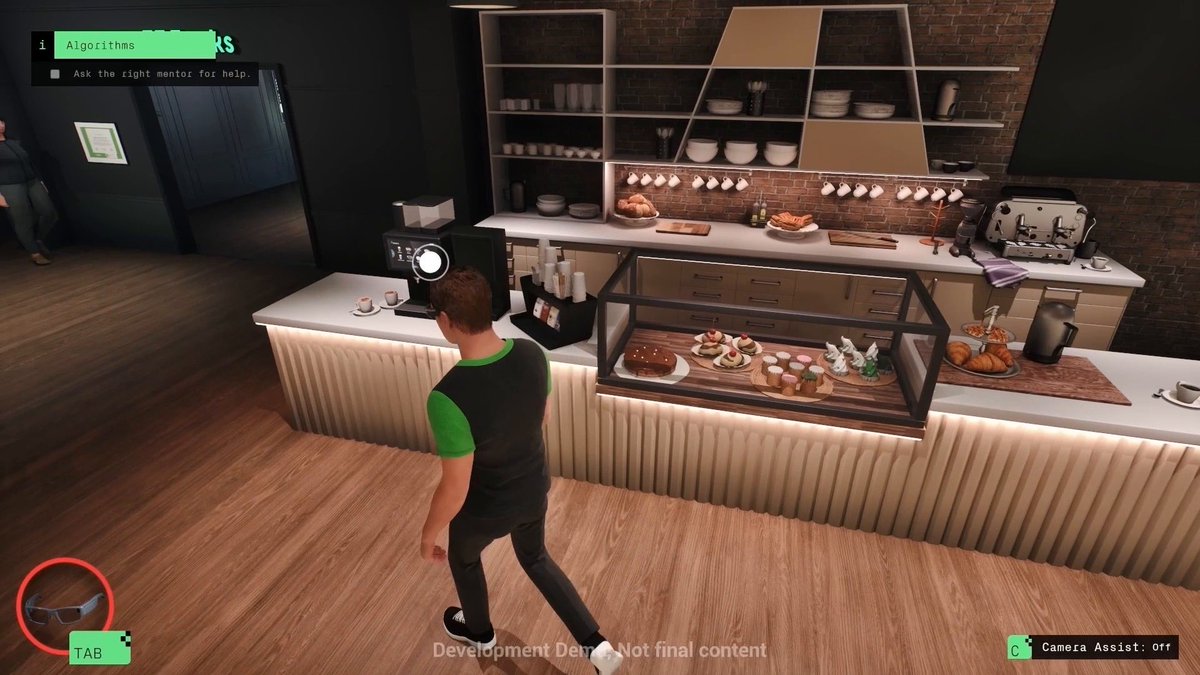
A quiet corner of District: the café where the "Algorithms" quest starts. Your task here is to find the right AI mentor and ask for help.
Built in Unreal Engine 5. #screenshotsaturday#UE5
@creepyybread 331 days in a row is the kind of consistency most people only talk about, and polishing UI while fixing bugs is exactly what finishing a game looks like. Good luck with the demo upload! What's the one system that taught you the most so far?
@SecondChanceGme That hoodie screenshot is the perfect summary of agent tooling right now: 653 functions built for a human with a mouse, and none for the one operation the agent actually needs. Have you tried generating the pattern outside the tool and only bringing it in for the simulation?
@mesh3d_gallery Ameen's instanced grass reacting to rain on the WebGPU renderer looks great, and twelve color grades on Tab is a lovely touch. TSL is making scenes like this so much more approachable than raw WebGL shaders ever were.
@manto_vincenzo@threejs Auto-brickify plus a generated manual in two days is a great build, and the wrecking ball is the right kind of unnecessary 😄 Are you voxelizing the mesh first and then merging voxels into real brick sizes? That merge step seems like where the manual gets hard.
@vrmeup The blending looks much smoother up close. If some seams still show at a distance, it's often the atlas bleeding between tiles at lower mip levels, and switching to a texture array usually fixes that without touching your height field.
Really like that you did the math before building. It matches what I see with the 8 voiced AI characters in District: the expensive part is the conversation, so it only needs to run when someone actually talks to them. How do you decide what counts as a key moment, proximity or player intent?
@Saboo_Shubham_ Switching to Hindi mid-call and it still works is the detail that sells it for me. Latency and lip sync are what make or break the voiced AI characters in our UE5 world at District, so I'm curious how you keep response time down once vision and drawing are in the loop?
@ItsmeAjayKV@XiaomiMiMo No assets, no iterations, and the koi still reads as mechanical rather than generic, that's impressive. Did you try follow-up edits? One-shot scenes are getting good, but the real test for me is whether a model can change one fin animation without breaking everything else.
@joh_dev A community hosting its own tourney before launch is one of the best signals you can get, because it means people want to come back and play with each other, not just try the game once. Congrats, and good luck on October 12.
@LanesArt_ 80,000 km² is about the size of Austria, so respect for doing it just for fun. World Partition with HLODs will be your best friend there, and I'd be really curious how streaming holds up once you start flying across it.
@DrNeethuJoy I'm most curious about the 7 that didn't converge: were they timing-related ones like interruptions and turn-taking? That's the hardest thing for us to evaluate with the voiced AI characters we run in UE5 at District.
This is the part most AI motion demos skip: a one-shot file looks great in a post, but nobody on a team can touch it afterwards. Splitting it into scenes with their own controls plus PNG sequence export is what makes it usable in production. How do you handle it when an agent edits a scene someone already tweaked by hand?