You have noticed it. ChatGPT feels dumber than it used to. Your prompts that worked six months ago produce worse results now. The writing sounds flatter. The ideas sound safer. The internet itself feels like it is shrinking. Every article reads the same. Every email sounds the same. Every answer sounds like it was written by the same voice.
You thought it was you. It is not you.
Researchers at Oxford and Cambridge published a paper in Nature proving what is happening. They call it Model Collapse.
Here is the mechanism in one sentence. AI trained on AI-generated data gets dumber every generation until it forgets what real human data looked like.
The internet is filling with AI-generated content. Blog posts. Articles. Reviews. Comments. Social media. AI companies scrape the internet to train the next generation of models. Which means the next generation of AI is being trained on the output of the current generation.
Each cycle loses information. Not randomly. It loses the rarest, most unusual, most creative parts first. The researchers call these the "tails of the distribution." The weird ideas. The unexpected perspectives. The things that made the internet feel human. Those disappear first.
What remains is the average. The safe. The expected. The bland.
Then the next generation trains on that. And loses more. And the next generation trains on that. And loses more. The researchers proved this is not a slow decline. Major degradation happens within just a few iterations. Even when some of the original human data is preserved.
They tested it on large language models. On image generators. On statistical models. The pattern was the same every time. The output converges toward a narrow, flattened version of reality that looks nothing like the original data.
The lead researcher put it plainly. "Large language models are like fire. A useful tool. But one that pollutes the environment."
The pollution is invisible. You cannot see which sentence on the internet was written by a human and which was written by AI. Neither can the AI that is about to train on it. And once the tails are gone, they do not come back. The damage is irreversible.
This is not a prediction anymore. It is a diagnosis.
The internet you grew up on was built by humans writing things no algorithm would have written. Strange, personal, imperfect, alive. That internet is being diluted. One generation of AI at a time. And the models trained on what remains are learning a smaller and smaller version of the world.
Model Collapse is not a technical problem. It is a cultural one. The thing that made the internet worth reading is the thing that disappears first.
Alright folks, here it is.
The Chairman’s take on my favorite sector in public markets right now.
The AI infra trade. It's getting crowded, for obvious reason. That doesn’t concern me.
The issue isn’t that there are too many of them. It's that that people are treating them like they’re all the same.
$IREN $NBIS $DGXX $CIFR $HUT $GLXY $APLD $HIVE $KEEL $BRUN $SLNH
Here’s my take:
The best company is not always the best stock.
I like a lot of these names.
$NBIS may be the better company long term. I have said that already.
I still chose $IREN and $DGXX.
Why?
Because ruthlessly I’m not trying to own the best company. I’m trying to own the one with the best asymmetry that is the most mispriced today.
$IREN: is the best vertically integrated AI infra landlord today. Scarce power, land, real execution, capital access, global footprint, $NVDA validation, and the clearest ability to turn energized sites into contracted compute capacity.
$CIFR: scaling well, cap markets access, and real BTC to HPC momentum.
$HUT: infra, power, balance sheet optionality.
$GLXY: more diversified, institutional, and cap markets driven exposure to the AI infra / data center buildout.
$APLD: one of the cleaner public AI data center infra stories. Real scale, real customers, but already much more discovered.
$DGXX: earlier-stage compute infra asymmetry. Smaller, messier, less de-risked, but exactly why it’s interesting.
$HIVE: global footprint and cleaner energy backed compute angle.
$KEEL: earlier stage powered-site compute setup.
$BRUN: proof that the market can reprice credible AI infra very quickly, even with a messy SPAC wrapper and some good standing questions.
$SLNH: energy first infra with compute optionality. BTM makes it interesting.
Now don’t come at me with the “ $NBIS is a better company bullshit” or “what about the $IREN ATM.”
I have addressed both. If that’s your takeaway, you either didn’t read the post or worse, you didn’t understand it.
I am not @jiahanjimliu, @FransBakker9812 or @Agrippa_Inv.
I’m not trying to out-model everyone on GPU rental rates, exact contract terms or every DC nuance.
My view is simple folks:
Where is the most asymmetry?
Where is the biggest bottleneck?
Who can deliver capacity the fastest?
Who has assets the market is still mispricing?
That’s why I chose $IREN and $DGXX.
$IREN is my core AI infra sleep tight at night bet. The market is somehow still debating whether it’s a miner or an HPC DC. That is why it’s an opportunity.
$DGXX is my earlier stage $IREN bet. Less proven. Less institutional. Less obvious. That is the point. When it executes, the rerate will be violent because the market has not fully put it in the right box yet.
This is all about choosing where I think the best risk-adjusted asymmetry sits today.
Right now, I’m certain it’s $IREN and $DGXX.
“There is no better teacher than history in determining the future—there are answers worth billions of dollars in a $30 history book.”
— Charlie Munger
Every book Charlie Munger has recommended since 1994:
The easy money is over.
• VIX rising
• Gold blowing off
• Crypto getting killing
• Leadership narrowing
• Market breadth weakening
• Momentum stocks rolling over
• Sell-offs on good earnings
• Multiple distribution days
• No actionable setups
• Closes near the lows
This is all you need to know about the market right now.
The conditions simply aren’t favorable to be aggressive at the moment. There are times to make money and times to protect it. Right now is about protection and managing risk. There is little reward in forcing long positions here.
Maybe this pullback is just a temporary top. Maybe it turns into something larger. Nobody actually knows. And the good news is that you don’t need to know.
You just need to be prepared. The next window of opportunity will come. When the market improves, it will be obvious.
Strong setups will come back. Leaders will reemerge. Breakouts will hold. You will have plenty of time to get back in. But patience matters.
You do not miss the next bull move by waiting for confirmation. You miss it by blowing up your capital.
This legendary investor worth $2,200,000,000 just broke the internet.
Howard Marks dropped 79 years of his best investing wisdom in 45 minutes, and it honestly blew me away.
Here are 10 invaluable insights from one of the greatest investors in history: 🧵
Any correction for these stock they gonna be strong buy:
They all have wide moat, strong ROIC, revenue growing at >12%, gross margin >40%, and FCF growth >12% and The diluted average shares outstanding CAGR from 2019 to 2024 <1%
NVIDIA $NVDA
Meta $META
MercadoLibre $MELI
AppLovin $APP
Intuitive Surgical $ISRG
Taiwan Semiconductor $TSM
Alphabet $GOOG
Fortinet $FTNT
Cadence Design Systems $CDNS
Adobe $ADBE
Intuit $INTU
ASML Holding $ASML
ServiceNow $NOW
Arista Networks Inc $ANET
Some of them are strong buy right now
Small caps with huge potential:
$TMDX (Recession-proof stock.)
$HIMS (Price target still $70. I want to see 3 million subscribers before raising the price.)
$SOFI (Price target: $20.)
$OSCR (Price target: $18.)
$GRAB (Price target: $10.)
$NBIS (Data centers remain in high demand.)
$ETSY (Making a bigger post — worth keeping on the watchlist until May 2026.)
If they experience any correction, they’ll be solid buys
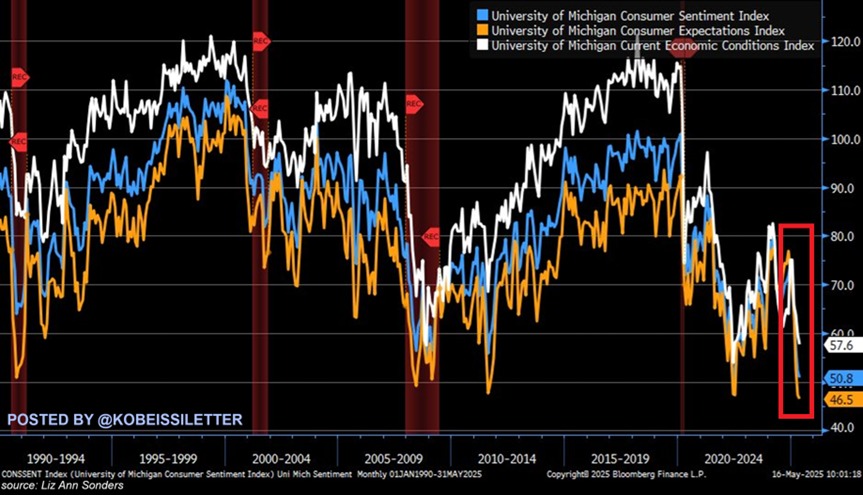
US consumer sentiment is getting even worse:
The Consumer Sentiment index declined 1.4 points, to 52.2, the second-lowest reading in the history of the survey.
This is even lower than 2008 and the 1980s recession.
Current conditions fell 2.2 points, to 57.6, the second-weakest level on record.
Concerningly, consumer expectations decreased 0.8 points, to 46.5, the lowest in 45 years.
This survey took place between April 22 and May 13, concluding 2 days after the US-China trade deal.
Americans have rarely been this pessimistic about the economy.
While everyone’s focused on Trump, Microsoft created a new state of matter.
It's going to change everything.
Here's what you need to know about Microsoft's Majorana 1 Quantum Chip:🧵
Mauboussin & Callahan just shared a paper on the psychology of expected value.
"How often you are right is not all that matters. What is vital is how much money you make when you are right versus how much you lose when you are wrong".
🧵 Our 8 favourite highlights:
UPDATED: Here's our latest list of global compounders. New adds: Stryker, Mycronic, Fabrinet and Hemnet.
Imagine having access to 15+ quality growth metrics for each of company (including cash return on capital, growth and valuation)?
If that's something you would be interested in (including monthly deep dives too), then check out my latest subscription service for only $20/month or $200/year
https://t.co/ZOOe8hwzSU
People were curious, so here's how I'm using Deep Research. I'll walk through the prompting and then an example:
1. First, I used O1 Pro to build me a prompt for Deep Research to do Deep Research on Deep Research prompting. It read all the blogs and literature on best practices and gave me a thorough report.
2. Then I asked for this to be turned into a prompt template for Deep Research. I've added it below. This routinely creates 3-5 page prompts that are generating 60-100 page, very thorough reports
3. Now when I use O1 Pro to write prompts, I'll write all my thoughts out and ask it to turn it into a prompt using the best practices below:
______
Please build a prompt using the following guidelines:
Define the Objective:
- Clearly state the main research question or task.
- Specify the desired outcome (e.g., detailed analysis, comparison, recommendations).
Gather Context and Background:
- Include all relevant background information, definitions, and data.
- Specify any boundaries (e.g., scope, timeframes, geographic limits).
Use Specific and Clear Language:
- Provide precise wording and define key terms.
- Avoid vague or ambiguous language.
Provide Step-by-Step Guidance:
- Break the task into sequential steps or sub-tasks.
- Organize instructions using bullet points or numbered lists.
Specify the Desired Output Format:
- Describe how the final answer should be organized (e.g., report format, headings, bullet points, citations).
Include any specific formatting requirements.
Balance Detail with Flexibility:
- Offer sufficient detail to guide the response while allowing room for creative elaboration.
- Avoid over-constraining the prompt to enable exploration of relevant nuances.
Incorporate Iterative Refinement:
- Build in a process to test the prompt and refine it based on initial outputs.
- Allow for follow-up instructions to adjust or expand the response as needed.
Apply Proven Techniques:
- Use methods such as chain-of-thought prompting (e.g., “think step by step”) for complex tasks.
- Encourage the AI to break down problems into intermediate reasoning steps.
Set a Role or Perspective:
- Assign a specific role (e.g., “act as a market analyst” or “assume the perspective of a historian”) to tailor the tone and depth of the analysis.
Avoid Overloading the Prompt:
- Focus on one primary objective or break multiple questions into separate parts.
- Prevent overwhelming the prompt with too many distinct questions.
Request Justification and References:
- Instruct the AI to support its claims with evidence or to reference sources where possible.
- Enhance the credibility and verifiability of the response.
Review and Edit Thoroughly:
- Ensure the final prompt is clear, logically organized, and complete.
- Remove any ambiguous or redundant instructions.
TalkSpace $TALK is a must-watch small cap...
Fundamentals: Talkspace is an online therapy platform that connects users with licensed therapists for remote mental health support.
It works with some of the largest healthcare providers, including Cigna, Aetna, Optum, Regence
STRONG numbers. +32% YoY sales growth, +96% YoY EPS growth. 47% gross margins. Close tor turning a profit.
$700m market vs. $2.2B market cap for competitor Teladoc $TDOC
Technicals: Climbing out of a massive cup & handle pattern. Breaking of a almost one-year base (handle), recorded highest weekly close in 3-years on Friday.
Heavy signs of accumulation past several months.
As an economist and commodities trader, I've seen firsthand how tariffs work. I initially opposed them, but my perspective has shifted. Despite being a massive headache at work, here's why I now support Trump’s tariffs… 🧵