With my own doubts about long-term WFH, I am going to pin this tweet, easy to revisit couple of years (or sooner) from now. This is only one of the reasons for my doubts, there’s the human/social aspect as well.
And companies won’t pay for or tolerate the former. Finding & retaining the latter won’t be easy, those side projects have a better chance of maturing now. Soon companies may realize this WFA (anywhere) is not a good idea.
China has everything consumer apps - order rides, food, commerce, send money etc.
Anthropic might be the first enterprise everything app, and if it works out for them, other labs (and non-labs) will replicate that as well - AI being the accelerator.
Intense flooding has been seen in numerous areas across San Francisco as heavy rain hits the city and inundates storm drains. Video shows streets completely flooded in the Mission District. Live updates here: https://t.co/Q1Tj4b1pJr
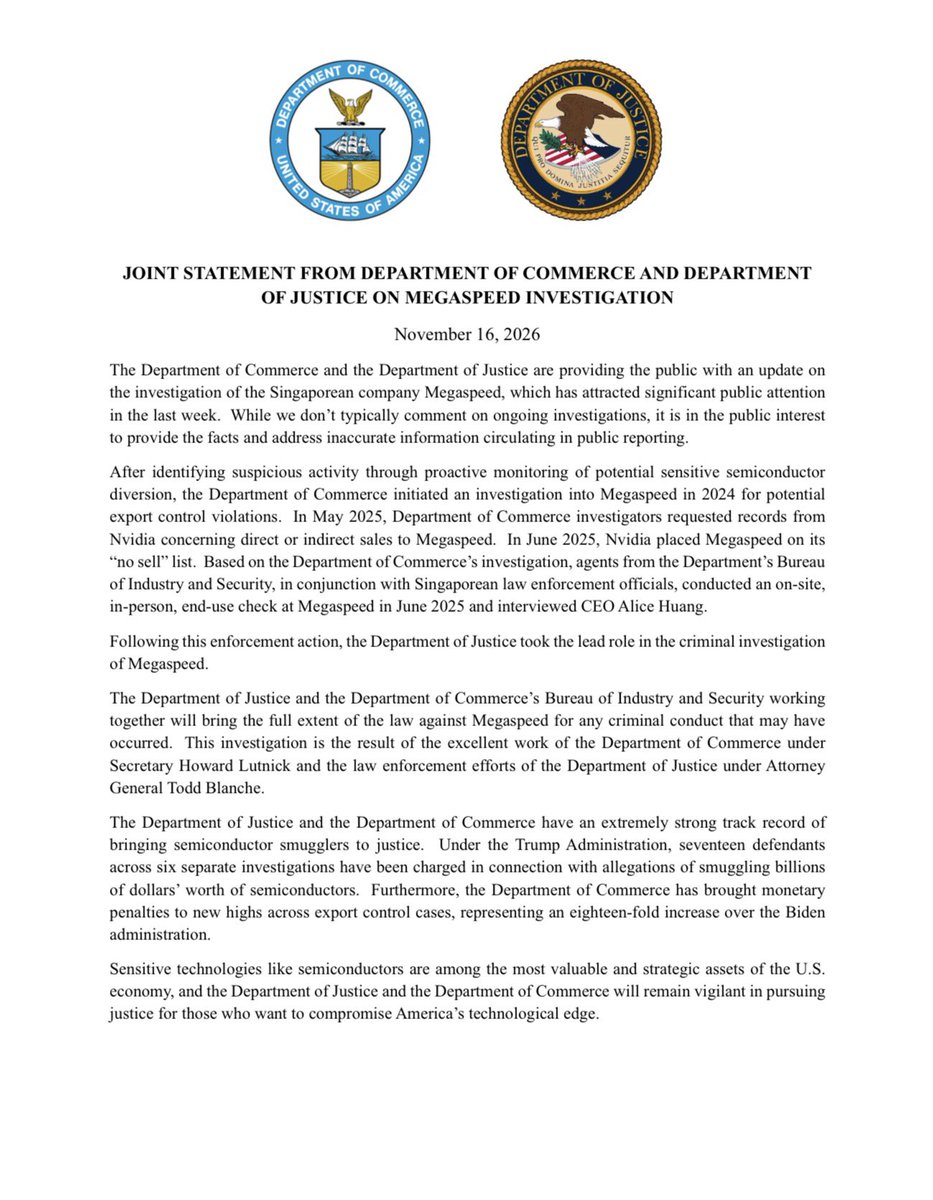
Interesting, this will only add fuel to some of the theories going around on why Jensen had to go, but I think the core issue was that security establishment had disagreements with Jensen on selling chips to 🇨🇳
Though there’s a possibility of him coming back in few years in case the new CEO fails; and also he would have served his exile/punishment
Likely gov agencies doing controlled penetration tests spread over days to both validate critical systems and analyze public response.
Why? Maybe prep work for coming advanced AI models, or maybe possible escalation in the Middle East.
Bottom line, we will continue to see more of these, including more investment in cyber security.
Long before Fibonacci’s famous rabbit problem (1202), Indian scholar Hemachandra discovered the exact same sequence in 1150.
He was calculating rhythms in Sanskrit poetry using short (1-beat) and long (2-beat) syllables, such that:
F(n) = F(n−1) + F(n−2)
Math born from music and poetry.
More than 1.5 GW of chips are in China that shouldn’t be. Unwinding that web could reshape open-source AI.
“In our view, there’s more than one and a half gigawatts of chips in China that are not supposed to be there according to US law. How they get there, that whole web, that’s what’s going to unwind.”
“If NVIDIA can no longer support the open-source ecosystem, because that was Jensen’s primary goal, does that mean the open-source ecosystem falls away?”
“Now open source looks a lot weaker with NVIDIA down and out. Anthropic looks much more likely to get a complete monopoly or a duopoly. This bodes really well for Anthropic’s IPO next week.”
“They’re more diverse in what chips they use than any other company in the world.”
Long before Newton and Leibniz, 14th-century mathematician Madhava of Sangamagrama and the Kerala School of mathematics discovered infinite series for sine, cosine, and pi.
In Hindu tradition, astronomy and math fall under Jyotisha, one of the six Vedangas. Madhava and his successors were Hindu scholars trained within the traditional Gurukula system. Math treatises of the era, such as the Yuktibhāṣā or Tantrasangraha, often opened with invocations to Hindu deities (such as Ganesha or Vishnu). In Indian intellectual tradition, uncovering the geometric and astronomical order of the cosmos was viewed as an act of understanding the divine structure of creation.
Take a moment to appreciate the incredible detail on this lathe-turned pillar in India. I’d give almost anything to go back in time and see how this was made.
Andrej Karpathy:
“A 1B model can be much more effective than most current LLMs.
90% of current models waste a ton of capacity and money on remembering stuff that doesn’t matter.”
here is his 5 core thesis about Small LLM’s:
1. the intelligence was never the knowledge. Strip the memorized internet, keep the reasoning. What’s left is the cognitive core, and it’s small.
2. the core might fit in ~1B params. Maybe less. “Plenty of room at the bottom.” We’ve been paying for a library when we needed a brain.
3. size stopped being the bottleneck. What makes an agent work is the tools it can call and how tight the feedback loop is, not parameter count.
4. intelligence lives in the system, not the weights. A raw LLM is a CPU with no OS. Small core + good harness > giant model alone.
5. you can own it. A model on your hardware is one no one can rate-limit, price-hike, or deprecate on you.
in 12 months the gap between teams shipping on-device and teams paying per-token frontier bills won’t be capability.
TwIL an 8.8B model at 90%+ of frontier isn’t a benchmark flex.
It’s the thesis Karpathy’s been repeating all year, made real.
study more on this below ↓
Modest intelligence is arriving faster than most people realize.
Today, we're open-sourcing TwIL-8B.
Just 8.8 billion parameters, yet approaching frontier-model scores on several difficult benchmarks:
• 93% of frontier performance on coding
• 92% on instruction following
• 90% on contest mathematics
All from a model small enough to run on your own hardware.
But the benchmarks aren't the most important part of this announcement.
For years, the AI industry has focused on building the most capable model, regardless of the cost required to run it.
I believe that equation is changing.
The next era of AI will be defined by the cost of completing work. Not simply the intelligence of the model, but how efficiently that intelligence can accomplish the task.
If a model with 8 billion parameters can reliably complete the same work as one with hundreds of billions, why pay for the larger model?
As smaller models become more capable, intelligence becomes something we can distribute, specialize, and run across the hardware we already own.
That's the future we're building at @thewebAI
TwIL-8B is available today. Open weights.
And this is just the first of several announcements we're making today.
HF Link: https://t.co/3lrTfeLaeI