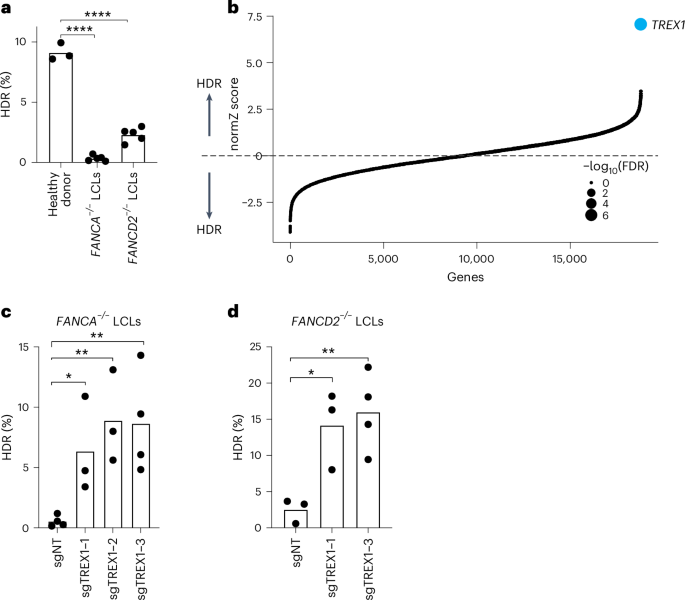
Have you ever wondered why some cell lines are easy to edit with CRISPR-mediated gene editing, while others are more difficult? Our paper is now online and offers an interesting answer: https://t.co/0ck5FHVXvb
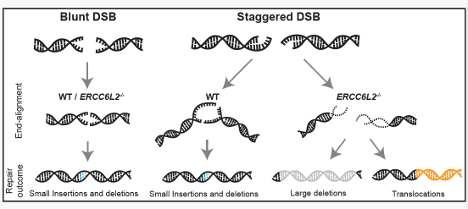
Many genome-editing tools work by cutting DNA - but the shape of the cut matters. Using #CRISPR screening, we show ERCC6L2 is specifically required to maintain #DNArepair fidelity at staggered DNA breaks, but not at blunt ends.
https://t.co/MbW8DTjIre
Congratulations to @SMSiegner who defended his PhD on Friday! His name will be on 6-7 papers by the time he leaves the lab, including a co-first Nature paper. What a superstar! Keep an eye out for his postdoc application 😉
Cells are filled with toxic stuff that damages healthy proteins. Is that garbage just left to rot on the curb? No way! Ubiquitin ligases have evolved to recognize chemical damage and clean it up! https://t.co/VKPnOX4ySJ
🎉Super excited to share our story on how the substrate receptor FBXO31 functions as a quality control factor by recognizing amides. This has been an amazing collaboration between Bode lab and @jcornlab. Special shutout goes to @matthias_muhar
https://t.co/MtiWUyJeyT
I'm looking for a #bioinformatician to join my group! Searching for someone collaborative & self-motivated with expertise in #NGS analysis. For example, functional genomics, #singlecell, splicing, RNA binding, lineage barcoding, ChIP-seq. Apply at https://t.co/p0kTvj1Bcu
Out in @Nature today! We report that a CDK5-cyclin B1 complex maintains proper cell division. We discovered that CDK5, a long regarded non-cell cycle CDK functioning only in neurons, yet overexpressed in many cancers, does regulate mitosis!
Link: https://t.co/ovFZyOXVAM
🚨 Excited to share our latest paper in @CellCellPress identifying how under-replicated chromosomes in micronuclei become shattered by the Fanconi anemia pathway during mitosis. This work was led by @UTSWGradSchool student @JustinEngel17. 🧵 (1/13):
https://t.co/ixa2y6oAQQ
please see the video summary of our paper:
https://t.co/SvzWrHakjb
prepared by @Sci_Ani and big thanks to Dr. Ana Gvozdenovic for the preparation and ideas.
Have you ever wondered why some cell lines are easy to edit with CRISPR-mediated gene editing, while others are more difficult? Our paper is now online and offers an interesting answer: https://t.co/0ck5FHVXvb
Have you ever wondered why some cell lines are easy to edit with CRISPR-mediated gene editing, while others are more difficult? Our paper is now online and offers an interesting answer: https://t.co/0ck5FHVXvb
Special thanks to our great collaborators @J_Maciejowski, @Ele_Toufektchan and Yanyang Chen from MSKCC, as well as Grégoire Cullot, Alessandra Albertelli and my postdoctoral advisor, @jcornlab Jacob Corn for their amazing help in making this publication possible.
We demonstrated that modifying DNA repair templates or reducing TREX1 expression before CRISPR genome editing significantly increased HDR efficiencies. We hope that this will help scientists overcome the difficulties with gene editing in various cell lines.
Thanks to @AbdelWahablab for the great Preview in @MolecularCell on work by @karasuerman1 and Alan D'Andrea showing that CCAR1 regulates splicing for #FanconiAnemia and hundreds of other transcripts! Super clear overview of the papers. https://t.co/hdTT1RdNKe